Ulsan Fire Department's 119 Special Response Unit
Rotation every 50 mSv of recorded exposure
Civil servant research group wins top prize from Ulsan city
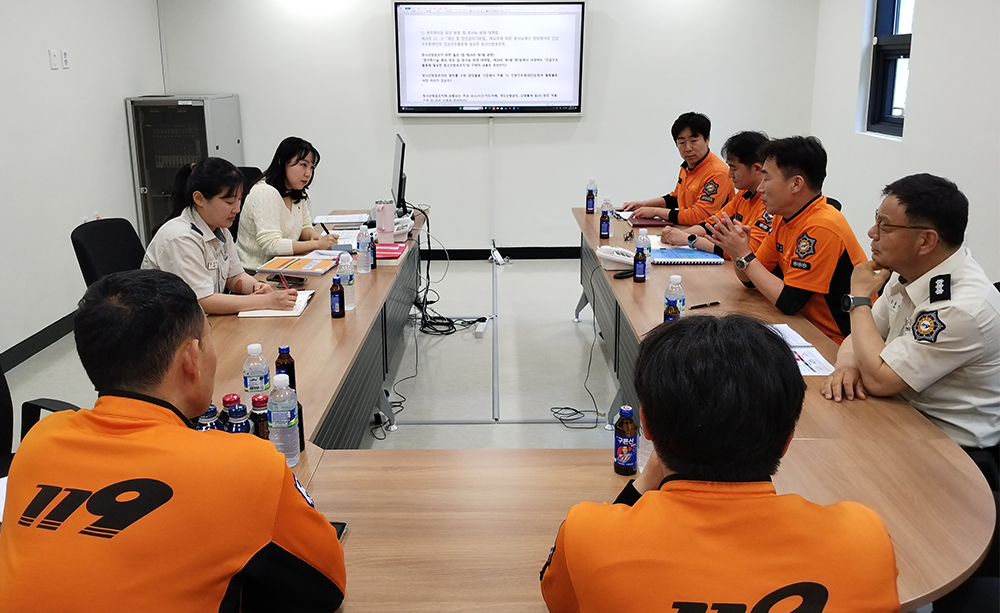
Amid a nationwide uproar among firefighters over Gyeonggi Province Governor Choo Mi-ae's remarks disparaging fire department funding, firefighters attached to the Ulsan Fire Department's 119 Special Response Unit have drawn attention by developing their own radiation exposure dose limits to guide firefighting and rescue operations at nuclear disaster scenes.
At radiation disaster sites, fire departments handle emergency response duties including firefighting, search and rescue, and scene control. Nuclear safety laws and other radiation-related statutes define only the emergency rescue role of fire departments, however — they contain no detailed protective provisions for firefighters, such as permissible exposure dose limits. A dose limit is the legal ceiling on the amount of radiation a person may receive over a given period.
With no detailed exposure regulations or operational manuals in place, firefighters have been left directly vulnerable to radiation at disaster scenes. In response, firefighters from the unit formed a research group called the 119 Atom Rescue Team, led by Fire Superintendent Jang Min-jae, and conducted comparative research on domestic and international dose standards to establish radiation exposure limits for firefighters at nuclear disaster sites.
Through a review of overseas regulations and radiation testing on five types of personal protective equipment used in nuclear accidents, the team proposed an "exposure control through activity time management" policy. Its core measure calls for rotating personnel every time a dosimeter reading reaches 50 millisieverts (mSv). The proposal won the top prize at the "2026 Civil Servant Research Group Evaluation," an initiative run by Ulsan city to encourage creative policy ideas from civil servants.
An exposure standard defines the amount of radiation the human body may safely receive. South Korea's Nuclear Safety and Security Commission and the International Atomic Energy Agency (IAEA) set the annual dose limit at 1 mSv for the general public and no more than 50 mSv for radiation workers. The World Health Organization warns that continuous exposure to 100 mSv or more raises the risk of cancer, and recommends that firefighters and other emergency responders at disaster sites follow access restrictions and withdrawal criteria set by the on-scene command structure.
The IAEA states that firefighters may be deployed in life-saving operations at nuclear or radiological emergencies up to a dose of less than 500 mSv, but only when the benefits of the rescue clearly outweigh the risks to the responders and when the responders voluntarily understand and accept those risks.
Because South Korea has no clear standard of its own, the policy proposed by the 119 Atom Rescue Team is expected to help field commanders protect firefighters and carry out rescues with minimal radiation exposure.
Lee Chang-wook, 35, the group's secretary-general and a fire sergeant, said the research began from a recognition that Ulsan is home to Saewul Nuclear Power Plant Units 1 and 2, which are already in operation, with Units 3 and 4 also scheduled to come online — yet the absence of exposure standards means proper on-scene command cannot be exercised when a nuclear accident occurs.
cityblue@heraldcorp.com