Bank of Korea report on youth employment slump and policy challenges
Youth employment rate down 2.8 percentage points since generative AI emerged
Share of temporary and daily workers up 1.3 percentage points
Rate of moving from temporary to regular jobs drops from 8% to 5%
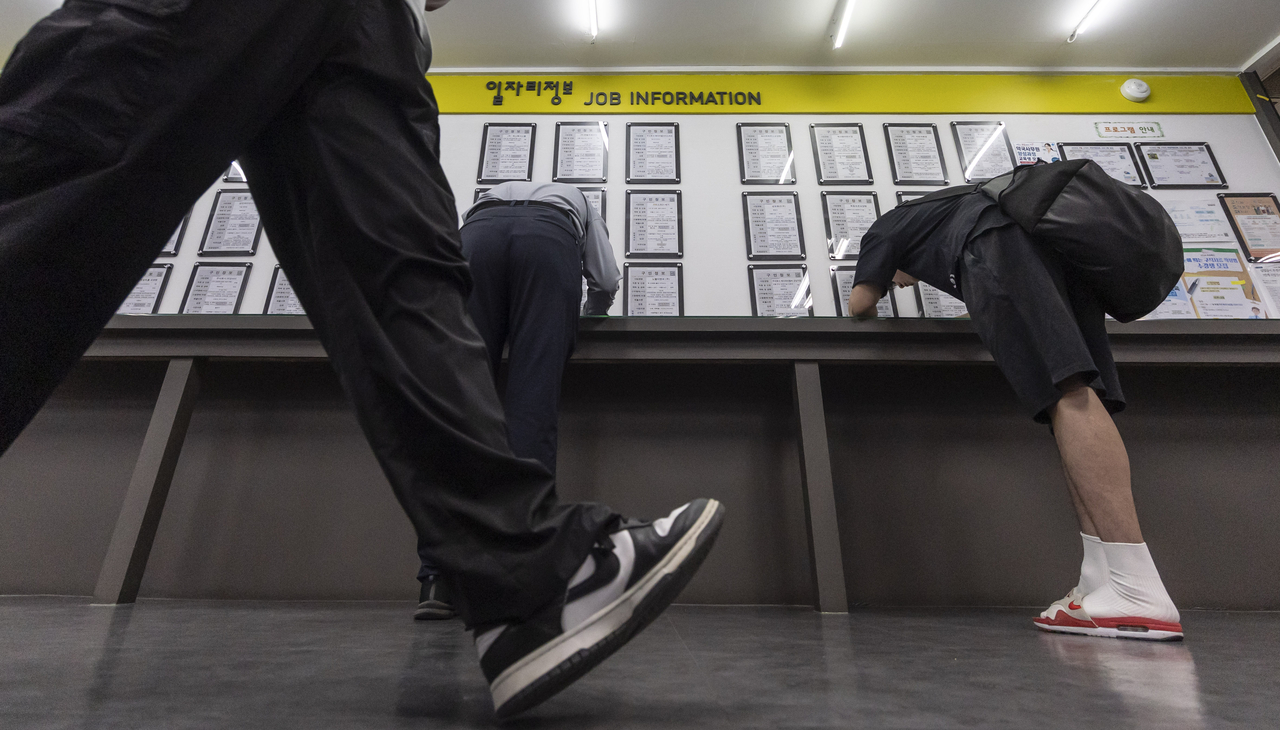
Since 2023 — the year after generative AI was introduced — South Korea's youth employment rate and economic activity rate have fallen by 2.8 and 2.6 percentage points, respectively, through this year, while the share of young workers in temporary or daily positions has risen by 1.3 percentage points. The figures suggest that the spread of generative AI has worsened youth employment in both quantity and quality.
The Bank of Korea released a report Monday titled "Youth Employment Slump and Policy Challenges," saying that "structural factors — industrial restructuring, AI-driven technological change, and a rigid labor market — are acting in combination to drive the youth employment problem."
The report analyzed youth employment conditions by dividing the labor market into two tiers: regular salaried workers in the primary market and temporary or daily workers in the secondary market.
Since 2023, young people between the ages of 15 and 29 have shown a clear tendency to lower their job expectations and enter the secondary market rather than wait for a primary-market position, leading to a deterioration in employment quality.
The Bank of Korea identified the restructuring of the industrial base around IT manufacturing as a key factor. IT manufacturing, which generates relatively few regular salaried jobs, has come to dominate production, while non-IT manufacturing and the services sector still account for the bulk of regular hiring — meaning economic growth is not translating into greater demand in the primary labor market. The bank noted that this stagnation in labor demand has been particularly concentrated among young workers.
The introduction of generative AI in late 2022 also marked an inflection point for youth employment. The average youth employment rate and economic activity rate through September this year stood at 43.7 percent and 46.8 percent, respectively — down 2.8 and 2.6 percentage points from 46.5 percent and 49.4 percent in 2023, the year after generative AI emerged. Over the same period, the share of young workers in temporary or daily positions rose from 31.3 percent to 32.6 percent, a gain of 1.3 percentage points.
"Even before the pandemic, the job competencies companies required in the primary labor market were becoming increasingly specialized and advanced, pushing hiring toward experienced workers," the bank said. "The rapid development and spread of AI technology in recent years has further reinforced this hiring structure and the trend toward reducing entry-level recruitment."
The preference for experienced workers has intensified in occupations and industries with high AI exposure, rapidly shrinking demand for the entry-level and basic tasks that young workers have traditionally filled. The bank said this shift in hiring patterns could act as a structural barrier to young people entering the labor market, particularly in high-AI-exposure sectors such as finance and insurance, professional and scientific services, and information and communications.
The so-called secondary-market lock-in effect has also grown stronger. The phenomenon refers to young workers who enter the secondary labor market — in temporary or daily positions with low job security — and find it difficult to move up to stable regular employment in the primary market. The share of young workers making that transition fell from around 8 percent in 2014–2019 to around 5 percent in 2023–2024.
The bank warned that even if labor demand recovers, a lack of pathways to build job skills and move upward could delay any improvement in youth employment.
The Bank of Korea also said that a rigid labor market structure is one of the factors blocking young people from entering the workforce.
OECD data show that countries with stronger employment protection tend to have lower youth employment rates. South Korea ranked around 10th out of 23 major economies on the index measuring protection against individual dismissal of regular workers — a comparatively high level of protection.
"Job policies focused on the labor supply side alone have fundamental limits as a solution," the bank said, calling for "a comprehensive approach that combines industrial policy with structural improvements to the labor market." It went on to propose expanding the spillover effects of IT manufacturing growth, strengthening the links between education and industry, and making employment systems more flexible.
kimstar@heraldcorp.com