Economic outlook index hits lowest since April
Consumer sentiment index falls back within a month
Job-opportunity outlook drops 2 points on semiconductor, AI hiring fears
Expected inflation holds at 2.7% for fourth straight month
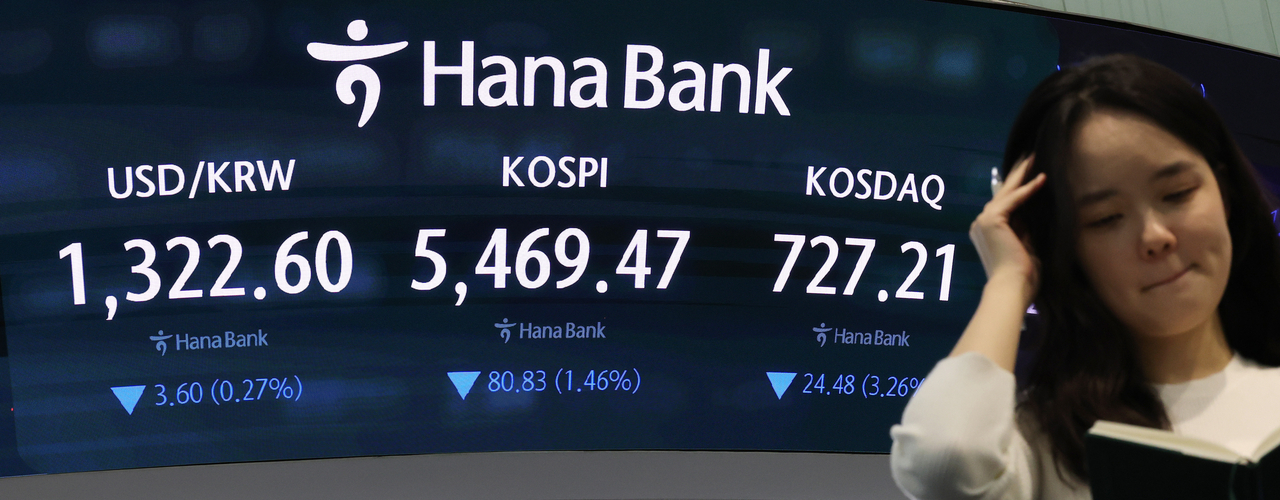
A sharp correction in the domestic stock market and renewed tensions in the Middle East dampened consumer sentiment, reversing a one-month recovery.
The Consumer Composite Sentiment Index, or CCSI, fell 1.2 points from the previous month to 105.4 in October, according to the Bank of Korea's October 2026 Consumer Trend Survey released Tuesday. The index had dropped 2.3 points in August before rebounding 2.1 points in September on rising share prices, only to turn lower again within a month.
"The index edged down as pessimistic economic outlooks increased somewhat, driven by the domestic stock market correction and continued conflict in the Middle East," said Kim Se-yong, a senior official at the Bank of Korea's Economic Sentiment Survey Team.
The Kospi fell 21.5 percent from 6,971.35 at the close on Oct. 1 to 5,469.47 on Monday.
The CCSI is a composite indicator of consumer sentiment toward economic conditions. It is calculated using six sub-indexes: current living standards, living standards outlook, household income outlook, consumer spending outlook, current economic assessment and future economic outlook. A reading above 100 indicates consumer sentiment is more optimistic than the long-term average; a reading below 100 signals pessimism.
Of the six sub-indexes in October, five declined, with only the current living standards index rising, up 1 point.
The household income outlook index fell 1 point to 101, weighed down by falling share prices and rising interest rates.
The future economic outlook index dropped 2 points to 88 — its lowest in six months since April (79) — as stock market turbulence and heightened uncertainty in the Middle East offset strong export growth. The current economic assessment index also slipped 1 point to 82.
The job-opportunity outlook index fell 2 points to 86, reflecting concerns about a potential slowdown in the semiconductor sector and the impact of AI advances on employment. The wage-level outlook index also dropped 2 points to 122. Park Yong-min, head of the Economic Sentiment Survey Team, said concerns about whether the semiconductor slowdown would persist were feeding into lower share prices and weaker economic assessments, and that a deteriorating economy could in turn affect employment and wages.
Park added that while strong growth and robust exports had been providing a structural boost to consumer sentiment, falling share prices, the ongoing Middle East conflict and rising interest rates had pushed the index lower.
The housing price outlook index fell 1 point to 124 — its lowest since June (120) — despite continued apartment price gains in non-Gangnam areas of Seoul and the broader Greater Seoul area, as government real estate measures and benchmark interest rate hikes weighed on sentiment. Park said rising apartment prices in mid- to low-priced areas of Seoul and the metropolitan area were acting as an upward force, while government real estate policies and rate hikes were pushing in the other direction. "There is no big movement, but it is edging down slightly — though it remains at a high level," he said.
The expected inflation rate over the next year held steady at 2.7 percent, unchanged from the previous month, as upward pressures — including continued rises in international oil prices — were offset by downward factors such as the extension of the oil price cap and benchmark interest rate hikes. The one-year expected inflation rate has held at 2.7 percent for four consecutive months since July. Park said international oil prices were acting as an upward factor while the oil price cap and rate hikes were keeping the figure in check.
Both the three-year and five-year expected inflation rates held steady at 2.6 percent, unchanged from the previous month.
Petroleum products were cited as the top factor expected to drive price increases over the next year, named by 52.6 percent of respondents, followed by agricultural, livestock and fishery products at 36 percent and public utility charges at 30.4 percent. Compared with the previous month, the share of respondents citing rent rose 1.6 percentage points and personal services rose 1.2 percentage points, while agricultural, livestock and fishery products fell 3.9 percentage points. Park said rising jeonse and monthly rent prices were leading more consumers to view housing costs as a driver of inflation.
kimstar@heraldcorp.com