On delays blamed on nuclear power deliberations: 'Not legally late'; AI data center power demand forecast likely to be trimmed
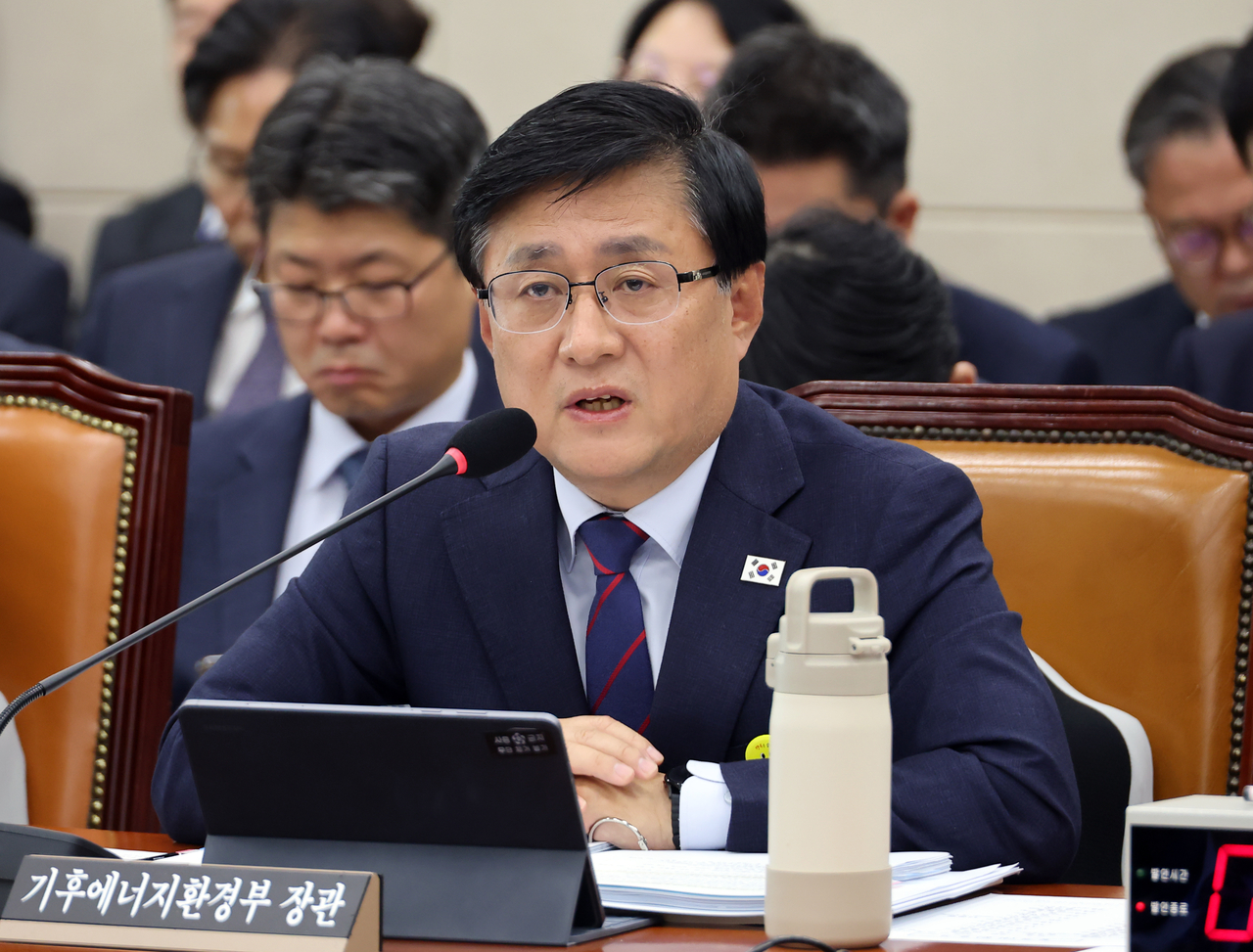
Minister of Climate, Environment and Energy Kim Sung-hwan said the government expects to report the 12th Basic Plan for Electricity Supply and Demand (2026–2040) to the National Assembly sometime between late December and early next year.
Kim also signaled that the projected power demand from AI data centers would be scaled back in the plan.
Speaking at a comprehensive national audit of the ministry by the National Assembly's Climate, Energy, Environment and Labor Committee on Monday, Kim told Committee Chairman Kim Jeong-ho that the public deliberation process on nuclear power — a prerequisite for finalizing the plan — was expected to wrap up in early to mid-December. "The timing for reporting the 12th basic electricity plan to the Assembly will likely be late December or early next year," he said.
A public deliberation committee on nuclear power, convened specifically for the 12th plan, has scheduled a citizen panel deliberation for Dec. 11 to 13, with final results expected to follow.
The basic electricity plan, drawn up every two years on a 15-year horizon, is the government's top-level framework for power supply and demand. The 12th edition will set out demand projections through 2040 and the supply measures needed to meet them.
Opposition lawmakers repeatedly pressed Kim during the audit, arguing that the ministry had unnecessarily launched a public deliberation process despite strong public support for nuclear power construction, causing delays in finalizing the 12th plan.
Kim rebuffed the criticism, saying the Lee Jae Myung administration bore full responsibility for the decisions in the 12th plan and therefore needed to examine public opinion more carefully. He also noted that the 11th plan was finalized in February last year, and that the current timeline was not legally overdue.
Responding to a question from People Power Party lawmaker Lee Jong-bae about AI data center power demand projections, Kim said the ministry would reflect accurate demand figures in the 12th plan "without over- or underestimating AI data center power needs."
Kim said that when the government announced the three mega-projects, it had tried to incorporate corporate demand as fully as possible, but that when it came down to it, far fewer demands had been concretely confirmed than expected.
"When the three mega-projects were announced, companies submitted very optimistic estimates, and the officials in charge of the electricity plan tried to factor those in as much as possible," he said. "But there is still quite a bit of demand that has not been finalized, and we are internally reviewing how much of that should be incorporated into the 12th plan."
Kim added that "it would be difficult to include all vague demand projections in the 12th plan" and that the ministry would take into account both corporate plans and realistic demand — signaling that previously announced forecasts would be revised downward.
The demand forecasting subcommittee of the 12th plan's steering committee projected in August that peak AI data center power demand in 2040 would reach 11.9 GW.
The subcommittee had initially put the 2040 AI data center peak demand figure at 4.0 GW in April, before the three mega-projects were announced, then raised it by 7.9 GW just four months later. That 7.9 GW increase is equivalent to the combined capacity of about 5.6 large nuclear reactors.
At the time, the subcommittee said it had "reflected only demand that had been concretely planned," but even that figure drew criticism as an overestimate.
The Ministry of Climate, Environment and Energy is in talks with related ministries and industry to reduce the AI data center power demand forecast.
oskymoon@heraldcorp.com