Exports grow 50,000-fold in nearly 80 years; semiconductors account for about 43% of total
Semiconductor supercycle drives record surplus as non-chip exports also surge 20%
Government vows to sustain momentum through AI and new industries despite protectionist headwinds
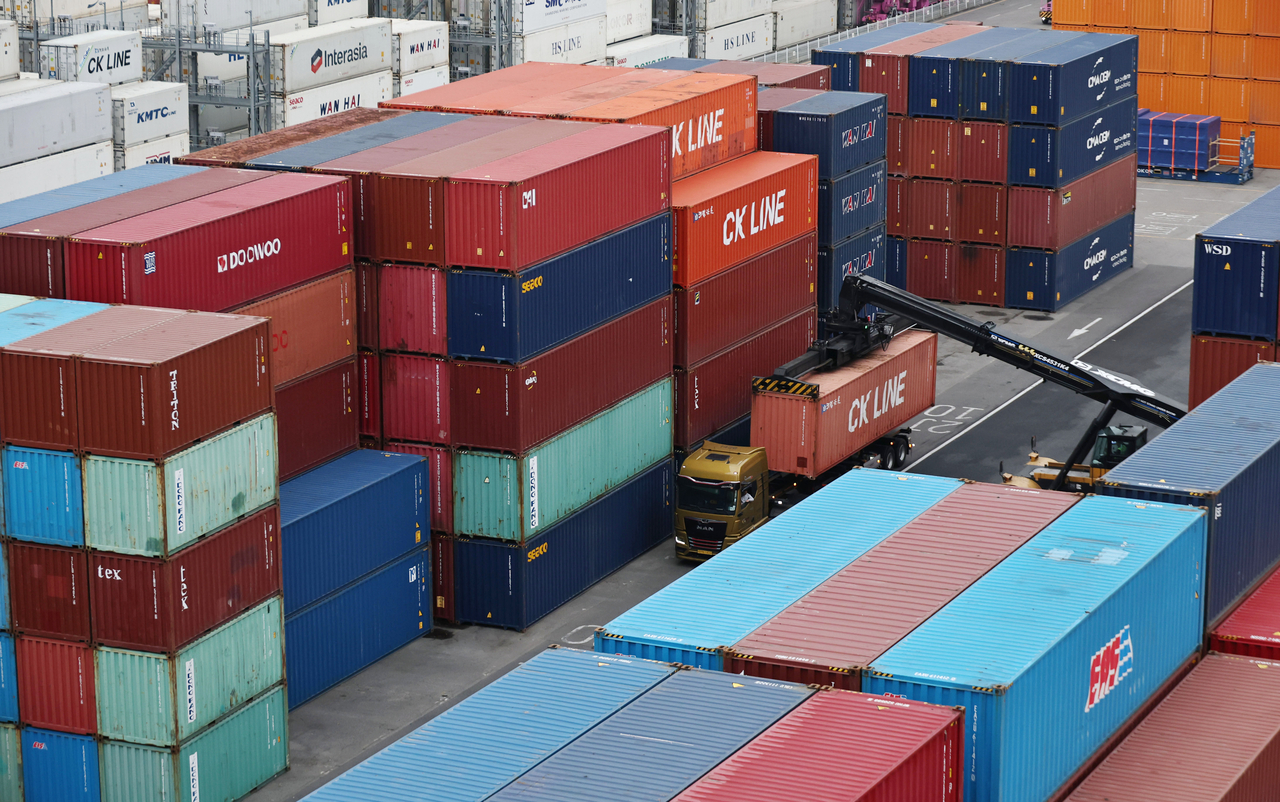
South Korea's exports surpassed $1 trillion for the first time in history Thursday, driven by a semiconductor boom, making the country only the fourth in the world to reach the milestone — after the United States, Germany and China — and surpassing Japan in the process.
The achievement has also raised concerns about the country's heavy reliance on semiconductors, which account for roughly 43 percent of total exports.
South Korea's Ministry of Trade, Industry and Resources said cumulative exports this year crossed the $1 trillion mark at 2:09:36 p.m. Thursday, based on preliminary figures.
The feat comes 19 years after the United States and Germany reached the threshold in 2006 and China in 2007. It places a nation of about 50 million people on equal footing with Germany (about 80 million), the United States (about 340 million) and China (about 1.4 billion).
The milestone carries added significance in that South Korea has, for the first time since the government was established in 1948, surpassed Japan — a barrier it had never cleared. Japan peaked at $822.6 billion in 2011 and has failed to cross the $1 trillion threshold for 15 consecutive years.
South Korea exported just $19 million worth of goods in 1948, ranking outside the world's top 100. In nearly 80 years, it has grown its export volume more than 50,000-fold. After closing to within striking distance of Japan with $79.3 billion in exports last year — compared with Japan's $738.3 billion — South Korea leapt straight into the $1 trillion era this year.
South Korea is also on track to rank fourth globally in total exports this year. According to World Trade Organization data covering January through August, China led with $2.92 trillion, followed by the United States at $1.64 trillion, Germany at $1.26 trillion, the Netherlands at $715 billion and South Korea at $694 billion.
Semiconductors were the single biggest driver of this year's record export performance. Fueled by a global wave of AI investment, semiconductor exports surged 193.1 percent year-on-year to $396.8 billion in the January–October period, accounting for 42.7 percent of total exports.
South Korea has cemented its role as a linchpin of the global AI infrastructure supply chain, holding an 83.0 percent share of the world HBM market as of the second quarter and a 65.6 percent share of the DRAM market in the first half of the year.
Key industries outside semiconductors also showed resilience. Non-semiconductor exports rose 20.2 percent through October, the strongest growth rate in 20 years, as the export base broadened to include consumer goods such as K-beauty and K-food products as well as emerging sectors including nuclear power plants and defense.
The cumulative trade surplus for January through October reached $294.9 billion, more than triple the previous annual record of $95.2 billion set in 2017.
Many observers say the achievement is all the more meaningful given that it was accomplished against the headwinds of rising protectionism and slowing global trade.
According to the Korea International Trade Association, the 2000s — when the United States, Germany and China each crossed the $1 trillion mark — were a high-growth era in which global trade expanded at an average annual rate of 8.9 percent. By contrast, South Korea reached the milestone with average annual trade growth of just 2.6 percent, while the share of global merchandise imports subject to trade restrictions has climbed to 19.7 percent as of 2025.
Export markets and exporters have also diversified. Exports grew in seven of nine major regional markets in the January–October period. Small and midsize enterprises, not just large conglomerates, posted record export figures over the same stretch, further broadening the country's export base.
Kwon Nam-hoon, president of the Korea Institute for Industrial Economics and Trade, said the pace of growth may slow somewhat next year due to base effects, but added that the $1 trillion trajectory should hold. He cautioned, however, that care must be taken to prevent the overall competitiveness of domestic industry from eroding — citing the imbalance between semiconductor and non-semiconductor sectors, macroeconomic shifts including exchange rate movements, and insufficient trickle-down effects.
oskymoon@heraldcorp.com