FKI, PIIE hold international conference on trade and growth
'Investment pledges fund US manufacturing revival'
'Partner nations face modest growth slowdown'
Semiconductor reliance leaves Korean economy exposed, experts warn
Countries that have pledged investment in the United States — including South Korea, Japan and Taiwan — will face currency depreciation, falling real incomes and slower growth, a leading American think tank warned Tuesday.
Investment plans drawn up under pressure from Donald Trump's tariff threats amount to a structure in which partner nations effectively bankroll the revival of US manufacturing, placing a heavy burden on those countries, experts said.
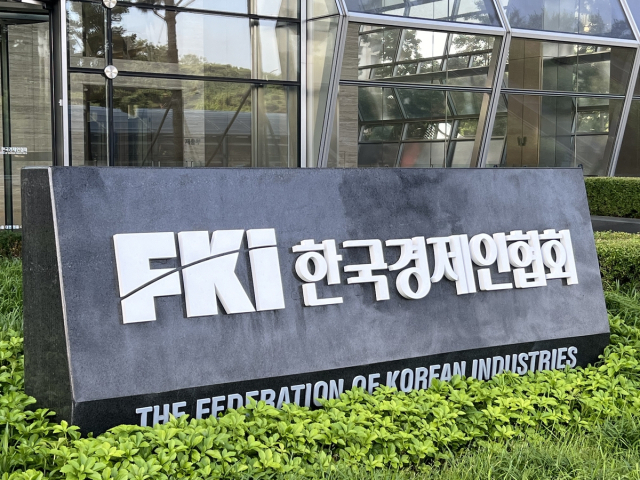
The Federation of Korean Industries held an international conference Tuesday at the FKI Tower conference center in Yeouido, Seoul, co-hosted with the Peterson Institute for International Economics. The event was themed "An Age of Fragmentation: New Growth Strategies — The Future of Trade, Industry and Jobs."
Marcus Noland, deputy director of PIIE, described the roughly $6 trillion in US investment pledges that the Trump administration has secured from nine economies in exchange for tariff negotiations as a "reverse Marshall Plan." Just as the United States funded Europe's reconstruction after World War II, he said, partner nations are now being asked to fund the reconstruction of American manufacturing.
"A country that sends such large sums abroad bears not only the cost of the investment itself but the additional burden of currency depreciation, which erodes real incomes," Noland said.
PIIE analysis projects that South Korea, Japan and Taiwan will see modest slowdowns in their growth rates, while the United States will grow somewhat faster but see its trade deficit widen due to a stronger dollar. South Korea's investment commitment spans 10 years — longer than Japan's four-year pledge — which PIIE said would cushion the impact somewhat.
Experts also warned that South Korea's heavy reliance on semiconductors leaves its economy exposed at a time when US tariffs and fiscal pressures are pushing global interest rates higher.
Kimberly Clausing, a PIIE visiting fellow, said the heaviest burden of US tariff barriers falls on American consumers, but countries exporting to the US also suffer losses. "The US fiscal deficit and AI capital investment could push global interest rates higher, crowding out investment capacity in other countries," she said.
Lee Jae-woo, a visiting fellow at the Korea Economic Research Institute, said South Korea's growth rate excluding semiconductors falls well short of its headline figure. "Economic expansion has failed to spread across industries — the entire economy is tethered to the semiconductor cycle," he said. "With fiscal policy, household finances and the stock market all leaning on the semiconductor sector, we need to watch long-term interest rates, exchange rates and semiconductor prices together."
Amid global economic fragmentation, speakers also suggested that AI could open new avenues for growth. World Bank President Ajay Banga, delivering a keynote address, said empirical evidence of AI-driven job losses remains limited. "What matters is focusing on how to use AI to raise labor productivity and improve working conditions," he said.
Lee Chang-yong, former Bank of Korea governor and a PIIE visiting fellow, said South Korea, whose growth potential is being eroded by a low birth rate and an aging population, must harness AI to boost productivity — and that structural reforms are needed to make that possible.
Speakers also argued that emerging and developing economies should focus on affordable, simple "small AI" tailored to agriculture, education and healthcare, rather than pouring astronomical sums into developing their own large-scale models.
Jung Chul, president of the Korea Economic Research Institute, said small AI could represent a new opportunity for South Korea as it seeks to position itself as an AI hub.
Amid the US-China rivalry over AI supremacy, experts advised South Korea to seek opportunities in physical AI.
Martin Chorzempa, a senior fellow at PIIE, said China has placed AI at the center of its national strategy but still lags significantly behind the United States in areas such as AI semiconductors.
He went on to say that South Korea should expand its AI talent pool and computing infrastructure, strategically selecting from both US and Chinese models, while combining its strong manufacturing capabilities and industrial data with advanced American models to widen its lead over China in physical AI.
joze@heraldcorp.com