A survey of 1,000 Korean workers finds depression is the strongest driver of productivity loss across all ages, but the health factors involved shift markedly around age 35

Workers with depressive symptoms were significantly more likely to miss work or suffer reduced productivity even when present, compared with those without such symptoms. Absenteeism showed a stronger link to depression among workers under 35, while presenteeism — reduced on-the-job efficiency despite attending work — was more pronounced among those 35 and older. The health factors associated with workplace productivity loss also varied by age: physical and social health were more relevant for younger workers, while mental and spiritual health were more closely tied to productivity loss in older workers.
A research team led by Yoon Young-ho, a professor in the Department of Family Medicine at Seoul National University Hospital, and Jung Ju-yeon, a professor in the Tourism and Wellness program at Hankuk University of Foreign Studies, announced Tuesday the findings of a cross-sectional study analyzing how depression and physical, mental, social and spiritual health relate to workplace productivity loss. The team surveyed 1,000 workers aged 20 to 49 across various industries in January 2024, comparing results between those under 35 and those 35 and older.
Of the 1,000 participants, 489 were under 35 and 511 were 35 or older. The research team defined depressive symptoms as a score of 10 or higher on the PHQ-9 screening tool. Workplace productivity loss was measured across three dimensions: absenteeism (the proportion of working hours lost due to health problems), presenteeism (the degree to which health problems reduced efficiency while at work), and overall work impairment (a combined measure of the two). Self-reported health status was used, and participants scoring above the group average on each measure were classified as having productivity loss.
Across both age groups, depressive symptoms showed the strongest association with absenteeism, presenteeism and overall work impairment — a pattern that held even after controlling for gender, education, income and other factors. Workers with depressive symptoms had higher odds of productivity loss than those without. The adjusted odds ratios for those under 35 were 5.42 for absenteeism, 2.13 for presenteeism and 2.43 for overall work impairment. Among those 35 and older, the figures were 2.89 for absenteeism, 4.78 for presenteeism and 4.84 for overall work impairment.
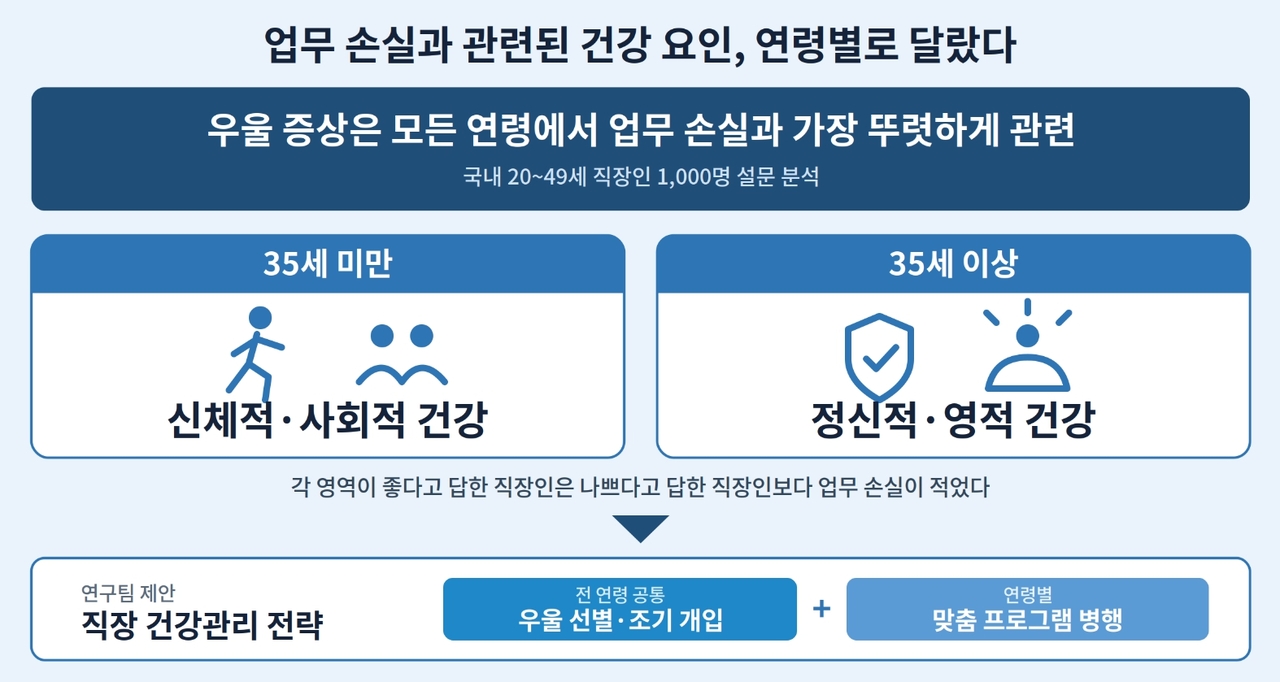
Workers who rated their health as good tended to have lower odds of productivity loss than those who rated it as poor, but the specific health domains linked to that loss differed by age group. Among workers under 35, good physical health was associated with presenteeism and overall work impairment odds of 0.52 each — roughly half the rate of those in poor physical health — while good social health was linked to overall work impairment odds of 0.50. Good mental health was associated with presenteeism odds of 0.59 in this group.
Among workers 35 and older, the links between mental and spiritual health and productivity loss were more pronounced. Good mental health was associated with presenteeism and overall work impairment odds of 0.32 each — about one-third the rate — while good spiritual health was linked to absenteeism odds of 0.41, less than half. The research team interpreted these findings as suggesting that physical vitality and workplace social relationships may be the key factors for workers under 35, while psychological resources and a sense of meaning in life may matter more for those 35 and older.
The rate of depressive symptoms was 33.1 percent among workers under 35, higher than the 27.0 percent seen in those 35 and older. The proportion of working hours lost to health problems averaged 6.8 percent in the younger group — roughly double the 3.3 percent recorded among older workers. Presenteeism (36.3 percent vs. 32.9 percent) and overall work impairment (39.5 percent vs. 34.4 percent) were also higher among those under 35.
Because depressive symptoms were associated with productivity loss in both age groups, the research team recommended that all workplaces pursue depression screening, early intervention and efforts to reduce mental health stigma across all age groups, while also implementing age-tailored programs. For workers under 35, physical activity programs and team-building or peer mentoring initiatives may be appropriate, while stress management, mindfulness and programs focused on finding meaning in life may be better suited for those 35 and older.
"Because the health factors linked to workplace productivity loss differ by age, what is needed is not a one-size-fits-all approach but wellness strategies tailored to the characteristics of each age group," said Jung, a professor at Hankuk University of Foreign Studies.
"Depression is the factor most clearly associated with reduced workplace productivity," said Yoon, who also serves as director of Seoul National University Hospital's Gangnam Center. "We need to shift our thinking — rather than treating health as a personal matter or simply a corporate welfare benefit, organizations should recognize that investing in the health of their members is a way to boost productivity and competitiveness."

The findings were published in the latest issue of the Journal of Occupational and Environmental Medicine, an international peer-reviewed journal in the field of occupational and environmental medicine.
kty@heraldcorp.com