- Korea Food Research Institute develops rapid detection technology using bacteriophages
- Quantification accuracy reaches 98.8% compared with conventional culture tests

Korean researchers have developed a technology that can cut the time needed to test for food poisoning bacteria from more than a day to within three hours.
The Korea Food Research Institute announced Tuesday that a research team led by Dr. Lim Jeong-a has developed a technique using bacteriophages to rapidly detect and quantify live food poisoning bacteria.
In food safety testing, identifying bacteria that are alive and capable of multiplying is critical, since only living bacteria pose an actual health risk. Conventional culture-based tests, however, typically take more than 24 hours to confirm the presence of live bacteria.
PCR-based genetic amplification tests are faster but cannot distinguish between live and dead bacteria, as they detect genetic material from both.
When bacterial counts in a food sample are low, bacteria can disperse throughout the testing solution, raising the possibility that the small volume of sample used for analysis will yield no detection.
To address these limitations, the research team developed a technology called MC-PAA-qPCR, which combines bacterial concentration, bacteriophage amplification and quantitative PCR analysis.
Bacteriophages are viruses that infect and replicate inside specific bacteria. The team exploited the property that bacteriophages multiply only within living bacteria.
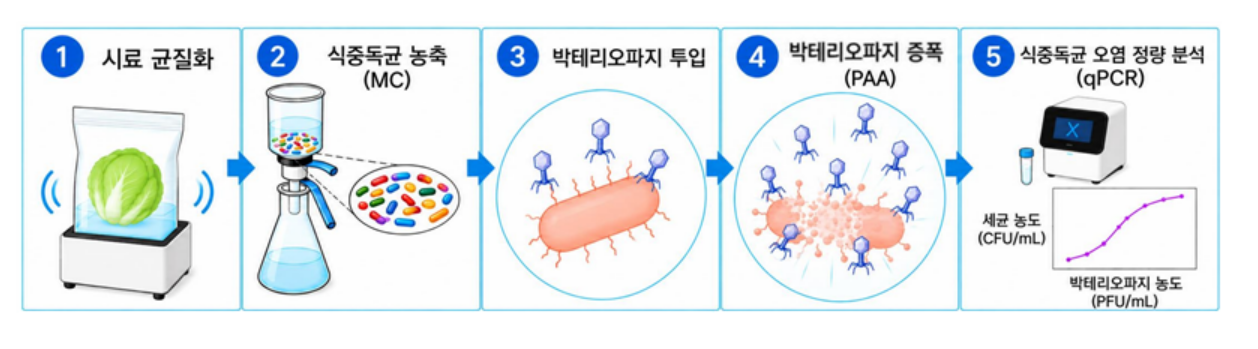
In the process, a food sample is first homogenized and passed through a specialized membrane to concentrate the bacteria. Bacteriophages that infect only the target bacteria are then introduced.
If live target bacteria are present, the bacteriophages multiply. The team then measures the quantity of replicated phages by PCR to calculate the number of living bacteria in the sample.
The technology can detect small numbers of live bacteria within three hours without a pre-enrichment step — the separate culturing process normally used to increase bacterial counts before analysis.
The team validated the technology against Salmonella and Bacillus cereus, two of the most common causes of food poisoning.
As a result, the bacteriophages multiplied only in live target bacteria and showed no replication in dead bacteria or other bacterial species.
In experiments using Chinese cabbage artificially contaminated with Salmonella, the technology achieved a mean quantification accuracy of 98.8±3.0 percent relative to conventional culture test results.
This means the method can accurately determine the quantity of live food poisoning bacteria while significantly reducing analysis time compared with existing tests.
The research team expects the technology to be used in food manufacturing and retail settings to quickly verify bacterial contamination and improve the efficiency of food safety management.
However, additional validation across a wider range of food types and bacterial strains will be needed before the technology can be applied in actual food testing environments.
The findings were published in Food Control, an international academic journal in the field of food safety.
"It is important that food safety testing technology consider not only analytical performance but also practical applicability in real testing environments," Lim said. "We will expand the scope to cover a wider range of food poisoning bacteria and continue refining the technology so it can be used in the field."
nbgkoo@heraldcorp.com