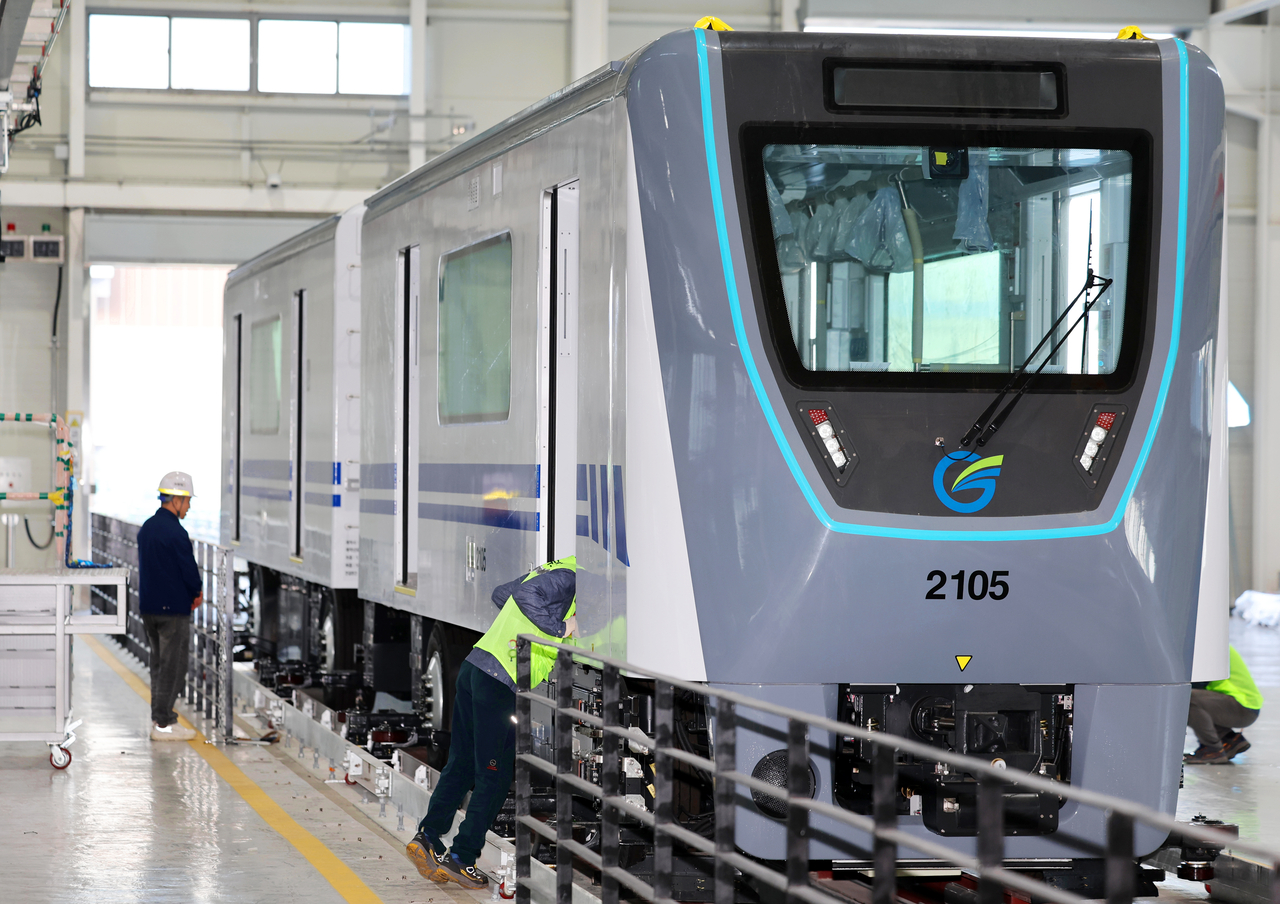
An audit of the Gwangju Metro Line 2 construction project has uncovered widespread deficiencies spanning design, construction and supervision, as well as project management.
The audit committee of the Jeonnam-Gwangju Integrated Special City released its findings Tuesday on the Metro Construction Authority, identifying 24 violations in the Line 2 construction project and calling for corrections, caution notices and the development of improvement measures.
The audit found that while the original master plan set Phase 1 for completion in 2026 and Phase 2 in 2029, authorities failed to revise the plan even though those targets are unachievable given remaining construction work and sections yet to break ground.
Line 2 is a circular urban route comprising a 17-kilometer Phase 1 segment — running from City Hall through World Cup Stadium, Baegwun Square, Chosun University and on to Gwangju Station — and a 20-kilometer Phase 2 segment connecting Gwangju Station to Chonnam National University, Ilgok, Yangsan, Cheomdan, Suwan and back to City Hall. Phase 1 is now targeted for opening in December 2028, with Phase 2 aimed for the end of 2035.
Train operating plans were also found to diverge from actual analysis results.
A 2022 operations report found that the Phase 1 average commercial speed would be 26.76 kilometers per hour — slower than the originally planned 33.45 kph. Maintaining five-minute headways would require increasing the fleet from 15 to 17 train sets, but this was never incorporated into a revised master plan.
Cost management also drew scrutiny: indirect construction costs tied to price fluctuations were miscalculated across six Phase 1 construction packages, resulting in overpayments or over-budgeting totaling 4.24 billion won ($3.21 million).
Station building contracts saw 2.86 billion won over-counted due to duplicate design items and quantity calculation errors, while six Phase 2 packages had quantities for work such as asphalt breaking and lane marking calculated incorrectly, requiring a reduction of 1.53 billion won.
At the rolling stock depot, overhead contact line work was carried out before the prerequisite track-surface grinding had been completed, and the possibility of errors caused by interference between the two work phases was not properly assessed.
A supervisor approved the work based on a visual inspection alone — without formal inspection documents — and certified completion in June 2025. It was subsequently confirmed in January this year that the overhead line height exceeded the adjustable range, making reinstallation necessary.
In Phase 1 Package 5, ground subsidence caused by heavy rainfall occurred, but construction continued without adequate follow-up measures. As a result, the structural clearance needed to secure train operating space was built up to 90 millimeters short of design specifications.
In Package 1, a completion inspection report was submitted as though work was finished even though 171.4 meters of fixed guide rail foundations — a vehicle guidance structure — had not been installed. Supervisors were aware of the omission but still signed off on the completion documents.
The audit also flagged problems with train operations and safety management.
Analysis indicated that Phase 2 may require 40 train sets to operate — seven more than the originally planned 33.
Auditors said that despite analysis showing in-train congestion could reach as high as 201.2 percent if extended operating hours were introduced without a sufficient fleet, no action had been taken to expand the number of train sets or adjust service intervals.
Of the 20 Phase 1 stations, 15 are planned to operate without staff, yet the audit found no means to alert passengers to crowding in advance or to control passenger entry. Crowd dispersal and control procedures were also absent from the unmanned operation scenarios.
An official at the Gwangju Metro Construction Authority said the agency would accept the audit findings and incorporate a realistic opening schedule and operating plan into the master plan, while also putting in place safety measures including real-time congestion alerts and passenger flow controls.
sij@heraldcorp.com