Park Hyun-joo previews Japan securities deal, China M&A also in pipeline
Mainland China financial firm acquisition expected before year-end
'AI revolution only 10–20% complete,' Park says, dismissing chip-peak theory
Warns retail investors against leverage products; sees apartment prices falling
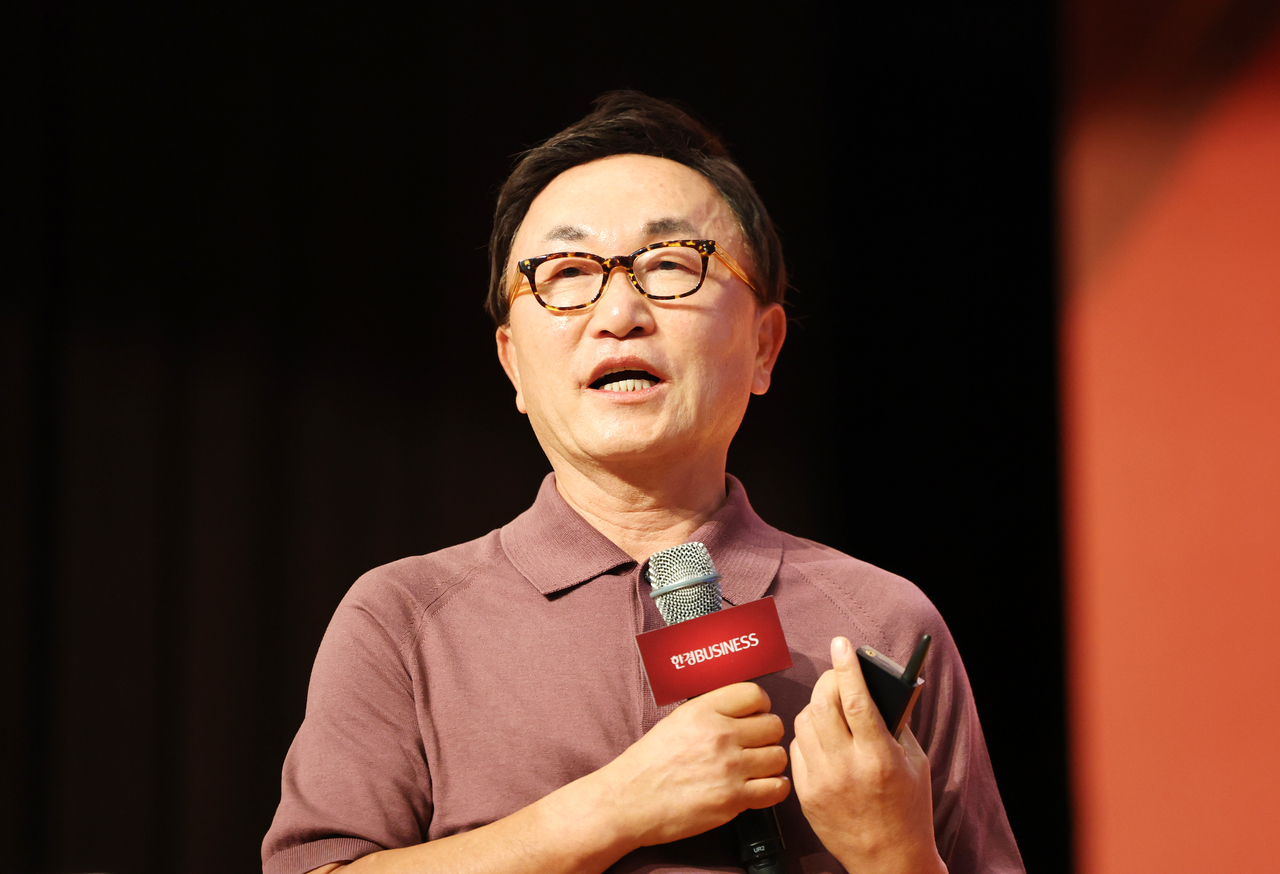
Mirae Asset Group Chairman and Global Strategy Officer Park Hyun-joo said Tuesday that the group plans to announce the acquisition of a Japanese securities firm on Thursday, while also pledging to complete a separate financial firm acquisition in mainland China before year-end. Park pushed back against the notion that the semiconductor industry has peaked, calling the theory likely wrong given the early stage of the AI revolution.
Park made the remarks at a special lecture held Tuesday at Kyung Hee University in Seoul to mark the 60th anniversary of the university's graduate school of business. The lecture was titled "Global Capital Markets, the Leap of the Next Generation, and a New Path for the Korean Economy."
During the lecture, Park initially said a Mirae Asset acquisition would be announced "around Wednesday afternoon." He later corrected himself when speaking with reporters after the event, saying the board meeting would be held Thursday, not Wednesday, and that the target was "a securities firm in Asia." The acquisition target is understood to be a Japanese brokerage.
Park also confirmed that a separate deal is in the works in China. "The M&A we are pursuing in mainland China will probably be wrapped up within this year," he said. That target is also understood to be a financial firm.
Park outlined plans to continue pursuing overseas acquisitions in countries with larger economies than South Korea. "The places I most want to be are the United States and China," he said, signaling his ambition to expand Mirae Asset's presence in global financial markets.
Park offered a skeptical view of the so-called semiconductor peak theory, which has dominated market discussion in recent months.
"Even at its most advanced, the AI revolution has only progressed about 10 to 20 percent," he said. "The semiconductor peak theory is very likely to be wrong."
He cited the AI industry's continued growth potential and constrained supply of high-performance memory chips as the basis for his view.
"There are only four companies capable of making memory chips and HBM, including China's CXMT," Park said. "If prices rise due to supply shortages, buyers can purchase them, but expanding production is difficult."
Park was more cautious on the question of chipmakers expanding shareholder returns. "Korea is a country driven by manufacturing," he said. "Manufacturing is subject to economic cycles — things can be going well and then suddenly a competitive problem emerges."
His remarks were interpreted as a call for companies to channel profits from boom periods into investment for future competitiveness rather than returning them to shareholders through dividends.
Park also renewed his warnings to retail investors about the risks of leveraged products.
"I have been opposed to leveraged ETFs," he said. "We do not create products for the company's profit."
He added that Mirae Asset could have offered leveraged ETFs in Hong Kong but chose not to. "We didn't do it because we were worried Korean investors would lose money," he said.
He was particularly pointed about leveraged virtual asset products. "Two-times, three-times, ten-times crypto leverage — these are things you must not do," he said. "I have a very strong feeling that they should absolutely be avoided."
On the exchange rate, Park said a stronger won is not necessarily good for the Korean economy.
"I think we need to change the idea that the won should be strong," he said. "Manufacturing accounts for 60 to 70 percent of the Korean economy — can we really strengthen manufacturing with a strong won?"
Turning to the domestic real estate market, Park raised the possibility of falling apartment prices.
"The biggest problem for the Korean economy is real estate," he said. "Apartment prices are very likely to fall."
He also proposed deregulation to boost housing supply, suggesting that buildings could be constructed with offices on the lower floors and apartments above. He also floated the idea of converting golf courses near Seoul into sites for rental housing.
Park spoke positively about the growth potential of China's technology industry.
"If I were Chinese, I would sell my house and buy CXMT," he said. "The fact that CXMT's market capitalization has surpassed that of Moutai is the starting point that shows China's market has begun to reflect its technology ambitions."
His remarks were seen as highlighting a broader shift in Chinese equity markets, where high-tech firms are drawing more attention than traditional consumer goods companies.
sjy@heraldcorp.com