Residents fear disadvantages from population-decline zone designation; rally draws 10% of county's population — equivalent to 1 million in Seoul
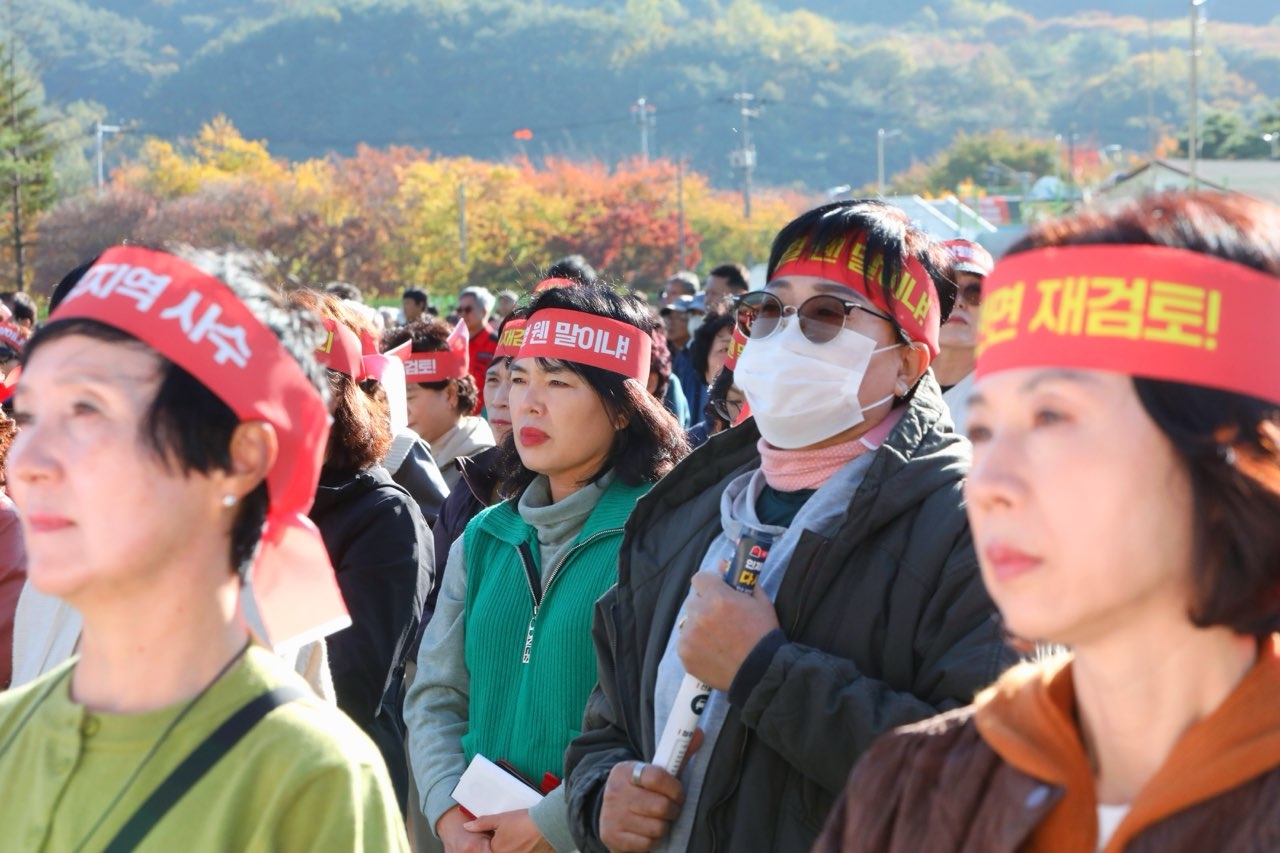
Residents of Inje-gun have risen up in mass protest after the government placed the county in Zone 2 of its local preference index for population-decline areas — a classification they say will leave them with less support than residents of comparably remote regions.
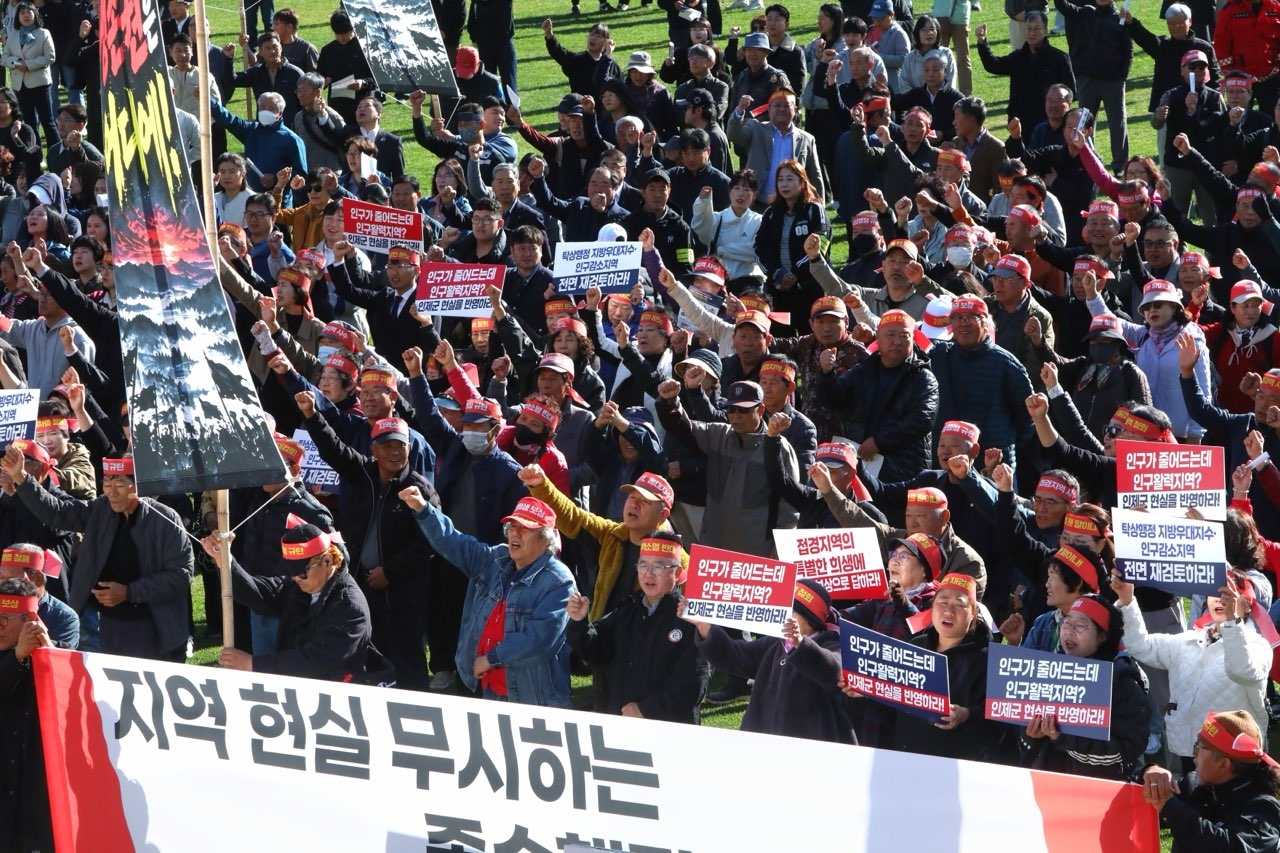
About 3,000 people, roughly 10 percent of the county's population, took part in a rally. The turnout would be equivalent to 1 million people holding a demonstration in Seoul.
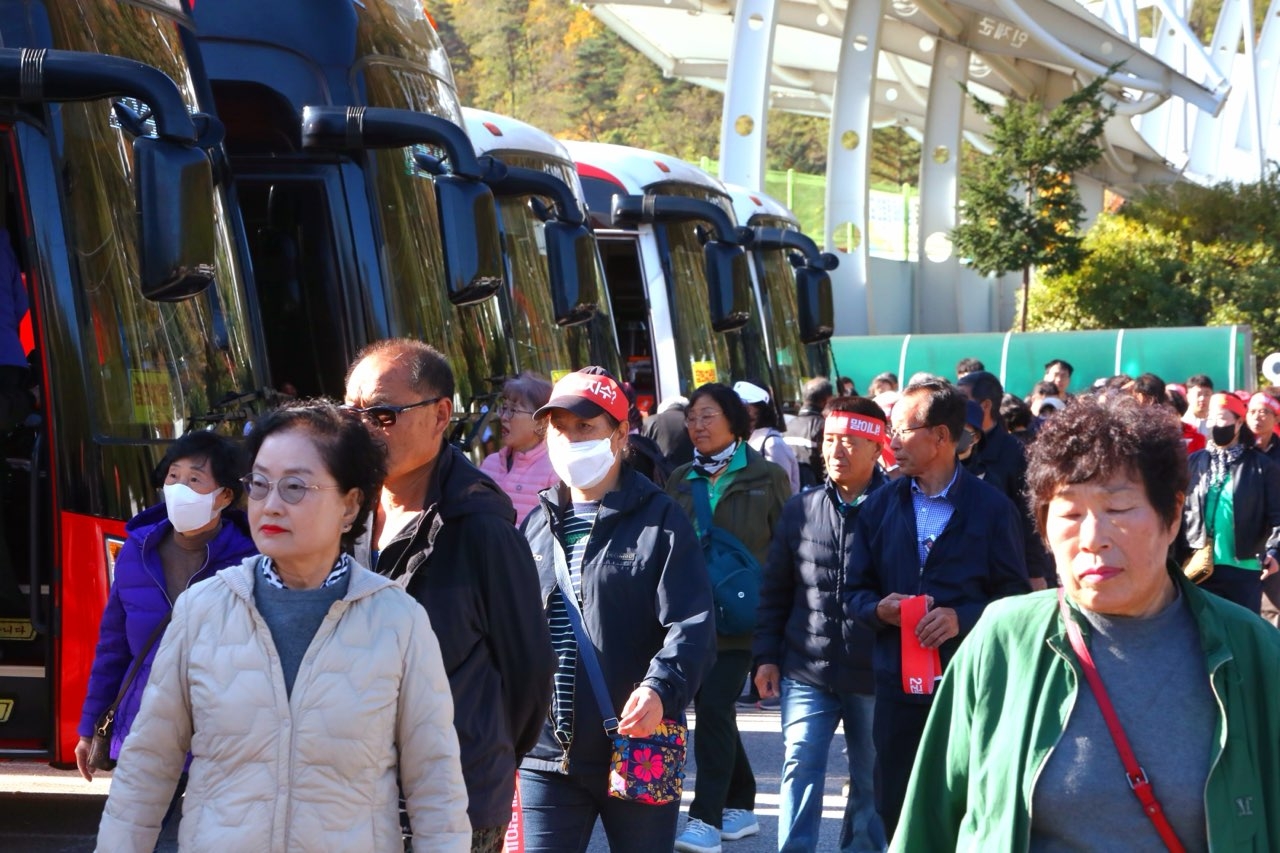
Some of them traveled to Seoul on Wednesday to stage protests at the National Assembly and other locations.
Residents mobilized out of concern that, despite ongoing population decline and persistent underdevelopment, Inje-gun has been placed in the same zone as urban areas — a classification they fear will put the county at a disadvantage in receiving government support.
Participants included not only ordinary residents but also Inje-gun County Chief Choi Sang-ki, the Inje County Council, the Inje-gun Village Heads Association and National Assembly member Lee Yang-su, whose constituency covers the area.
The first rally was held Tuesday morning at Inje Lawn Stadium, drawing about 3,000 residents. Of those, some 600 traveled to Seoul and staged a protest in front of the National Assembly's main gate from 12:30 p.m., denouncing the government's regional classification and calling for it to be revised.
A follow-up rally is scheduled for Wednesday at 1 p.m. on the steps of the National Assembly building, with Inje-gun County Chief Choi Sang-ki, Inje County Council Chairman Kim Do-hyeong, residents and civic group members — about 200 people in total — expected to attend.
Leaders of local civic groups plan to shave their heads at the rally as a show of protest. After the demonstration, organizers intend to deliver a letter of grievance to the chairman of the National Assembly's Budget and Accounts Special Committee, calling for institutional reforms that reflect Inje-gun's actual conditions and for the establishment of a rational support plan.
The protests were triggered by the Ministry of Interior and Safety's recent announcement of its revised population-decline area designations and local preference index classifications.
On Oct. 7, the ministry excluded Inje-gun from the list of population-decline areas, instead classifying it as a "population vitality-plus region." Then, in a separate announcement on Oct. 20, it placed Inje-gun in Zone 2 of the local preference index alongside Chuncheon, Wonju, Gangneung and Sokcho.
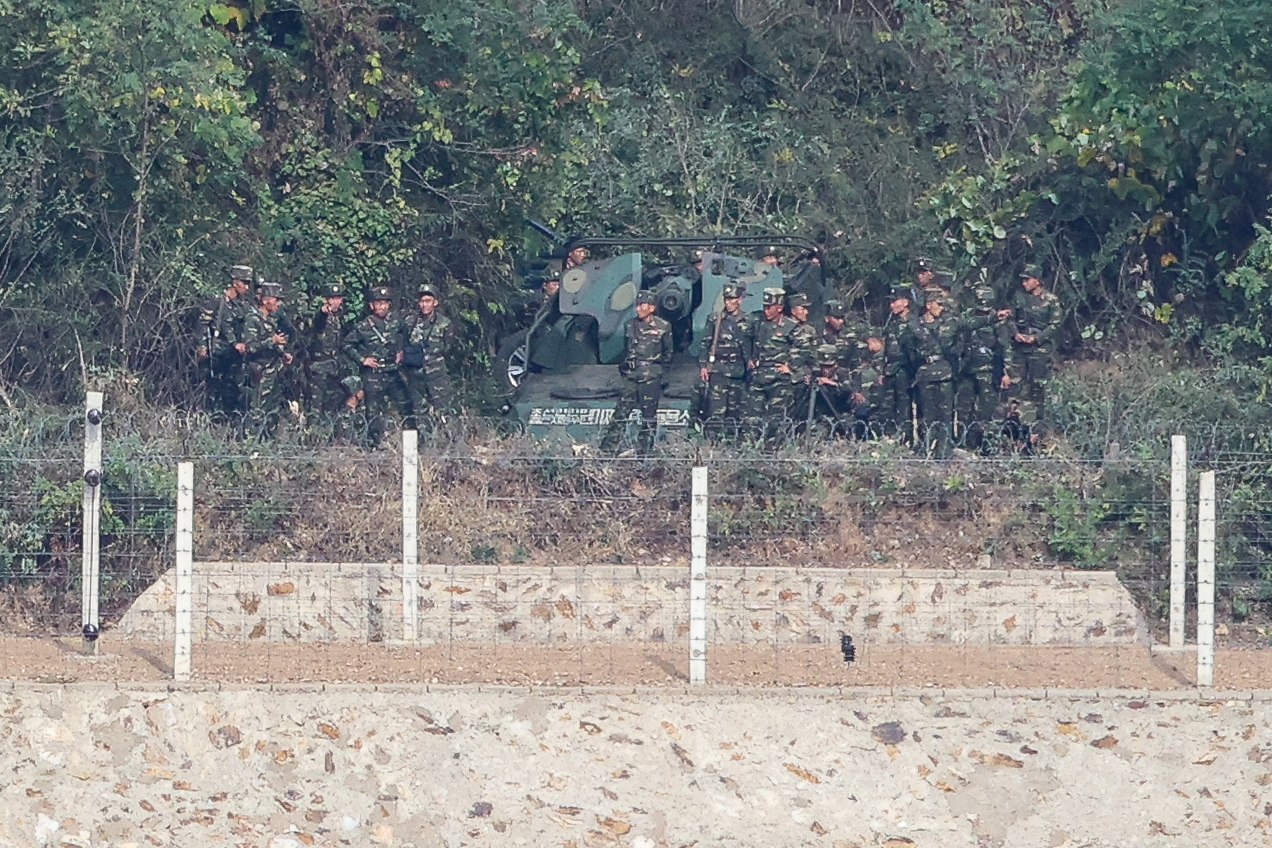
Inje-gun, however, is a border county with a population of about 30,000, and its development has long been constrained by military facility protection zones and various environmental regulations. Its registered population fell by 1,529 — from 32,165 at the end of 2021 to 30,636 as of September — and the county ranks 151st out of 167 cities and counties nationwide on the regional underdevelopment index.
Inje-gun is also the only county-level jurisdiction in Gangwon Province placed in Zone 2, and residents argue it is unreasonable to group it with cities that differ significantly in population size and development level. They also contend that the straight-line distance from Seoul used in calculating the local preference index fails to adequately reflect actual travel times and transportation conditions, and that the index should instead account for the particular circumstances of border and mountain regions, as well as access to essential lifestyle services such as healthcare and education.
Residents are also concerned that the classification could translate into widening gaps in government fiscal support and benefits. When the local preference index takes full effect in 2027, differentiated support by zone is set to apply across multiple government programs, including subsidies for local gift certificate issuance. There is particular worry that if child-welcoming grants are also tiered according to the index and Inje-gun receives a relatively lower amount, the county's already difficult conditions for childbirth and child-rearing — amid sustained population decline — could worsen further.
Kim Do-hyeong, chairman of the emergency response committee, strongly criticized the outcome at Tuesday's rally, saying the government's regional assessment had failed to properly reflect the reality of Inje-gun, which "has long endured various regulations for national security and environmental conservation." He also called for a full review of the local preference index calculation method, the public disclosure of the evaluation criteria for each indicator, and a rational adjustment of zone boundaries that reflects local conditions.
Earlier, Inje-gun and local civic groups held an emergency response meeting on Oct. 21. The following day, County Chief Choi Sang-ki, the Inje County Council, the Inje-gun Village Heads Association and the Inje Junior Chamber of Commerce held a press conference at the Gangwon Special Self-Governing Province office, urging the government to reform the system. They subsequently formed a subcommittee under the emergency response committee and have been discussing joint measures, including a collective resident petition and the submission of civic group opinion statements.
Through the two-day rally, the emergency response committee is strongly demanding a full review of the Zone 2 classification under the local preference index, the additional designation of Inje-gun as a population-decline area, and improvements to the evaluation criteria that reflect the particular circumstances of border regions as well as the county's actual population decline and underdevelopment.
Kim Geun-seong, chairman of the Inje-gun Village Heads Association, said in a resolution statement Tuesday that "preferential treatment that fails to properly examine a region's hardships is not preferential treatment — it is just another form of discrimination." He urged the government to withdraw the Zone 2 designation, improve the calculation criteria, disclose the basis for the evaluation and put in place substantive support measures.
The emergency response committee plans to ensure the rallies do not end as a one-time protest by continuing to convey the community's collective voice to the government through resident petitions and civic group opinion statements. The committee said it will maintain its joint response until a fair evaluation that reflects Inje-gun's reality is established and substantive support measures are put in place — so that border regions that have long borne various restrictions for national security and environmental conservation are not left behind in government support.
abc@heraldcorp.com