Province to complement national youth farming policy with locally tailored programs covering succession planning, agribusiness employment, new rural jobs and cooperative work

Gangwon Special Self-Governing Province has unveiled a strategy to help young people enter, work in and settle permanently in its farming communities, with phased implementation set to begin in 2027.
The province said it will build on the national government's existing youth-farmer support programs while filling gaps those programs cannot adequately address — specifically in succession planning, employment at agricultural corporations, rural industry jobs and cooperative youth activities — through its own Gangwon-tailored initiatives.
The strategy expands the policy focus beyond simply recruiting young farmers and supporting independent farming startups, extending support to the full arc of a young person's rural life: entering the sector, building a livelihood, settling down and growing professionally.
Gangwon Province said it aims to build a virtuous cycle linking youth inflow to employment, housing, daily life, settlement and long-term growth — advancing both a generational transition in agriculture and a revival of vitality in rural communities.
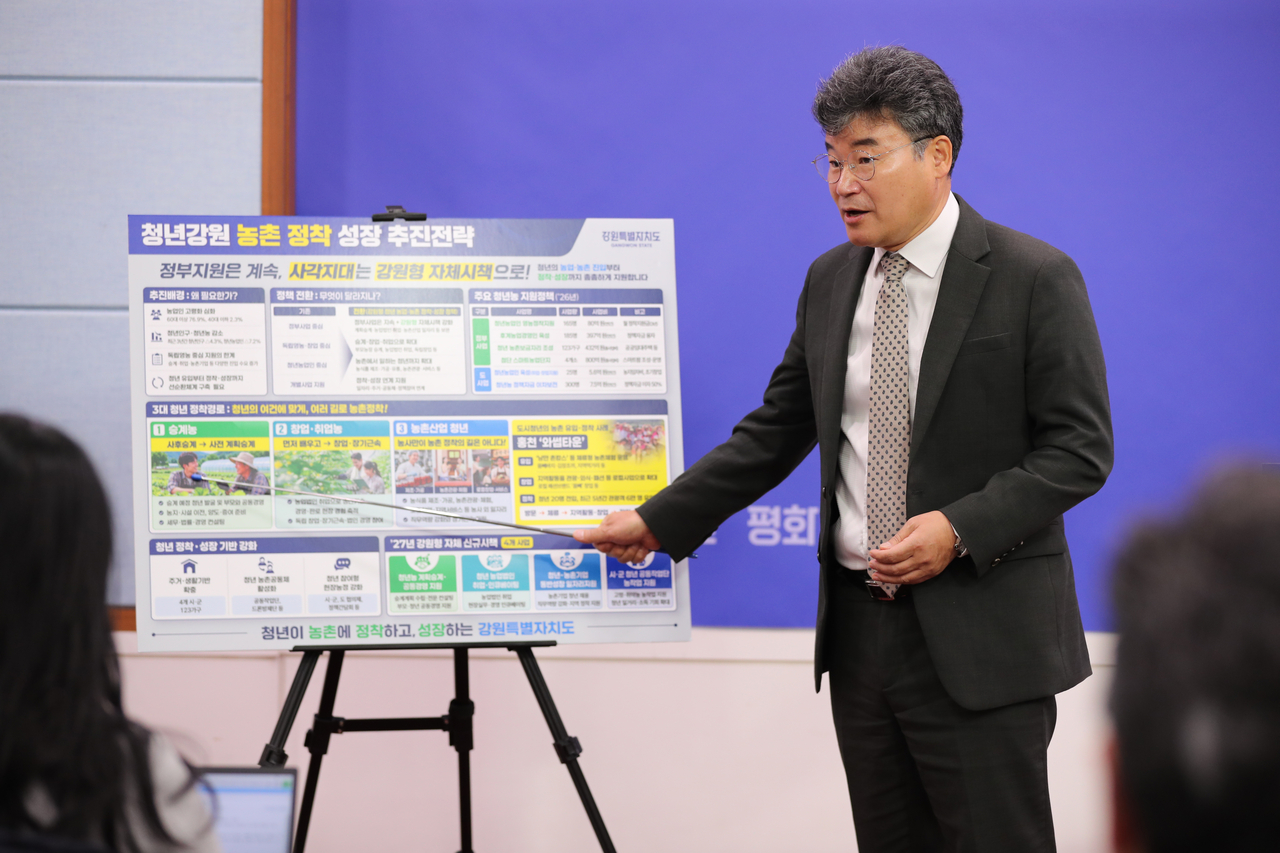
Provincial statistics released Wednesday show that as of 2025, people in their 60s or older account for 76.9 percent of Gangwon's farming population, while those in their 40s or younger make up just 2.3 percent. Over the past three years, the province's population of residents aged 18 to 39 fell 4.3 percent, and the number of young farmers in the same age group dropped 7.2 percent. The figures underscore how difficult a stable generational handover has become in agriculture — a sector central to food security.
The province said the worsening demographic picture made it necessary to move beyond policies focused solely on independent young farmers and to open up diverse pathways for young people to enter agriculture and rural life, prompting the development of the Gangwon-style settlement strategy.
The province will establish three main settlement pathways tailored to young people's circumstances and how they enter farming: farm succession, startup and employment farming, and rural industry youth.
For farm succession, the province will shift from after-the-fact transfers to planned, advance succession. It will identify young people expected to inherit a farm while their parents are still actively farming, then support joint management between parents and the next generation along with a phased handover of operations. The plan links land and facility transfers with tax, legal and management consulting to help aging farmers pass on their operations smoothly and help young successors settle in early.
For the startup and employment pathway, the province will expand routes that let young people learn on the job before launching their own operations or committing to long-term employment. Young people who are not ready to farm independently from the outset will be able to join agricultural corporations to gain hands-on experience in production technology, farm management, accounting, and retail and marketing — then move on to independent startups, long-term employment or participation in corporate management.
Working from the premise that farming is not the only path to rural settlement, the province will also extend its policy reach to rural industries. It plans to connect young people with jobs in agri-food manufacturing, processing and retail companies, rural tourism, experiential and service businesses, and local startups — broadening the routes through which urban youth can enter rural life.
Examples of this approach are already emerging across the province.
In Wassup Town, a youth village in Seokmyeon, Hongcheon-gun, urban young people are experiencing rural life through extended-stay programs such as "Nangmanchon Kangsu," building relationships with local residents through community activities and local startups before eventually settling in the area.
In Goseong-gun, Airbnb's "We Live Together. Here, in Goseong" campaign has recently highlighted young settlers who run local accommodation and restaurant businesses while building ties with the community.
Gangwon Province said it plans to spread a range of rural settlement models that allow young people to visit, stay, work and start businesses in rural areas and transition naturally into permanent residents.
To support stable long-term settlement, the province will strengthen not only employment opportunities but also housing, daily-life infrastructure and local community support.
Youth rural housing communities will be established in four cities and counties — Samcheok, Jeongseon, Inje and Hwacheon — combining public rental housing with leisure, cultural and childcare facilities to reduce the housing burden on young people and lay the groundwork for long-term settlement.
The province will also cultivate youth networks and cooperative farming and work organizations by region and crop type. Through youth cooperative work teams, drone pest-control units, and shared seedling, harvesting and sorting operations, it aims to strengthen the community foundations that allow young people to work and grow together within their regions.
In addition, the province will operate youth agriculture and rural affairs councils at both the city-county and provincial levels, and through policy forums and on-the-ground proposals will elevate young people from passive recipients of support to active participants in shaping local agricultural policy.
To fill gaps left by national programs, the province plans to introduce four new Gangwon-tailored initiatives starting in 2027.
The new initiatives will be developed in consultation with the provincial assembly and will go through required procedures — including a review by the Ministry of Health and Welfare on establishing new social security programs — before launching in 2027.
The four new initiatives are: support for planned farm succession and joint management by young farmers; youth employment and incubation at agricultural corporations; a joint-growth employment support program linking young people with rural businesses; and city-county youth cooperative work teams for farm labor support.
The succession planning initiative will support the drafting of succession plans, specialist consulting, and joint management between parents and young successors. The agricultural corporation employment initiative will help young people build practical and management experience in the field, with a path toward long-term employment or independent startups.
The rural business employment initiative will connect youth hiring and job-skills development at agri-food and rural industry companies with local settlement. The youth cooperative work team initiative will aim to reduce the labor burden on elderly and small-scale farmers while providing young people with work opportunities and income.
"We will continue building on the foundation of the national government's youth-farmer policy, while using Gangwon-tailored initiatives to fill the areas it has not been able to adequately support," Jeon Jae-seop, director general of agricultural policy at Gangwon Special Self-Governing Province, said. "Going forward, we want the measure of our policy's success to be not how many young farmers we recruited or how much money we handed out, but whether young people are actually coming to rural areas, working, living, settling down and growing."
"We want rural areas to be not just a place where young people farm, but a space of opportunity where they can start businesses, build a life with their families and shape their own futures," Jeon added.
abc@heraldcorp.com