The two sides also agreed to continue ammunition production cooperation; China skips defense ministers' meeting
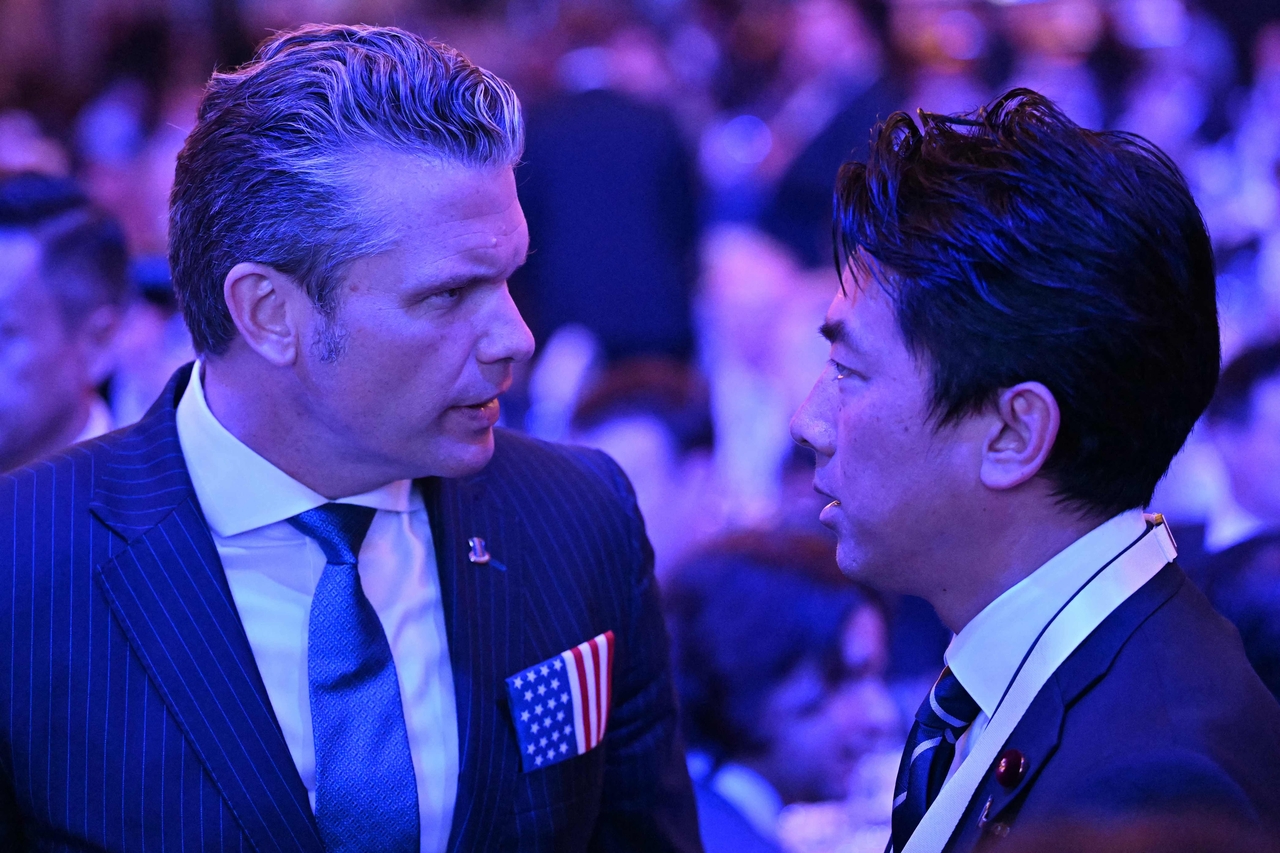
US Secretary of Defense Pete Hegseth and Japanese Defense Minister Koizumi Shinjiro agreed Wednesday to strengthen security cooperation by building up defensive posture along the first island chain and expanding defense investment to bolster deterrence against China.
Hegseth and Koizumi held bilateral talks in Cebu, the Philippines, and confirmed the joint direction, according to Kyodo News. Both officials traveled to the Philippines to attend the 13th ASEAN Defence Ministers' Meeting-Plus, or ADMM-Plus, set for Thursday.
The two countries agreed to cooperate in reinforcing defensive posture along the "first island chain" — the arc stretching from Japan's southwestern Nansei Islands through Taiwan to the Philippines — as a check on China.
They also shared the view that strengthening "denial capability" — the ability to prevent an adversary from achieving its military objectives even if it launches an attack — is critical. Expanding defense investment was confirmed as essential to that end.
The Japanese government plans to revise its three core security documents, which center on bolstering defense capabilities, within the year. The revision is expected to make denial capability a core concept, particularly by enhancing counterstrike capabilities that would prevent an adversary from achieving its military goals.
The approach aligns with the US National Defense Strategy announced in January, which calls for establishing a robust denial-based defensive posture along the first island chain.
The two countries also agreed to continue close cooperation on ammunition production in preparation for a prolonged conflict, Kyodo News said.
In addition, the two sides agreed to take effective measures to prevent a recurrence of an incident in which a US service member stationed in Okinawa Prefecture was recently indicted on charges of robbery and murder of a local woman.
The ADMM-Plus meeting on Thursday will bring together ASEAN member states and eight dialogue partners — South Korea, China, Japan, the United States, Russia, India, Australia and New Zealand — to discuss security issues and defense cooperation.
A meeting of the Squad, the security cooperation framework among Japan, the United States, Australia and the Philippines, is also scheduled.
China's decision to send a defense attaché from its local embassy rather than Defense Minister Dong Jun to the ADMM-Plus has prompted speculation that it reflects Beijing's ongoing dispute with host country the Philippines over South China Sea territorial claims. However, the overlap of the meeting with the fifth plenary session of the 20th Central Committee of the Chinese Communist Party has also been cited as a possible reason for the absence.
Meanwhile, Kyodo News reported that arrangements are being made for Japanese Prime Minister Takaichi Sanae and US President Donald Trump, among others, to visit Manila on the sidelines of an ASEAN summit the bloc plans to hold in the Philippine capital in mid-November.
mokiya@heraldcorp.com