- UNIST, POSTECH uncover atomic vibration secret in hafnium oxide
- Findings expected to advance high-density, low-power memory development
South Korean researchers have found a way to store more information in smaller semiconductor memory chips. The team identified the principle that allows data-storage regions in hafnium oxide — a leading next-generation memory material — to be divided at the atomic level with exceptional density.
UNIST announced Wednesday that a research team led by Professor Lee Jun-hee of the Department of Energy and Chemical Engineering had collaborated with a team led by Professor Choi Si-young of Pohang University of Science and Technology (POSTECH) to uncover how the boundaries between different data-storage regions inside hafnium oxide form in an extremely thin and stable manner.
Hafnium oxide has drawn attention as a next-generation nonvolatile memory material that retains information even when power is cut. It is highly compatible with existing semiconductor manufacturing processes and can maintain ferroelectric properties even at very thin film thicknesses.
A ferroelectric material can switch the direction of its electrical polarity in response to an external electric field. Regions sharing the same polarity are called "domains," and the two opposing polarity directions are used to represent 0 and 1, enabling data storage.
To increase memory storage capacity, these domains must be arranged as small and densely as possible. However, forming the boundaries between domains — known as "domain walls" — requires energy, and wider boundaries limit how tightly the domains can be packed.
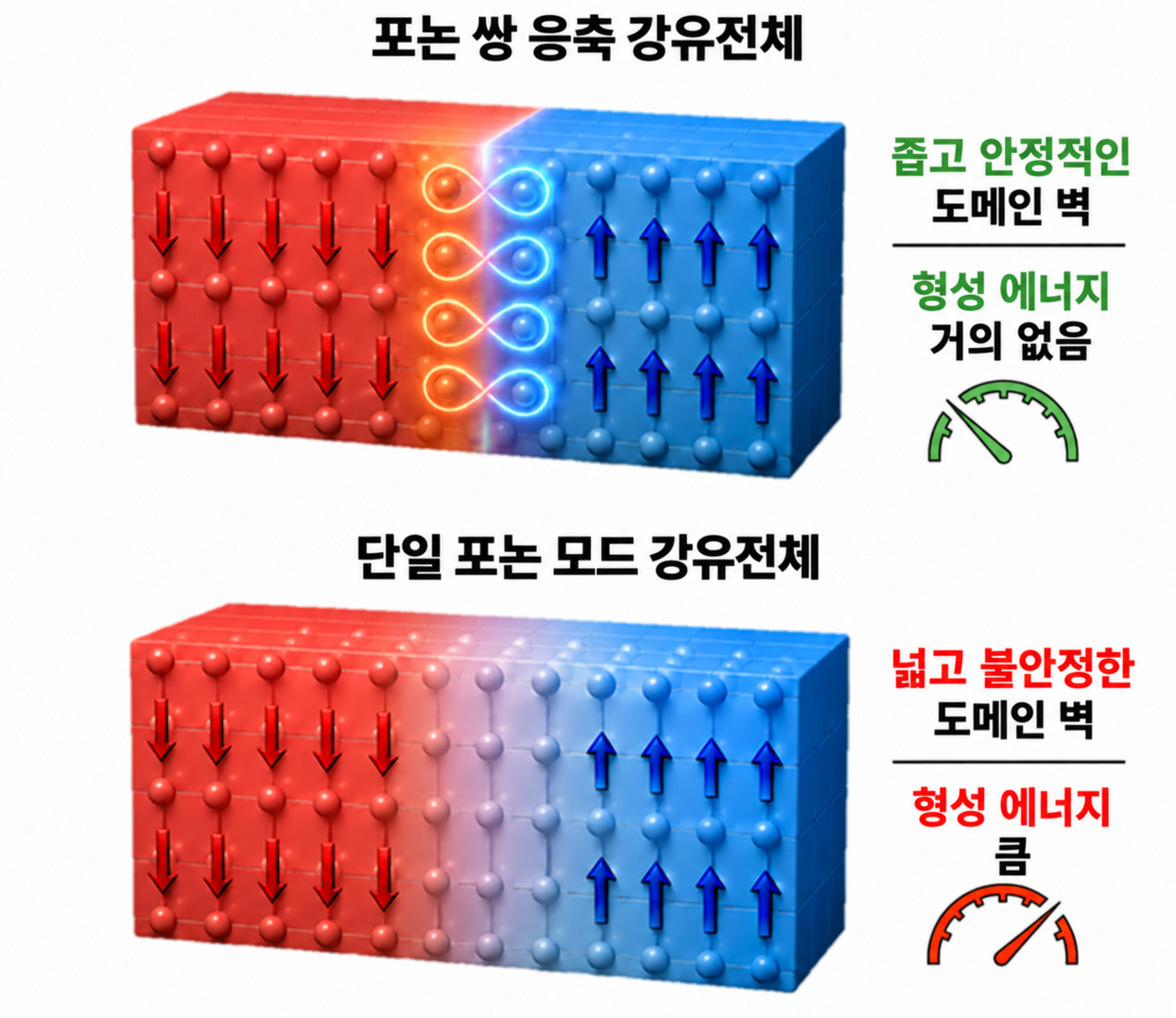
The research team found that domain walls in hafnium oxide form with almost no additional energy because of a phenomenon called "phonon-pair condensation."
A phonon is a concept used to describe the collective vibrations of atoms inside a crystal. In conventional ferroelectric materials, certain atomic vibrations weaken at domain boundaries, reducing the structural stability of the crystal.
In hafnium oxide, however, when one phonon mode weakens, another emerges to compensate. The two vibrations divide roles between them, maintaining a stable crystal structure at domain boundaries that closely resembles the structure found in the interior.
In simpler terms, there is no need to create a thick buffer zone between two regions storing data in opposite directions — allowing data-storage regions to be arranged far more densely.
The research team also verified their theoretical predictions experimentally. POSTECH researchers used an annular bright-field scanning transmission electron microscope (ABF-STEM) capable of observing atomic-level structures to analyze the arrangement of oxygen atoms in hafnium oxide. The actual direction and distance of atomic displacement matched the theoretical calculations.

The findings carry significant weight because they suggest that domain walls — long regarded as defects that cause energy loss in conventional ferroelectric materials — can in fact be precisely engineered.
Because stable data-storage characteristics can be maintained even as the spacing between domain walls is reduced, the results are expected to contribute to the development of high-density, low-power ferroelectric memory chips.
"Hafnium oxide can maintain its ferroelectric properties even in very thin film form and is well suited to existing semiconductor processes, making it a highly promising new memory material," Lee said. "By applying the principle we have identified, it will be possible to reduce the spacing between domain walls while maintaining a stable ferroelectric state, which should help increase the integration density of next-generation memory chips."
The findings were published in the Aug. 18 issue of the international journal Physical Review X.
nbgkoo@heraldcorp.com