External uncertainty persists despite US rate hold
November treasury bond issuance to be reviewed carefully
Repayment burden on vulnerable borrowers to be assessed, additional measures planned
The government has drafted a roadmap to shorten the stock settlement cycle from the current two trading days to one and will begin gathering market feedback next week.
In preparation for heightened financial market volatility stemming from external uncertainties, including the US midterm elections, the government plans to carefully review the volume of treasury bond issuance in November and, if necessary, implement market-stabilization measures such as emergency buybacks. Additional support measures for vulnerable borrowers facing heavier repayment burdens due to rising interest rates will also be prepared.
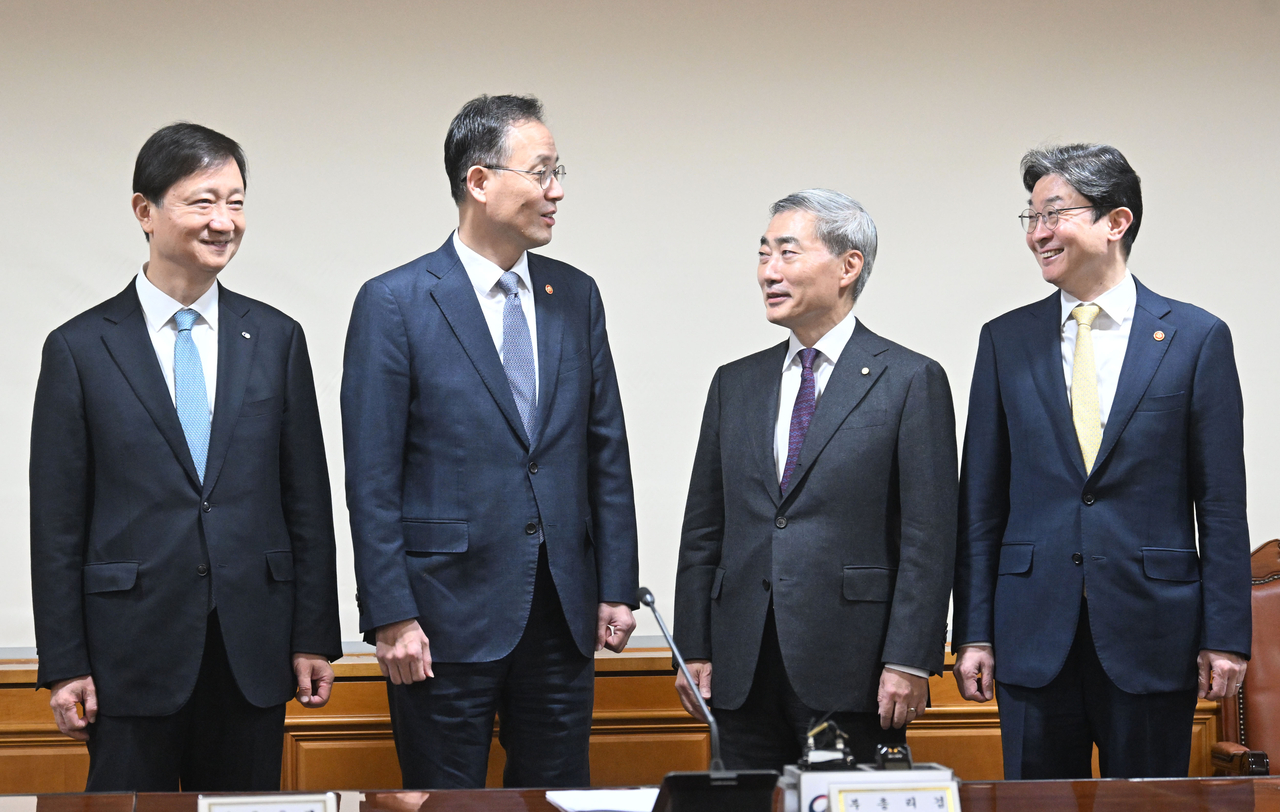
The Ministry of Economy and Finance said Deputy Prime Minister and Minister of Economy and Finance Lee Hyung-il chaired an expanded macroeconomic and financial meeting, known as the F4, on Thursday at the Korea Federation of Banks building in Seoul. Bank of Korea Governor Shin Hyun-song, Financial Services Commission Chairman Lee Eok-won and Financial Supervisory Service Director Lee Chan-jin attended.
The meeting took up a draft roadmap for shortening the stock settlement cycle from the current T+2 to T+1. The settlement cycle refers to the time between a trade being executed and the transaction being fully settled; a shift to T+1 would move the settlement date one business day earlier.
Lee said shortening the settlement cycle "is an important task that can reduce settlement-related risks and improve the efficiency of fund utilization," but added that "for a stable transition, we must fully consider the readiness of the financial investment industry and domestic and foreign investors, settlement and foreign-exchange liquidity, system stability, and the progress of similar moves by major Asian countries."
Korea Exchange and the Korea Securities Depository, along with other relevant institutions, plan to begin soliciting broad feedback from market participants — including the financial investment industry and domestic and foreign investors — on the T+1 transition roadmap draft starting next week.
The meeting also reviewed the impact of the US Federal Reserve's policy rate decision on domestic and international financial markets and discussed how to respond. The Fed held its policy rate at an annual 3.75 to 4.00 percent at the latest FOMC meeting.
On the decision, Lee said it appeared to reflect the Fed's intent to "maintain price stability while assessing the effects of the September rate hike and economic indicators before determining the future policy path."
On domestic and international financial market conditions, the meeting assessed that long-term interest rates in the United States and other major economies remain elevated, while the earnings and investment outlook of major technology companies and movements in international oil prices are amplifying market volatility.
The US midterm elections, scheduled for early next month, were also flagged as a key variable. Lee said "there is a need to monitor changes in US foreign policy following next week's midterm elections — depending on how Congress is composed and how the political environment shifts — and to assess the resulting market impact." Lee added that "the government will work closely with relevant agencies to track the effects of shifts in US foreign policy, international oil prices and global capital flows on domestic financial and foreign-exchange markets, and will respond swiftly when necessary."
On the domestic stock market, the meeting found that it has been exhibiting sharp swings — alternating between steep drops and rebounds — as concerns over changes in global interest rate expectations, geopolitical uncertainty in the Middle East, and the profitability of AI investment and semiconductor industry conditions all weigh simultaneously.
However, the meeting assessed South Korea's economic fundamentals as sound, noting that GDP grew 1.0 percent from the previous quarter in the third quarter and that growth in the mid-3 percent range is projected for this year.
Lee said the treasury bond market has shown some stabilization, with yields declining after the announcement of a reduction in October issuance volumes. However, Lee expressed caution over the possibility that external uncertainties — including the US midterm elections and fiscal instability in France — could spill over into the treasury bond market.
"We will closely monitor market conditions and carefully review the November issuance volume," Lee said, adding that the government would "work closely with relevant agencies to carry out timely market-stabilization measures, including emergency buybacks, if necessary."
The repayment burden on financially vulnerable borrowers due to rising interest rates was also placed under review. The recent upward trend in interest rates is being passed through to lending rates with a lag, increasing the repayment strain on vulnerable borrowers.
Lee said the government would "push ahead without disruption with the support measures for vulnerable borrowers announced in preparation for a period of rising interest rates," and pledged to "continuously monitor the impact of changing financial market conditions on vulnerable borrowers and the financial sector, and prepare additional measures."
Lee went on to say that "financial market stability is an important foundation supporting the growth of our economy," adding that the government would "look at market conditions and real economic conditions together and further strengthen the link with policy responses."
y2k@heraldcorp.com