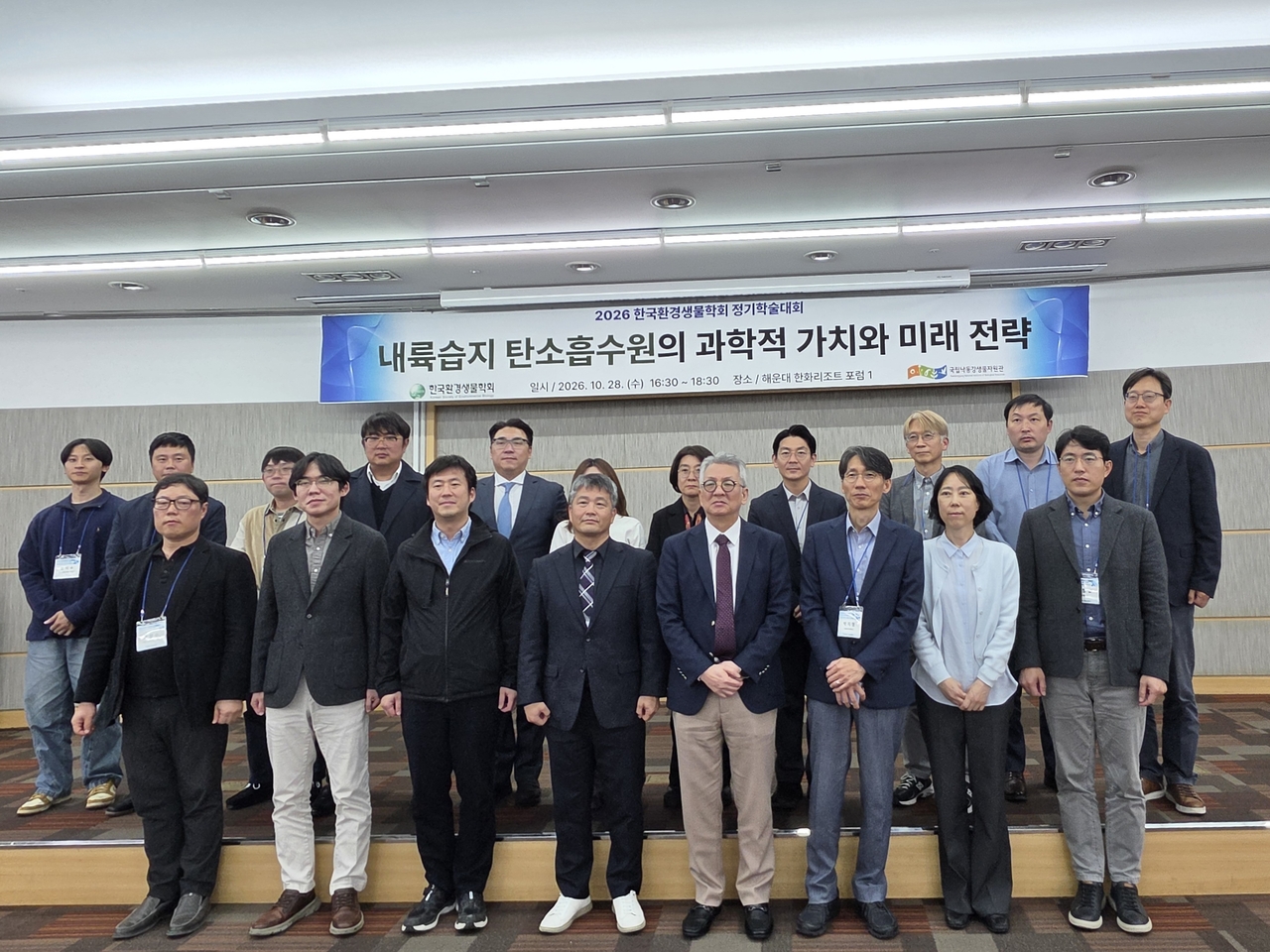
The National Institute of Biological Resources of the Nakdong River held a special presentation and discussion session titled "Scientific Value and Future Strategies for Inland Wetland Carbon Sinks" at the 2026 Korean Society of Environmental Biology annual academic conference, held Wednesday at Hanwha Resort Haeundae in Busan.
The session brought together experts to share the latest research on carbon absorption and storage in inland wetlands, the role of freshwater microalgae, and the development of greenhouse gas emission factors. Participants also explored ways to establish a carbon sink assessment framework suited to domestic freshwater environments and to apply the findings to policy.
The institute presented research estimating that approximately 93 tons of carbon accumulate each year in the underwater sediment layers of Upo Wetland.
Presenters said analysis showed that up to 80 percent of the carbon stored in those sediment layers originates from freshwater microalgae, concluding that freshwater organisms play a significant role in carbon storage within inland wetlands.
In the discussion that followed, participants examined ways to jointly assess carbon storage and greenhouse gas emissions in wetlands and to incorporate the results into national greenhouse gas statistics.
Lee Won-seok, head of the institute's Freshwater Biological Research Division, said the institute must consistently build up scientific data to reflect the carbon storage value of inland wetlands in policy. "We will continue research on carbon absorption, storage and greenhouse gas emissions, and work with relevant agencies to ensure the findings contribute to carbon neutrality policy and wetland conservation," Lee said.
kbj7653@heraldcorp.com