First trial: 10 million won fine → Second trial: not guilty
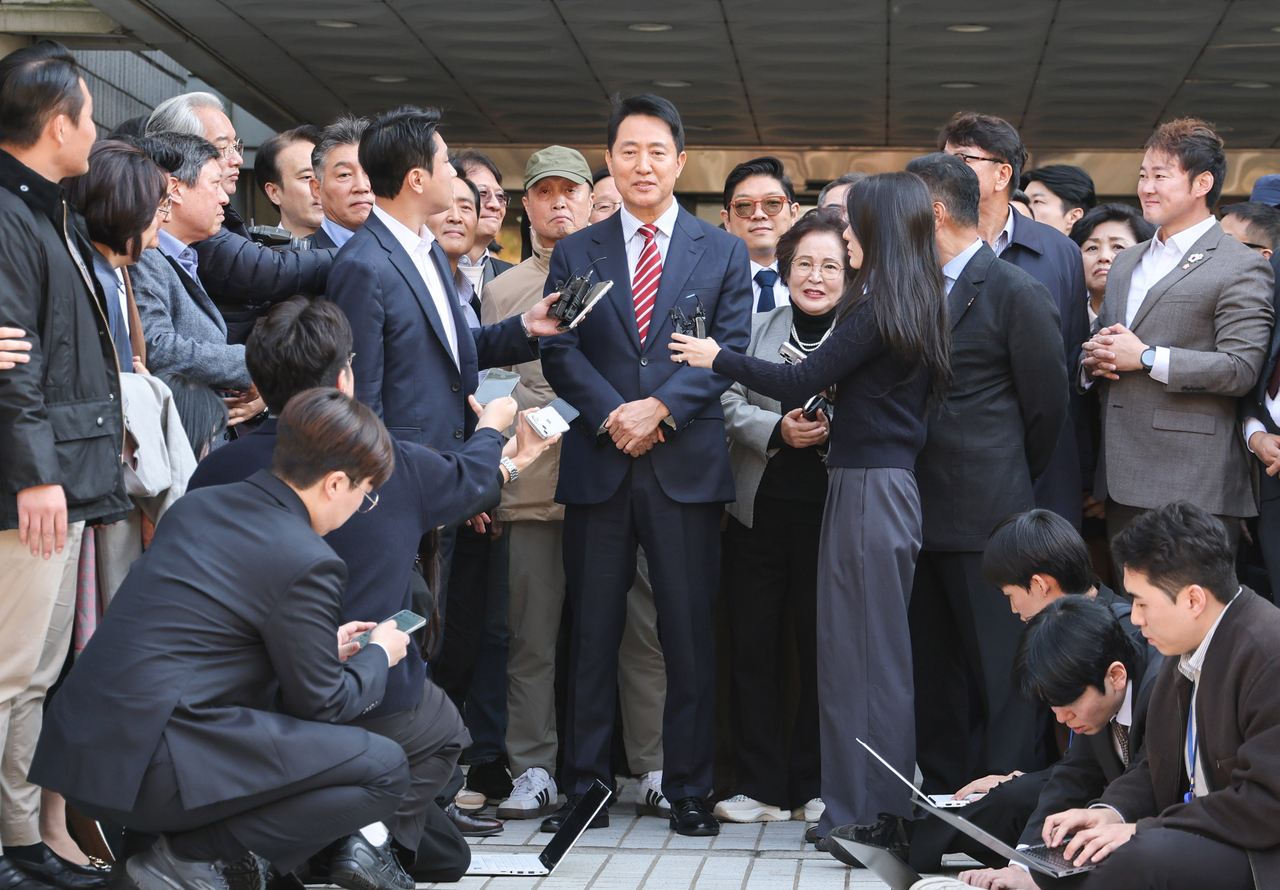
The special prosecutor's team investigating first lady Kim Keon Hee filed an appeal with the Supreme Court against the acquittal handed down by the appeals court in the political funds law violation case against Seoul Mayor Oh Se-hoon. The team argued that a key piece of evidence underlying the appeals court's ruling — recorded phone calls between political broker Myeong Tae-kyun and Oh's supporter Kim Han-jeong — had been selectively submitted to the court. The appeal sends Oh's case to the Supreme Court for a final ruling.
The special prosecutor's team said Friday it had filed the appeal with Seoul High Court's Criminal Division 7, presided over by Judge Gu Hoe-geun, which had acquitted Oh. Oh stands accused of receiving polling data from Myeong ahead of the 2021 Seoul mayoral by-election and having a supporter cover the costs. A first-instance court had sentenced Oh to a fine of 10 million won ($7,490) — a penalty that would have stripped Oh of the mayoral post — but the appeals court acquitted Oh on Thursday. The appeals court also acquitted Oh's aide Kang Cheol-won, former deputy mayor for political affairs of the Seoul Metropolitan Government, and supporter Kim, who were tried alongside Oh.
The special prosecutor's team said the appeals court had erred in assessing the credibility of Myeong's testimony and the corroborating evidence, and that the court's factual findings and legal conclusions contained errors. The team also said the recorded calls between Kim and Myeong had been selectively submitted and that the court had disregarded the nature of corruption offenses and the probative value of key circumstantial evidence.
The team said the appeals court had overstepped the bounds of free judicial discretion in overturning the first court's finding — that Myeong's testimony was credible where it aligned with objective evidence and the circumstances at the time — and concluding instead that no circumstances existed to exclude reasonable doubt.
The special prosecutor's team said there was sufficient basis to find that Oh and Kang had commissioned and conducted the polling. Even if parts of Myeong's testimony were difficult to believe, the team argued, the key portions consistent with the charges were supported by objective grounds that compelled belief, or by other corroborating evidence.
The team said that while Kim claimed to have independently commissioned the polling, questionnaires and results had continued to be delivered to Kang — not to Kim — for a considerable period after payments of 10 million won and 5.5 million won were made on Feb. 1 and Feb. 5, 2021, respectively. The team also said messenger records between Kim and Myeong confirmed the two had not met until Feb. 21, 2021.
Regarding the recorded phone calls between Kim and Myeong from around March 2021 — newly submitted at the appeals stage — the team said Kim had possessed the recordings during the investigation but concealed them, only to selectively submit a handful after the first-instance verdict, after Myeong's cross-examination at the appeals court had already concluded, as though they had just been discovered.
The recordings contain Myeong telling Kim: "I met you through Mayor Oh, but it wasn't Mayor Oh who introduced us directly," and "I don't know what kind of relationship Mayor Oh and I have." The appeals court cited the recordings as grounds to reject the credibility of Myeong's testimony.
The team also noted that crimes such as bribery and illegal political donations are typically carried out through covert agreements and undisclosed financial transactions between the parties, making direct evidence difficult to obtain. The team said the appeals court had too readily dismissed the probative value of Myeong's direct testimony on the grounds of doubt, when the only recourse was to weigh the circumstantial evidence as a whole.
"The appeals court's flawed judgment — which disregarded the nature of the offense and the character of the evidence, and rejected the probative value of key circumstantial evidence supporting a guilty verdict — must be corrected by the Supreme Court," the special prosecutor's team said.
bell@heraldcorp.com