Two-day forum at Seoul Women's Plaza brings together AI experts and working women to share practical knowledge
From neuroscience and medicine to job-seeking and entrepreneurship, event aims to sharpen women's edge in the AI era
Six program graduates step up as instructors, showcasing a virtuous cycle from learning to practice
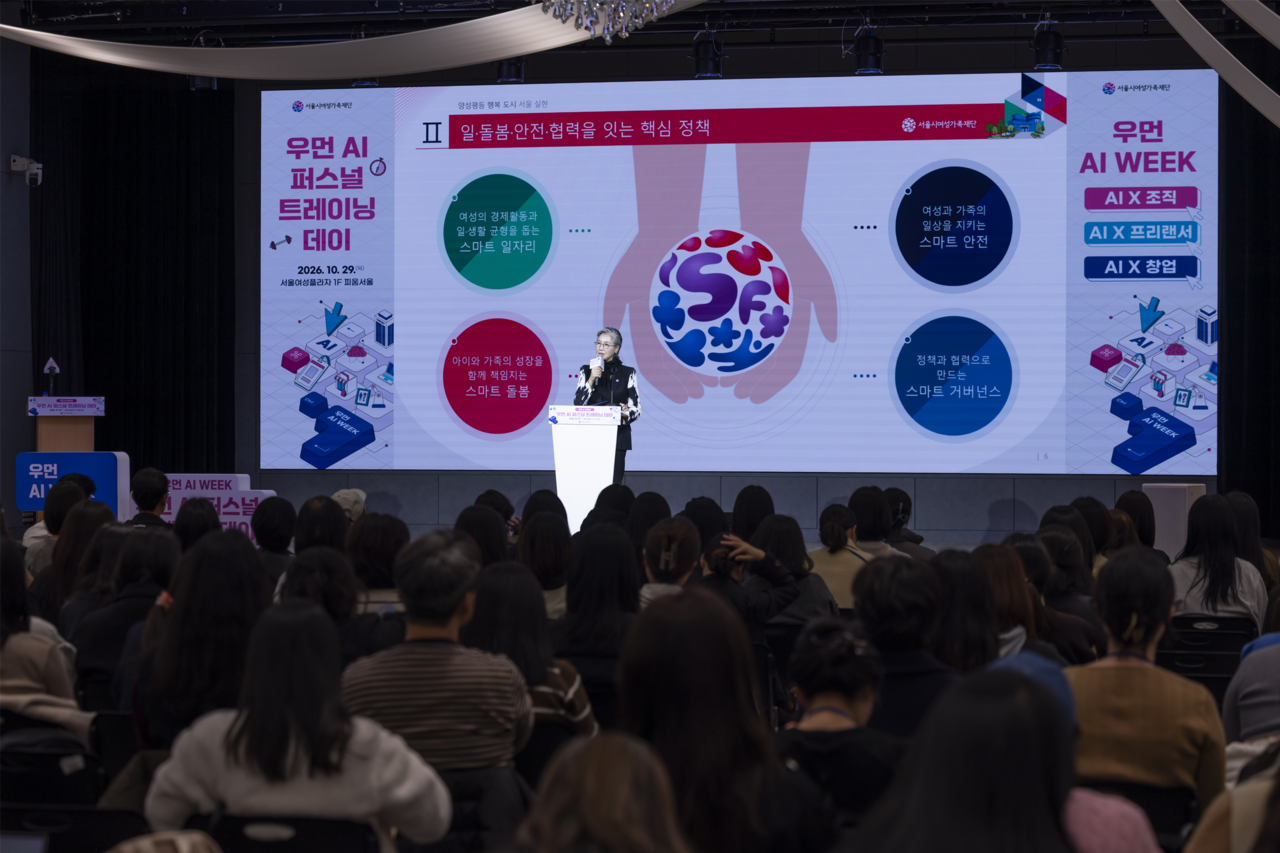
As AI reshapes jobs and daily life, the Seoul Foundation of Women and Family organized a two-day event to help women build AI skills and explore new career opportunities. The event drew strong public interest by going beyond basic technology instruction to offer hands-on experience applicable to real workplaces and startups.
The foundation said Friday that more than 500 people attended "Women AI Week," held Wednesday and Thursday at Seoul Women's Plaza in Dongjak-gu, Seoul, wrapping up the event to wide acclaim.
The event was part of the Seoul Metropolitan Government's "Seoul Smart Women Project." It focused on bridging the expertise of AI specialists with the on-the-ground experience of women who use technology in their work, offering participants concrete ways to apply AI in both professional and everyday settings.
On the first day, Wednesday, the foundation co-hosted a science communication forum with the Korean Federation of Women's Science and Technology Associations. Women leaders in science and technology took the stage to examine how AI is transforming human thinking, learning, healthcare and consumer life, and to explore its future possibilities.
Speakers included Lee In-a, a professor in the Department of Brain and Cognitive Sciences at Seoul National University; Choi Eun-kyung, a surgery professor at Seoul National University Hospital's Healthcare System Gangnam Center; and Cha Kyung-jin, a professor at Hanyang University's College of Business. Drawing on their respective fields, the three outlined the changes AI will bring to individuals and society and offered guidance on how citizens can understand and make use of the technology.
The second day, Thursday, featured "Women AI Personal Training Day," dedicated to integrating AI into real work and career development. The session drew particular interest from women in their 20s and 30s looking to acquire new skills and sharpen their competitiveness amid accelerating AI adoption and uncertainty in the job market.
Demand was so high that registration had to be capped. Office workers who came straight from work stayed well into the evening, underscoring strong appetite for practical AI training.
The day's program comprised nine sessions across three tracks — corporate employment, freelancing and entrepreneurship. Expert sessions examined how AI is reshaping the job market and outlined growth strategies by field, while a follow-on "AI × Real-World Application" segment featured participants sharing firsthand experience and practical tips for using AI on the job.
A notable highlight was the participation of six graduates from the foundation's Women AI Education Platform, who served as instructors themselves. By applying skills learned through the program to their own work and then sharing those results with the public, the format demonstrated the program's real-world effectiveness.
In the corporate track, Oh Yeon-su and Jo Mi-ra — participants in the "WomenEats Talker" program — presented case studies on using AI in planning work, walking the audience through specific methods for boosting efficiency from idea generation to problem-solving.
In the freelance track, Jeong Ha-rim and Kim Hyeon-hui, leaders of the collaborative learning program "It's Study," led sessions on building AI-assisted portfolios and using personalized AI tools to strengthen freelancers' professional competitiveness.
In the entrepreneurship track, Park Ha-eun and Kim Min-seo — grand-prize winners of the "Seoul Women Tech Hackathon" — shared their experience preparing a startup and running a small organization with AI, showing how the technology can offset limited staff and resources in the early stages of a venture.
Participants rotated through sessions across all three tracks, encountering a wide range of use cases and picking up practical methods they could apply to their own work. The program's blend of expert theory and real-world practitioner experience was also noted as a distinguishing feature.
The event demonstrated that building AI competency among women need not stop at completing a course — it can translate directly into economic activity and career advancement.
In particular, the structure in which program graduates return as instructors to share their own experience was highlighted as a model of how the benefits of public education can ripple outward from individual growth to society at large.
Building on the strong demand for education confirmed through the event, the foundation plans to expand its practice-oriented AI training. It intends to continuously identify professional instructors and course content that meet private-sector standards, and to support women in broadening their opportunities in employment, entrepreneurship and career transition through stronger AI skills.
Park Jeong-suk, chief executive of the Seoul Foundation of Women and Family, said the importance of education that citizens can apply directly to their work is growing amid AI transformation and a shifting employment landscape. "Through the Seoul Smart Women Project, we will strengthen practice-centered education and support so that more women can create new opportunities in the AI era," Park said.
7toy7@heraldcorp.com