The government and the Jeonnam-Gwangju Special Metropolitan City plan to hold a residents' referendum on relocating the Gwangju military airport to Muan-gun only after drawing up a support package for the area — but delays in finalizing that package are pushing back the entire process, with analysts saying the relocation site may not be confirmed until next year.
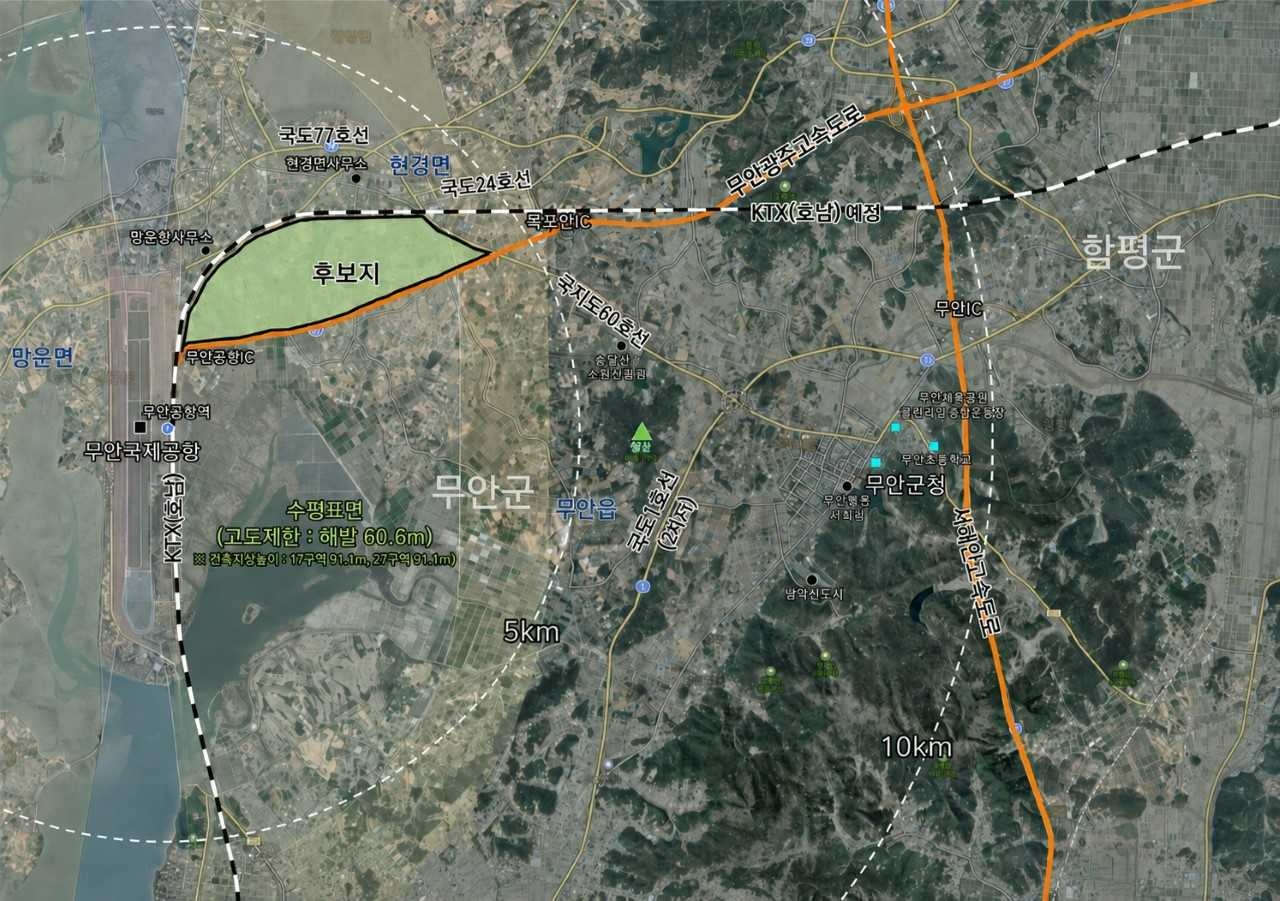
According to the Jeonnam-Gwangju Special Metropolitan City and other officials, after the Mangun-myeon area of Muan-gun in South Jeolla Province was selected in August as the candidate site for the Gwangju military airport relocation, the Ministry of National Defense, the special metropolitan city and Muan-gun formed a task force to draw up a support plan for communities surrounding the relocation site.
The task force on support projects for Muan-gun related to the military airport relocation has held two meetings recently, discussing noise-damage countermeasures and regional development projects.
The task force has been working to develop a support plan — including sector-by-sector and year-by-year implementation schedules and financing arrangements — based on three preconditions Muan-gun has demanded: the prior relocation of Gwangju's civilian airport to Muan International Airport, 1 trillion won ($749 million) in support from the special metropolitan city and the central government, and the provision of exceptional national-level incentives.
The task force had planned to present the support plan at a public hearing for residents, but internal disagreements over sector-specific support measures have stalled progress.
As a noise-damage countermeasure, Muan-gun proposed to the Defense Ministry that a 3.3 million-square-meter noise buffer zone be created around the airport and developed into a solar energy facility, but the Defense Ministry is understood to have raised objections.
Muan-gun's requests for nationally funded projects — including the construction of a Honam-region ESS complex, development of the Seongdong district as a residential hub for the Muan industrial complex, and road expansion — are still under negotiation.
The fiscal composition of the 1 trillion won in support to be provided by the special metropolitan city and the central government is expected to take considerable time to work out.
Of that amount, the allocation of 640 billion won tied to site development cannot be determined until an amendment to the Military Airport Relocation Act, currently pending before the National Assembly, is passed.
With key elements of the support plan — including the fiscal arrangements — still unresolved, the public hearing that must precede the referendum has yet to be scheduled, further slowing the relocation process.
Some observers say that without concrete support and financing plans in place before the referendum, it may prove difficult to set a voting date at all.
Civil society groups in Muan have also called for the major commitments — including the prior relocation of Gwangju's civilian airport to Muan International Airport, the 1 trillion won in support, and the development of a national industrial complex — to be put in writing before any referendum is held.
There are also concerns that rushing to a vote before adequate support measures are presented could reignite community conflict in the region.
"We will carefully review Muan-gun's demands, including the three preconditions, and draw up a support plan for communities surrounding the relocation site," an official from the Jeonnam-Gwangju Special Metropolitan City said. "We will also coordinate with the Defense Ministry to advance the military airport relocation as quickly as possible."
sij@heraldcorp.com