- Ministry of Science and ICT revamps cross-ministry research support system IRIS
- Auto-fill for paper details, 24 new mobile services added

Researchers conducting state-funded R&D projects will soon be able to register publication data automatically by entering only a paper's digital object identifier, or DOI — with the title, authors and journal name filled in without manual input. Funding payment status checks and research ethics consent forms will also be handled via smartphone, significantly reducing the administrative load on researchers.
South Korea's Ministry of Science and ICT announced Sunday it will overhaul the user interface and user experience of IRIS, the cross-ministry integrated research support system, to free researchers from unnecessary administrative tasks and let them focus on their work.
IRIS is an integrated online platform covering the entire lifecycle of national R&D projects — from application and evaluation to grant management and results reporting. Since its launch in January 2022, it has unified what had been a fragmented, ministry-by-ministry project management structure. Researchers have nonetheless complained about a cluttered interface and repetitive data entry requirements.
The centerpiece of the overhaul is automated registration of research outputs. By linking IRIS to the international academic database Web of Science and the National Researcher Information system, the platform will automatically populate bibliographic details — title, authors and journal name — once a researcher enters a paper's DOI.
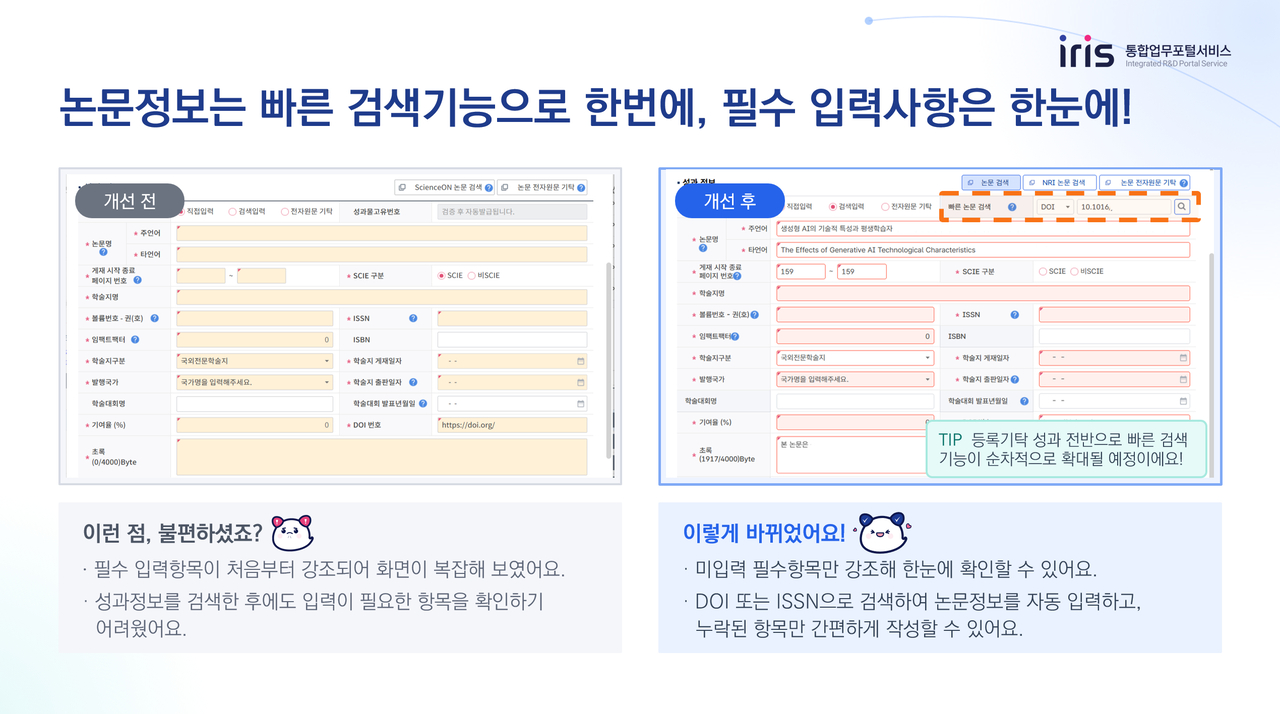
With researchers no longer required to key in publication details by hand, the ministry expects the update to cut time spent on administrative work and minimize input errors such as typos and omissions.
Mobile functionality is also being substantially expanded. The revamp introduces 24 new mobile services, allowing researchers to check project announcements, application and agreement status, and grant payment information from their phones.
Straightforward administrative steps such as research ethics consent can now be completed on a smartphone without a PC. A notification feature covering key deadlines and agreement-related updates has also been added, enabling researchers to handle administrative tasks while traveling.
The update also addresses friction in the research proposal drafting process. Terminology and item sequencing in the system interface have been aligned with the standard forms prescribed under the National Research and Development Innovation Act, and required fields have been moved to the front.
New features include an integrated pop-up that displays the full contents of a research proposal at a glance and a collapsible panel for the grant management screen. The changes are designed to minimize navigation between screens and prevent omissions during the drafting process.
The Ministry of Science and ICT began a pilot run of the revamped system in mid-October. It plans to assess stability under high concurrent user loads and conduct researcher satisfaction surveys before finalizing the system.
Park In-gyu, head of the ministry's Science and Technology Innovation Division, said the overhaul "reflects, as the top priority, the voices from the research community that have long complained about complex administrative procedures and the inconvenience of manual data entry." Park added that the ministry would "continue developing a user-centered research support platform so that researchers can fully immerse themselves in their work, free from unnecessary administrative burdens."
nbgkoo@heraldcorp.com