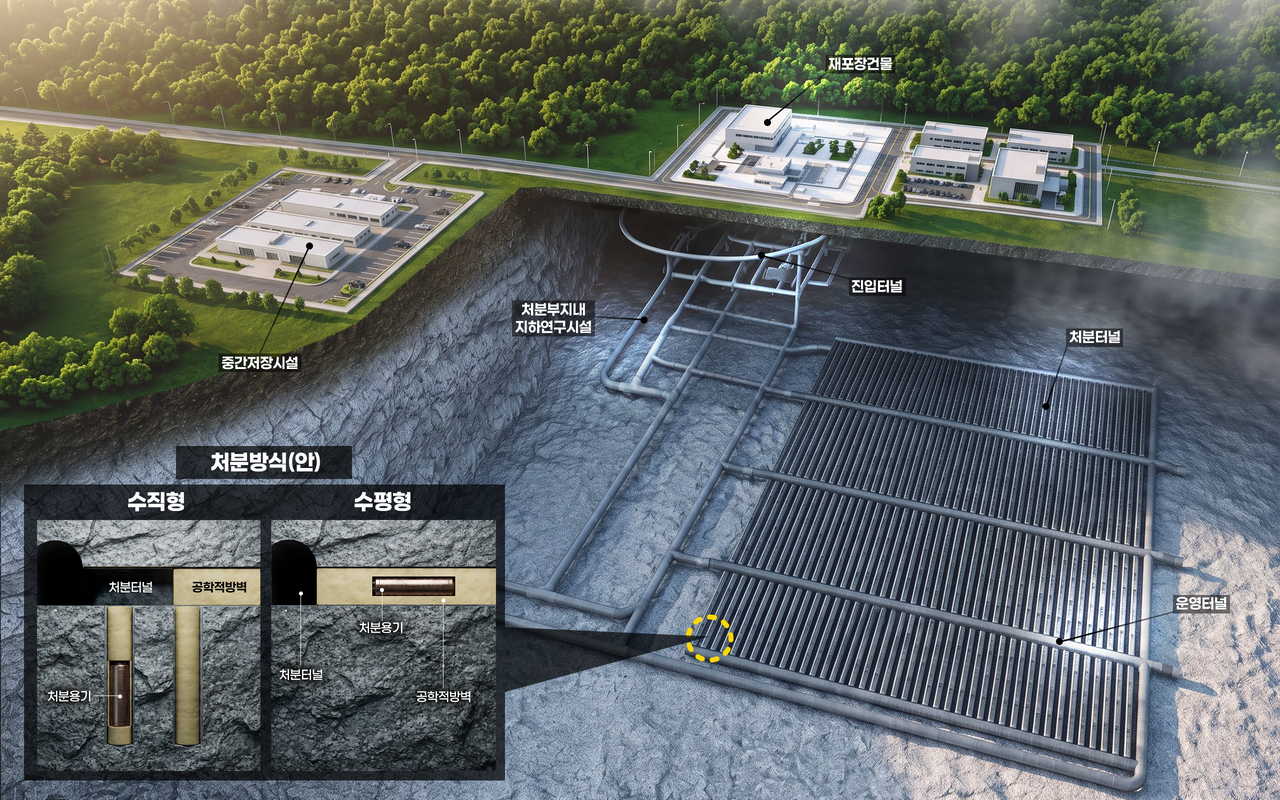
The Korea Radioactive Waste Agency (KORAD) announced Sunday that the ninth High-Level Radioactive Waste Management Committee, which met Friday, approved the agency's proposed exclusion criteria for sites deemed unsuitable for a high-level radioactive waste management facility.
The finalized criteria comprise 12 standards in total — six outright exclusion criteria and six conditional exclusion criteria — designed to screen out areas that are unsuitable for siting the facility or that would pose constraints on site investigation.
Key exclusion targets include areas within an 8-kilometer radius of active faults, areas within an 8-kilometer radius of the epicenter of an instrumentally recorded earthquake exceeding magnitude 5.5, and areas at risk of crustal deformation from volcanic activity.
Also covered are areas with a high likelihood of future excavation due to mineral resource exploration, as well as areas where rock types with geological instability factors are distributed.
Under relevant legislation, Gyeongju — which hosts an existing low- and intermediate-level radioactive waste disposal facility — is also excluded from the pool of candidate sites for preliminary investigation.
For areas subject to constraints related to transportation conditions, surrounding facilities or land-use regulation, the committee will assess the feasibility of proceeding with the project and the time required once the relevant local government resolves those issues, before deciding whether to designate the area as a preliminary investigation site.
KORAD developed the criteria by analyzing overseas site-selection cases, domestic research findings, and relevant laws and technical standards.
The agency plans to apply the finalized criteria to a geographic information system to identify candidate sites for preliminary investigation and to prepare for a public call for site applications.
KORAD cautioned, however, that a site not meeting any exclusion criterion does not automatically confirm its safety — geological and groundwater characteristics and long-term safety will be verified in stages through subsequent preliminary and in-depth investigations.
"The exclusion criteria for unsuitable areas are an important starting point for enhancing the objectivity and transparency of the site-selection process," said Lee Jin-ho, president of KORAD. "We will pursue the high-level radioactive waste management project safely by communicating with relevant agencies and local communities on the basis of scientific evidence."
kbj7653@heraldcorp.com