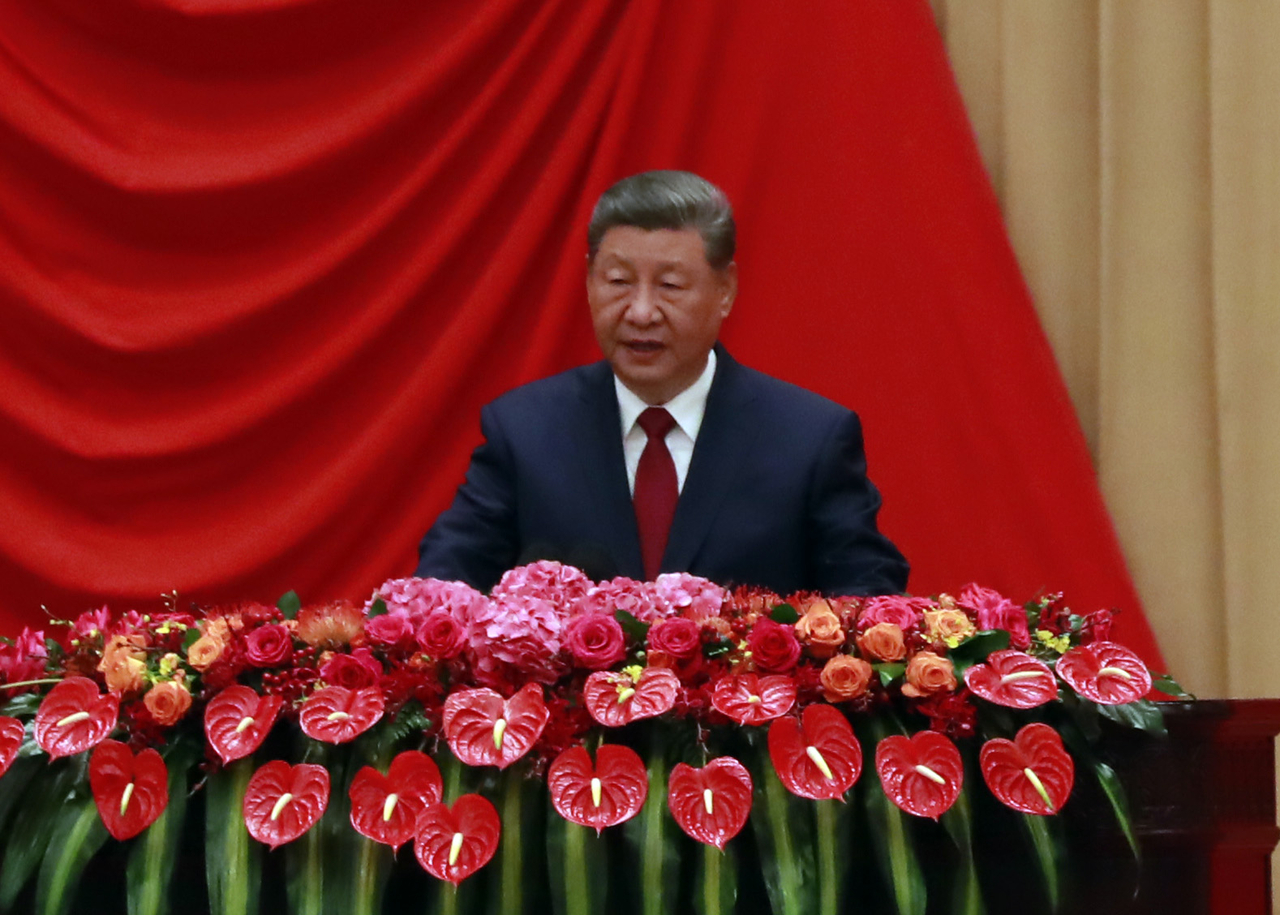
The Chinese Communist Party has released a resolution centered on consolidating Xi Jinping's authority, ahead of next year's party congress that will determine whether Xi secures a fourth consecutive term.
The party published the full text of the resolution from the fifth plenary session of the 20th Central Committee, held from Monday to Thursday, through the Xinhua News Agency on Sunday. The document is formally titled "Decision of the CPC Central Committee on Several Major Issues Concerning Persisting in Comprehensively and Strictly Governing the Party."
Running to more than 17,000 Chinese characters, the resolution is grounded in the recognition that shifts in the global balance of power, combined with deepening domestic development disparities, have made the management of party members and officials increasingly important.
"The mainstream of the party ranks is good, but problems of ideological, organizational and work-style impurity have not yet been fundamentally resolved, and the quality and capabilities of some party members and officials have failed to keep pace with the demands of the times," the resolution said. It added that a minority of members and officials, including senior cadres, lack strong party spirit, waver in or lack ideals and convictions, and some have even abused power for personal gain or fallen into corruption and moral decay.
As remedies, the resolution called for strengthening party spirit — with unity around Xi at its core — enforcing the principle of democratic centralism to regulate the authority of leaders at all levels, tightening cadre evaluations, improving party organizational systems and continuing the anti-corruption campaign.
The document placed particular emphasis on raising the level of intra-party democracy within party organizations at all levels and empowering collective leadership, so that officials cannot treat their assigned work, sector or region as a personal fiefdom. It also introduced constraints on leaders' authority, including provisions to prevent the forced passage of major decisions when dissent exists within a party organization.
Cultivating a "personal cult of authority" by leaders at any level was explicitly prohibited, and the resolution called for establishing a system in which higher-level organizations supervise the heads of lower-level ones.
At the same time, the resolution repeatedly reaffirmed what are known as "loyalty slogans" tied to Xi — including the "Two Establishes," a formulation that enshrines Xi's status within the party and the standing of Xi's socialist ideology.
The resolution also called for institutional improvements covering senior officials, including enhanced personal disclosure requirements, investigations triggered by changes in personal assets, and stricter oversight of family-run businesses.
The document used the metaphors of "tigers" for high-ranking corrupt officials, "flies" for lower-level ones, and "foxes" for corruption suspects who have fled abroad. It said the party must "highlight key areas, issues and targets, and deepen the rectification of corruption in areas where power, funds and resources are concentrated," and vowed to "thoroughly purge toxins and restore the political ecosystem in localities, departments and units where serious corruption cases have occurred."
Xi separately distributed explanatory materials under Xi's own name that day, saying the party's ranks had undergone structural changes — with the proportion of members and officials born after the reform and opening-up era growing steadily, creating new demands for education and management. "The mainstream of the party membership is good, but there are no small number of problems and latent risks that weaken the party's advanced nature and purity and affect its long-term hold on power," Xi said.
klee@heraldcorp.com