Debuted with one-act play "Sanulrim" at 1968 spring literary contest
First sageuk drama 'Jang Nok-su' followed by 'Wang gwa Bi,' 'Empress Myeongseong,' 'Sindon'
Final work was MBC's 'Son Kkok Jabgo, Jineun Seokyangeul Baraboja'
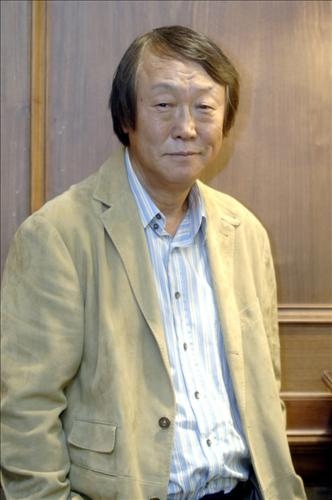
Jeong Ha-yeon, the screenwriter celebrated as a master of the grand sageuk drama for bringing turbulent historical figures — from Jang Nok-su to Empress Myeongseong — to life on the small screen, died Sunday. Jeong was 82.
According to the Korea Broadcast Writers Association and the family, Jeong had been hospitalized for a chronic illness and died Sunday afternoon.
Born in 1944 in Anak, Hwanghae Province, Jeong honed a craft for the stage through Yonsei University's theater troupe, the Yonhui Drama Arts Research Society. In 1968, a one-act play, "Sanulrim," won the Seoul Sinmun spring literary contest, and that same year a full-length play, "Mujigae Ssureojida" ("Rainbow Falls"), earned the rookie award from the magazine Sedae. The following year, "Hwansang Salin" ("Fantasy Murder") was selected as the winning full-length play in a joint competition held by the National Theater and the Kyunghyang Shinmun.
Through the 1970s, Jeong moved busily between Chungmuro, the broadcasting studios and the stage. Screenwriting credits included "Eoneu Sarang-ui Iyagi" (1971), directed by actor Shin Sung-il, "Geugeon Neo" (1974), "Mongma wa Suknyeo" (1976) and "Yeonggwang-ui 9hoemal" (1977). After writing radio dramas, Jeong entered television with scripts for KBS programs "TV Literary Hall" and "Legends of the Hometown." Theater remained a constant: "Maronieu-ui Gil," staged by theater company Jajakgeukhoe, won the grand prize at the 15th Dong-A Theater Awards, and the work also brought Jeong a special prize at the same ceremony in 1979 along with the Baeksang Arts Awards prize for playwriting.
Jeong's career as a sageuk writer opened past the age of 50. The 1995 KBS series "Jang Nok-su" was the first, followed in quick succession by "Jo Gwang-jo" (1996), "Wang gwa Bi" (1998–2000), "Empress Myeongseong" (2001–2002) and the MBC series "Sindon" (2005–2006). "Empress Myeongseong" ran for 124 episodes, with Choi Myung-gil taking over the title role from Lee Mi-yeon. In 2011, Jeong wrote "Insu, the Queen Mother" as JTBC's launch drama series, and in 2013 penned "Court Scandal — War of Flowers," centered on Royal Consort Jo (played by Kim Hyun-ju), a concubine of King Injo. Actor Chae Si-ra played the role of Queen Insu twice — in "Wang gwa Bi" and in "Insu, the Queen Mother."
In contemporary dramas, Jeong probed human desire with relentless focus. SBS's "Morae Wie-ui Yokmang" (1992), KBS's "Yokmang-ui Bada" (1997) and MBC's "Yokmang-ui Bulkkot" (2010) all charted the rise and ruin of people willing to do anything to succeed. The KBS drama series "Wife" (2003) — a remake of a 1982 production starring Han Jin-hee, Kim Ja-ok and Yoo Ji-in — told the story of an amnesiac man and two wives, drawing attention as a melodrama remake penned by a veteran sageuk writer. In an interview with the Seoul Sinmun at the time of broadcast, Jeong said the work "depicted, at a slow tempo, the simple innocence of a life we had forgotten." The MBC drama series "Sweet Life" (2008), about a crisis in a middle-aged couple's marriage, also came from Jeong's pen.
Jeong also devoted considerable effort to dramatizing cultural history. The first installment of EBS's cultural history series, "Myeongdong Baekjak" (2004), portrayed poets and artists — including poet Kim Su-young — who gathered in Seoul's Myeong-dong in the aftermath of the Korean War. The third installment, "Jigeum-do Maronieu-neun" (2005), depicted the youth of poet Kim Ji-ha and novelist Kim Seung-ok as young people in the 1960s.
Jeong's final work was the 2018 MBC Wednesday–Thursday drama series "Son Kkok Jabgo, Jineun Seokyangeul Baraboja," a story of the last love of a housewife, Nam Hyeon-ju (played by Han Hye-jin), standing at the edge of life. For "Wang gwa Bi," Jeong received the KBS Drama Awards' writer prize in 1999 and the Korea Broadcast Producers Award for writing in 2000.
In youth, Jeong regarded television writing as something to be ashamed of — not a novel, not a play, but writing done for money. By Jeong's own account, it was only after director Kim Su-dong delivered a sharp rebuke — asking why anyone would treat so carelessly a drama watched by millions — that the attitude changed. Jeong had been writing scripts drunk, dismissing the income as tainted. That scolding left a lasting mark. In a 2009 interview, Jeong still held to one conviction: "A writer is a seonbi who handles words."
A memorial altar has been set up at the funeral hall of Soonchunhyang University Seoul Hospital in Yongsan-gu, Seoul, room No. 5, receiving visitors from 9 a.m. The funeral is scheduled for Wednesday.
shee@heraldcorp.com