'When education funding shakes, so does children's future'
Strengthening foundational learning support, expanding student mental health safety net
Dedicated unit for teacher protection, reinforced emergency response
Shift to inquiry-, exploration- and writing-centered classes for the AI era
Seoul's education system is at a crossroads, shaped by a shrinking school-age population and the rapid spread of AI. Even as student numbers fall, demand for support in areas such as aging school facilities, foundational learning, student mental health and digital education continues to grow. With the central government pushing to overhaul the local education grants formula, securing stable education funding has emerged as a pressing concern.
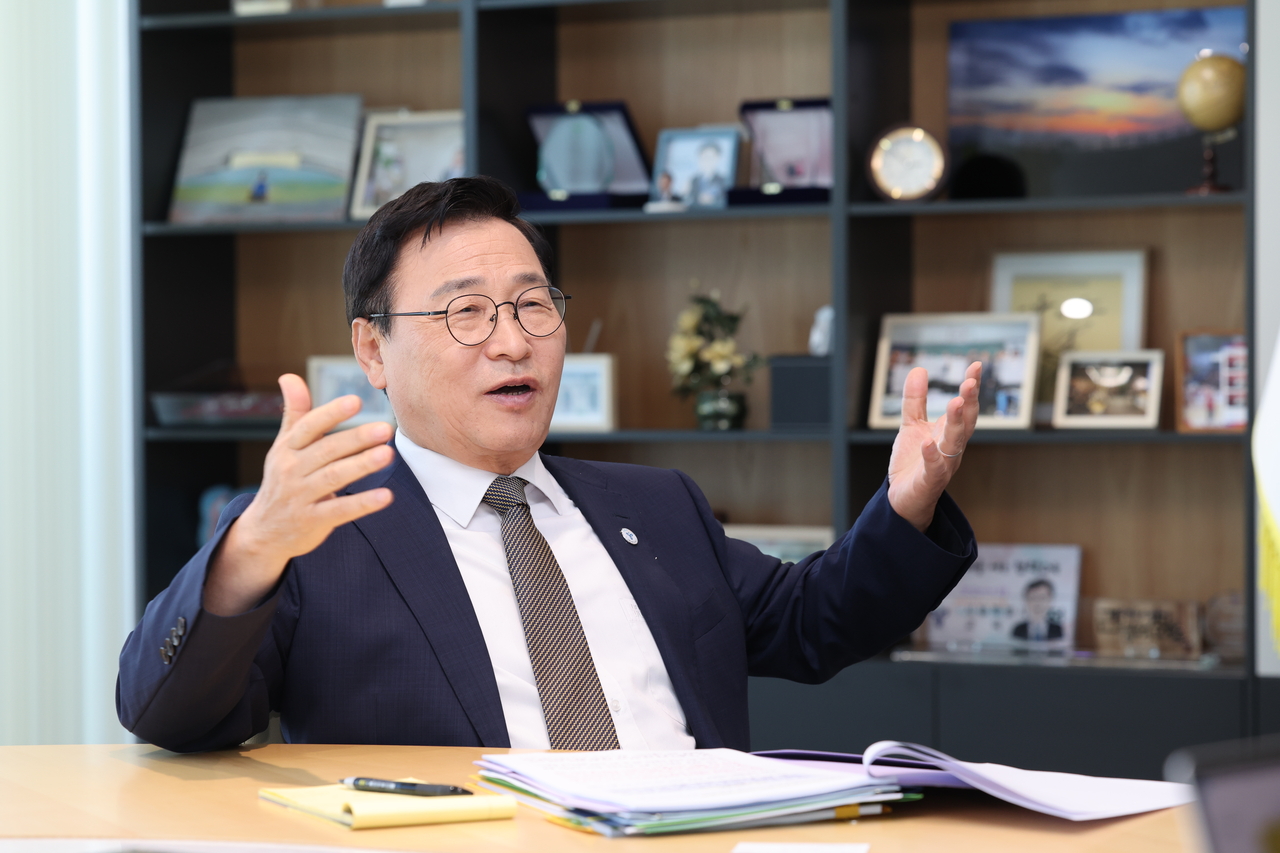
Seoul Superintendent of Education Jung Keun-sik said in an interview with The Herald Business that "if education funding becomes unstable, no other policy can be carried out properly," adding that he would "cut unnecessary spending but absolutely protect the legitimate resources children need."
Jung named stabilizing education funding as his top priority and outlined four main policy directions: guaranteeing a level starting point for every student through foundational learning policy, building a mental health support system spanning prevention through recovery, protecting teachers' educational activities, and transforming classroom instruction for the AI era.
The issue Jung said concerns him most is the planned overhaul of the local education grants system. The government is moving to scrap the formula that has linked grants to 20.79 percent of domestic tax revenue for 55 years, replacing it with a new calculation that factors in economic growth rates and changes in the school-age population.
Jung estimated that if the revised formula is applied, the Seoul Metropolitan Office of Education's grants would fall by about 2.7 trillion won ($2.02 billion) compared with the current system.
"The number of students in Seoul dropped 10 percent — from 825,503 in 2021 to 743,216 in 2025 — but the number of schools has remained essentially the same," Jung said. "You cannot assume that education funding needs fall at the same rate as student enrollment."
Upgrading aging school facilities is also urgent. Seoul has 3,234 education facility buildings that are more than 30 years old, and improving them over the next decade is estimated to cost about 23.3 trillion won. Of the 3.5 trillion won needed for facility improvements this year alone, only 1.2 trillion won was budgeted.
"If fiscal capacity shrinks, improvements to facilities students use every day — restrooms, windows, cafeteria ventilation — will inevitably be delayed," Jung said.
Foundational learning, mental health: expanding tailored student support
To close the education gap, the office plans to strengthen a support system tailored to each student's individual characteristics.
"Where a student lives or what kind of home they come from should not determine what they learn or what future they can have," Jung said. "Rather than providing the same education to every student, we need support that matches each child's level of development and individual traits."
To that end, the Seoul Learning Diagnosis and Growth Centers — currently operated by district education offices — will be expanded step by step to all 25 autonomous districts, and the number of specialist foundational-learning teachers and learning-support tutors will be increased. Starting in the 2027 school year, co-instructors will be placed first in first- and second-grade elementary school classes to prevent early learning gaps.
Mental health policy for students will also shift toward prevention. Students from first grade in elementary school through the final year of high school will receive at least 15 sessions of social-emotional education per year, and cooperation between professional counseling staff and local medical institutions will be strengthened.
In 2027, the office plans to fully launch the GRIP (emergency crisis response officer) system, designed to detect warning signs in high-risk students and intervene quickly. A mental recovery school — where students can receive treatment while continuing their studies — is also being prepared, with a target opening date of March 2028.
"What matters is not where a warning sign is spotted, but whether help begins the moment it is found," Jung said, stressing the need for a support system that connects schools, families and the community.
Protecting teachers' educational activities is another key priority. Jung said students can learn in a stable environment only when teachers are able to focus on teaching.
The Seoul Metropolitan Office of Education plans to establish a dedicated department for protecting educational activities at its main office and to reinforce response staff at district education offices.
The SEM119 emergency support team for educational activity protection, currently operating across 11 district education offices, has 551 members drawn from internal staff and outside specialists, providing legal support, psychological counseling and conflict mediation.
For cases involving infringement of educational activities, the office will expand its responsibility to cover the full range from initial conflict mediation to legal response and psychological recovery. Counseling support for teachers will be strengthened, and dedicated teacher-rights counselors will be placed at all 11 district education offices in stages.
"Students can learn in a stable environment only when teachers do not have to face difficulties alone," Jung said, pledging to build a system in which the education office takes responsibility for everything from prevention and response to healing and return.
Jung also emphasized the need to change how classes are taught and assessed in the age of AI. The faster knowledge and answers become accessible, he said, the more important it is for students to develop the ability to ask their own questions and make their own judgments.
The Seoul Metropolitan Office of Education plans to expand classes centered on questioning, inquiry and writing, and to strengthen essay- and short-answer-based assessments that examine students' thinking processes and growth.
Chaeum AI, the office's AI-based essay and short-answer assessment support system, will also be upgraded for full deployment in schools in 2027. The goal is to maintain teachers' assessment expertise while reducing the burden of grading and improving the fairness and objectivity of evaluations.
"The essence of education in the AI era lies not in dependence on technology but in building human agency," Jung said. "Students must develop the power to ask their own questions, pursue their own inquiries and express their own thoughts."
Jung added that he would "set the standard for basic education so that not a single student is left behind in learning, growth or safety," and that he would ensure "students, parents and school staff can actually feel the change — not just see policies being made."
7toy7@heraldcorp.com