Japan targets double shipbuilding output by 2035
Annual goal of 18 million gross tons
Japanese shipbuilding workforce down 15% in a decade
KOTRA facilitates $82 million in export consultations in Kobe
Japan's push to revive its shipbuilding industry — backed by 8.4 trillion won ($6.29 billion) in planned investment — is opening new market opportunities for South Korean marine equipment makers. With Japan aiming to double its annual vessel output, analysts say labor shortages and a weakened domestic parts supply chain are driving demand for cooperation with Korean firms.
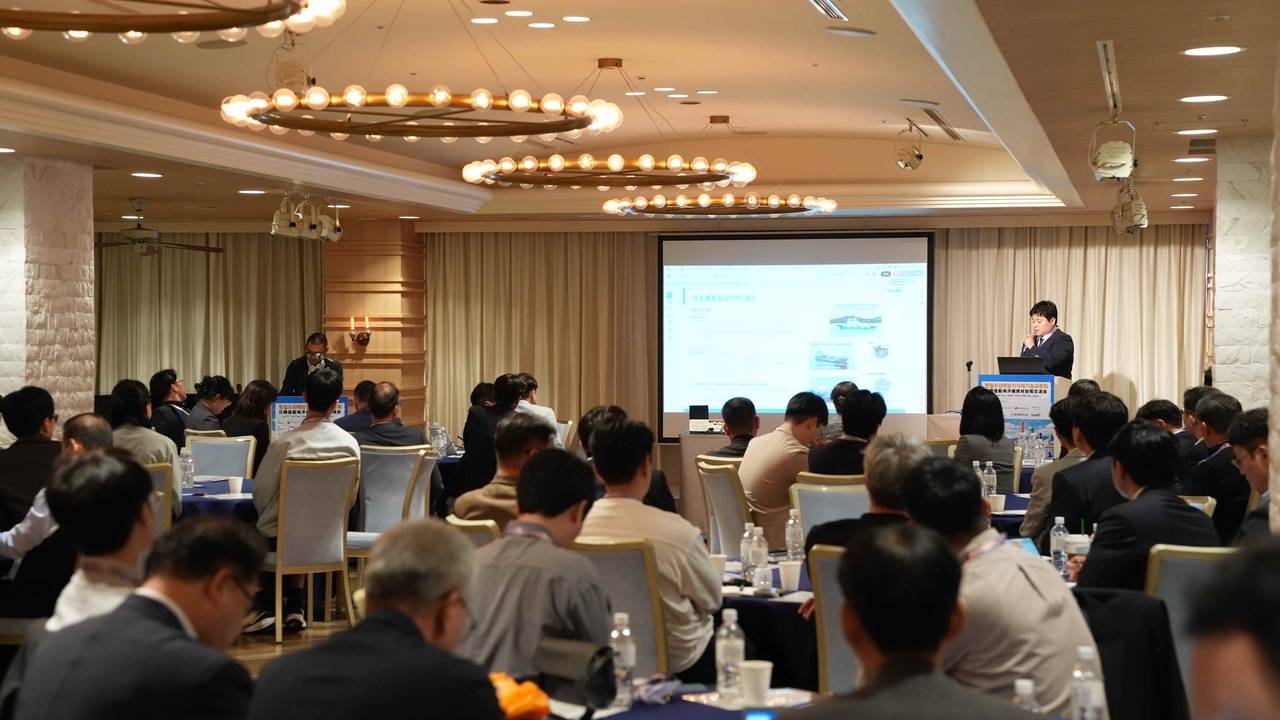
According to the Korea Trade-Investment Promotion Agency (KOTRA) on Monday, more than 40 South Korean marine equipment companies took part in the 2026 Korea-Japan Marine Equipment Technology Exchange, held over two days in Kobe, Japan, starting Tuesday. Some 55 representatives from Japanese shipyards, shipping companies and power equipment firms also attended, generating 167 export consultations worth $82 million in total. One MOU was also signed at the event.
The event was organized to help Korean equipment companies enter Japan's local supply chains, capitalizing on the country's expanding shipbuilding investment. KOTRA co-hosted it with the Busan Marine Equipment Industry Cooperative and the South Gyeongsang Province Marine Equipment Industry Cooperative.
Japan plans to invest 1 trillion yen ($6.34 billion) through a public-private partnership by 2035, raising annual shipbuilding output from roughly 9 million gross tons to 18 million gross tons. The country is also working to resume construction of LNG carriers, suspended since 2019.
To that end, the Japanese government has designated shipbuilding as one of 17 priority investment sectors and is accelerating the replacement of aging production facilities and the expansion of automated equipment. In September, the government approved eight investment plans under its "Shipbuilding Revival Fund," covering dock expansion, crane procurement and production automation. Total investment under those plans stands at around 900 billion yen, with government support capped at around 311 billion yen.
Securing the workforce and equipment needed to support the production expansion, however, remains a challenge. According to Japan's Ministry of Land, Infrastructure, Transport and Tourism, the number of workers in the domestic shipbuilding industry fell roughly 15 percent, from 91,000 in 2016 to 77,000 last year. Years of industry contraction have also eroded the domestic supply base for some critical equipment and components.
As a result, KOTRA said, Japanese shipbuilders are increasingly turning to Korean equipment suppliers, which have relatively stronger technological capabilities and delivery track records.
South Korea is also pursuing investment to boost shipbuilding productivity. On Oct. 12, the government and the shipbuilding industry announced a joint public-private plan to invest more than 1.4 trillion won by 2030 to apply AI to shipbuilding manufacturing processes. The initiative aims to extend automation technology beyond large shipyards to mid-sized builders and equipment suppliers as well.
At the Kobe event, KOTRA structured the consultations to encourage joint responses from Korean companies by sector. The four cooperation areas were eco-friendly propulsion and fuel systems, carbon neutrality and renewable energy, digital shipbuilding and smart vessels, and engines and land-based power generation equipment. The focus was not simply on showcasing individual companies' technologies, but on presenting the equipment and systems that actual shipyards require.
On the first day, Japanese experts in shipbuilding and finance briefed attendees on local market conditions, and companies from both countries discussed potential areas of cooperation. On the second day, leading Korean firms delivered technical presentations, followed by sector-by-sector consultations with Japanese shipyards and shipping companies.
Japanese buyers showed strong interest in alternative fuel supply systems for LNG, methanol and ammonia. On-board carbon capture and storage technology, as well as autonomous navigation and vessel monitoring systems, were also prominent topics. Inquiries about auxiliary marine engine equipment and power generation systems for data centers rounded out the discussions.
KOTRA plans to follow up by visiting shipyards in western Japan in November and December, focusing on cooperative projects identified during the consultations. Online follow-up meetings and company-specific support will run in parallel, with the aim of converting leads into actual supply contracts.
Kim Kwan-muk, KOTRA executive vice president and head of the Economic Security and Trade Cooperation Division, said Japan is accelerating the revival of its manufacturing industries — including semiconductors and shipbuilding — through public-private collaboration, and demand for cooperation with Korean parts, materials and equipment companies is growing. "We will do our utmost to identify concrete cooperation needs from Japanese companies and help Korean suppliers achieve new supply chain entry results," Kim said.
kwater@heraldcorp.com