Keynote address at Asia-Pacific German Business Conference
Merz highlights economic ties, joint ambitions in advanced industries
Cooperation to cover semiconductors, batteries and industrial AI
'Korea an impressive example of what free markets and technology can achieve'
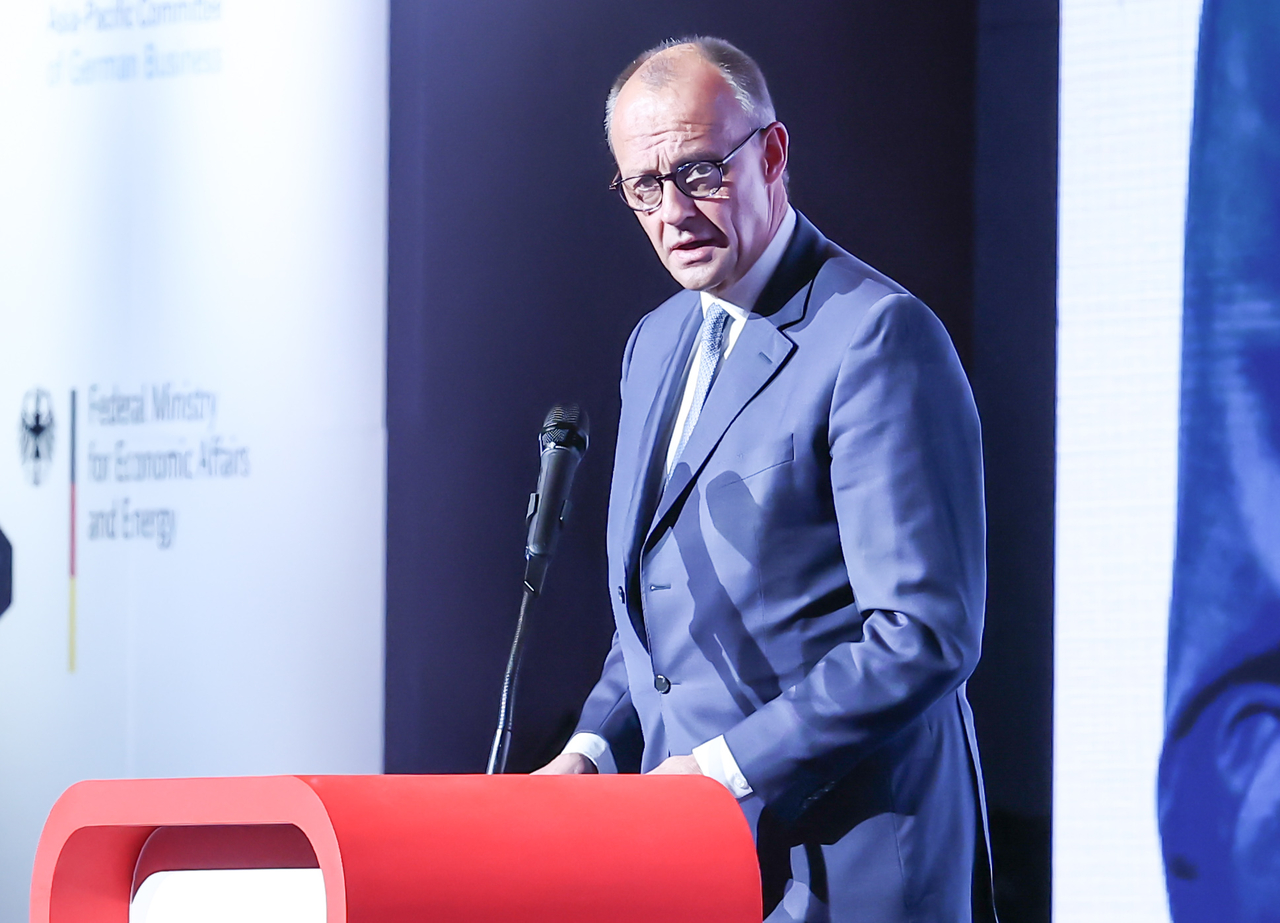
German Chancellor Friedrich Merz said South Korea and Germany would expand cooperation in advanced technology and jointly lead future industries.
Merz made the remarks in a keynote address at the 19th Asia-Pacific German Business Conference (APK 2026), held in Seoul on Friday, citing a joint declaration of intent on an economic and high-tech partnership framework signed by the two countries. "It contains a concrete cooperation roadmap covering next-generation industries such as microelectronics, industrial AI and robotics," Merz said. "We welcome every company that joins this transformation and will support them fully."
South Korea's Ministry of Trade, Industry and Energy and Germany's Federal Ministry for Economic Affairs and Energy signed the declaration on the sidelines of a bilateral summit, committing to expand cooperation in advanced industries — including semiconductors, batteries and industrial AI — as well as critical mineral supply chains. The two countries plan to strengthen ties in supply chain diversification and resilience, critical minerals and energy security, and to broaden the scope of cooperation into advanced technology and future industries.
Merz also praised South Korea's industrial competitiveness. "Korea is an impressive example of what can be achieved when a free-market economy, outstanding technological capability and political will come together," Merz said. "It has grown into a globally respected advanced-industry democracy."
Merz identified the structural similarities between the two countries' industrial bases as a key opportunity for deeper cooperation. "The structural similarities between our two industries offer an excellent opportunity to strengthen our partnership," Merz said.
Merz described Germany's engineering expertise and its specialized small and medium-sized enterprises as complementary to the digital innovation capabilities of South Korea and the broader Indo-Pacific region. "AI will be a decisive factor in determining future competitiveness," Merz said, adding that AI requires not only innovation but also advanced chips, raw materials and stable energy at reasonable prices.
Merz also stressed the need to diversify supply chains in response to shifts in the global trade environment, calling for de-risking — reducing excessive dependence on any single country. "Diversification is the key. Our goal is to preserve our economic strength, stability and freedom of action," Merz said.
Merz was careful to distinguish de-risking from decoupling. "This is by no means decoupling," Merz said. "On the contrary, those who pursue decoupling will lose their security, capacity for innovation, prosperity and freedom of action."
Merz said Russia's invasion of Ukraine, rising tensions in the Middle East and intensifying US-China competition were all placing strain on global supply chains, making it necessary to build fair cooperative relationships in critical raw materials and technology while reducing dependence on specific sectors.
Merz called on the international community to work together to uphold the rules-based trading order, proposing a strengthening of the World Trade Organization framework and a coordinated response. "The international community must unite to defend a rules-based trade order," Merz said.
"Germany and the Indo-Pacific region have much to offer each other economically," Merz added. "We will work with like-minded countries that share our values to protect a free and fair trading order."
boo@heraldcorp.com