128 birdwatchers survey 20 km of coastline in August and September; 12 rare species totaling about 10,800 individuals observed
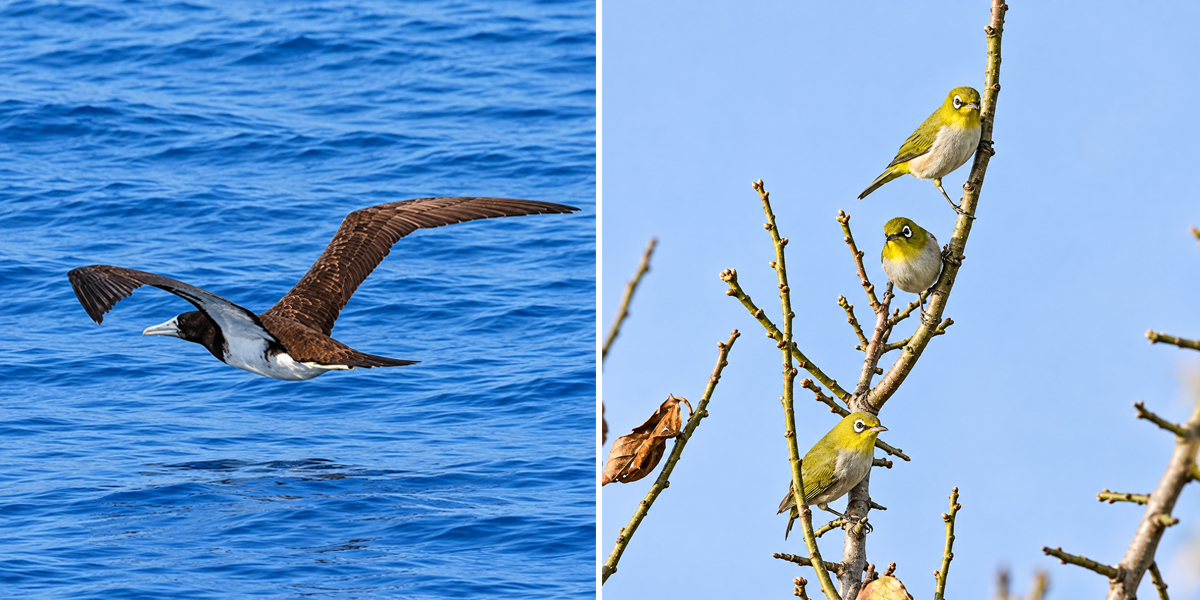
The coast of Daewangam Park in Ulsan's Dong-gu and the waters off its shore have been confirmed as a key stopover on the migration routes of rare bird species from around the world.
Ulsan city said 128 birdwatchers from across the country — members of the Ulsan bird-watching group Jjaekjjaek Hyugeso and bird correspondents — conducted eight rounds of surveys between August and September within 20 kilometers of Daewangam Park and the surrounding maritime area, observing 10,824 individual birds across 12 species.
The most frequently observed species was the streaked shearwater, a web-footed seabird, with 9,626 individuals counted. It was followed by the red-necked phalarope at 846, the common tern at 264, the Aleutian tern at 39, the storm petrel at 24, the Japanese white-eye at 14 and the rhinoceros auklet at 4. Three species of skua — the Arctic skua, the long-tailed skua and the pomarine skua — were also recorded.
The rhinoceros auklet is a natural monument and a Class II endangered wild species, and along with the Aleutian tern is classified as Vulnerable on the International Union for Conservation of Nature (IUCN) Red List. The streaked shearwater and the storm petrel are listed as Near Threatened on the same list.
The Japanese white-eye, typically observed on islands along the west coast, was also spotted, as was a juvenile rosy starling — a species that breeds from eastern Europe to northwestern China and winters in India and Sri Lanka. The rosy starling is a rare vagrant in South Korea, with only scattered records since it was first documented in Yangsu-ri, Gyeonggi Province in 2000.
On Aug. 2, a single brown booby — a species native to tropical and subtropical waters of the Pacific, Indian and Atlantic oceans — was observed in the East Sea off Daewangam Park. The bird is a rare vagrant that has only occasionally been recorded in South Korea since its first domestic sighting on Hongdo Island in Tongyeong, South Gyeongsang Province in 1986, with subsequent records limited to Gageodo Island in Sinan, South Jeolla Province, Jeju Island and Haeundae in Busan.
Hong Seung-min, head of Jjaekjjaek Hyugeso, said the sighting of a brown booby — a species that lives in tropical and subtropical seas — "indirectly reflects climate change, including rising sea surface temperatures." Hong added that the first-ever observations in Ulsan of the Japanese white-eye and the rosy starling, which arrived on strong winds during the chuseok holiday, "demonstrate that the Daewangam Park coastline occupies an important position as a stopover for migratory birds."
cityblue@heraldcorp.com