South Korea plans to shorten its stock settlement cycle from two days after a trade (T+2) to one day (T+1) starting in 2028, securities industry bodies announced Monday. The market had previously discussed a possible October 2027 launch to align with Europe, but the timeline was pushed back after foreign investors raised repeated concerns, with authorities opting to allow more preparation time.
Korea Exchange, the Korea Securities Depository, Korea Securities Finance and the Korea Financial Investment Association jointly released a draft roadmap for the settlement cycle change.
The overhaul — the first since the T+2 settlement system was introduced in 1972 — calls for completing an upgrade of the clearing and settlement infrastructure by October next year, conducting at least six months of industry-wide integrated testing, and making the final switch sometime in 2028.
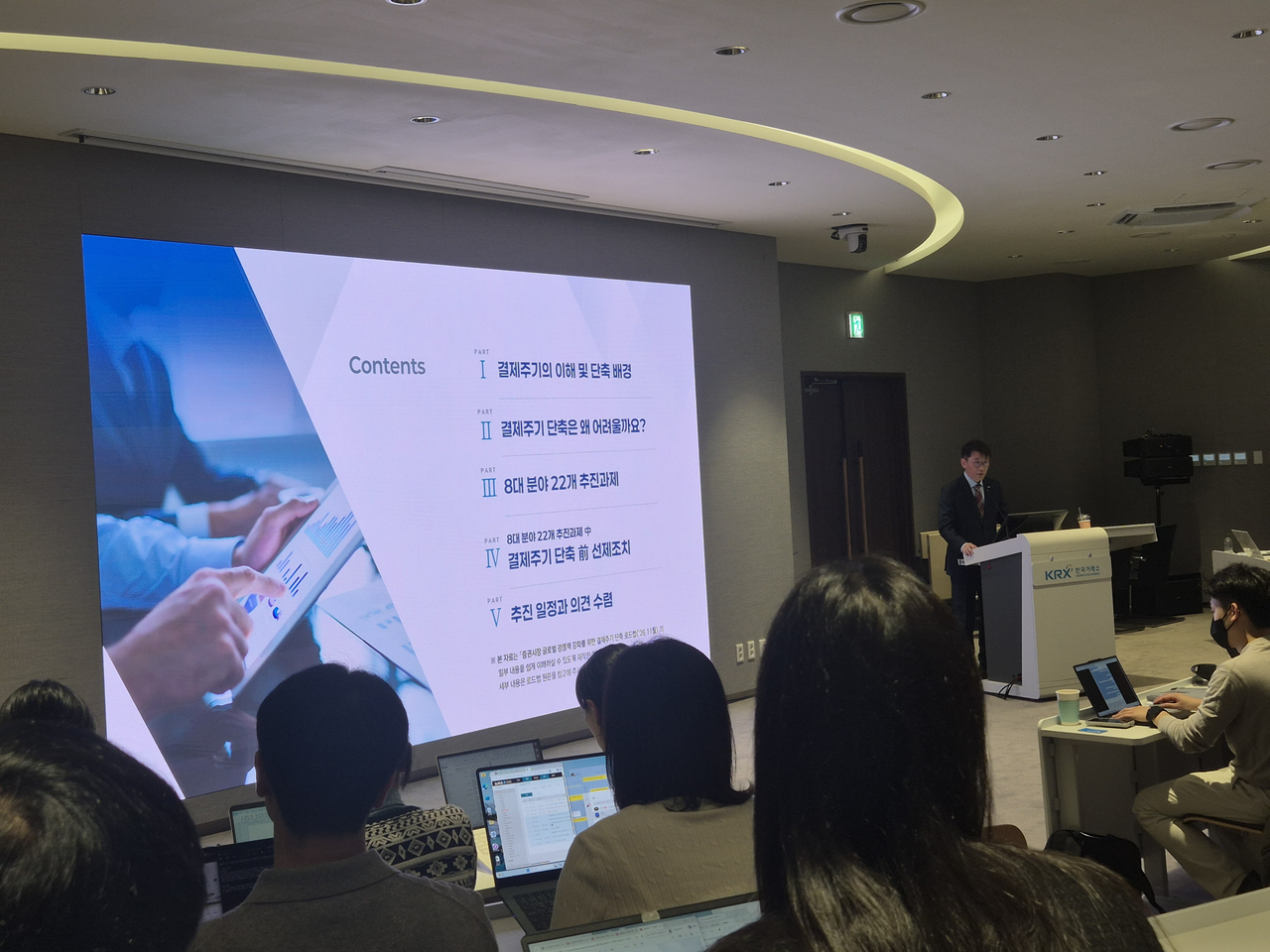
Park Sang-wook, head of Korea Exchange's clearing and settlement division, said the target timeline was set after consulting working groups of major brokerages and related bodies, surveying foreign investors and reviewing overseas cases. "The readiness of more than 600 financial institutions varies widely, so it is difficult to fix a specific launch date at this point," Park said at the forum. "But we felt it was necessary to give the industry a visible target."
The most decisive factor behind the 2028 target was concern from foreign investors, who account for 38.9 percent of the domestic stock market's total market capitalization as of the first half of this year. In a survey of 32 global market participants conducted by the securities bodies, 33.3 percent said they would reduce their exposure to the Korean market if the switch to T+1 were made without sufficient preparation. In addition, 53.2 percent of respondents said they needed at least 18 months to prepare, and 84.4 percent said they preferred a launch date in the second half of 2028 or later.
However, Park said the earlier survey was not designed to capture country-by-country investment volumes or detailed breakdowns from the overseas institutions that flagged insufficient readiness. "We plan to gather the necessary information through public hearings and additional surveys going forward," he added.
Foreign investors' wariness about a faster timeline stems from time-zone differences and the multi-layered nature of cross-border settlement. When the Korean stock market closes — at 8 p.m., including the after-hours session — it is still before business hours in New York, meaning a shift to T+1 would sharply compress the window available for processing transactions.
Concerns were also raised about the operational burden on foreign investors, who typically pass through 10 or more steps involving multiple overseas and domestic custodian banks. A T+1 cycle could require them to set up overnight desks dedicated to the Korean market, while a surge in demand for won conversion could create liquidity shortfalls.
Hong Kong's decision to delay its own T+1 transition target from the second half of 2027 to the second half of 2028 also influenced the schedule adjustment, as Hong Kong is a major Asian market.
On whether Asian markets could coordinate a joint transition, Park said cooperation was harder in Asia than in the United States or Europe. "The US and Europe either have strong inter-market linkages or operate within an economic community, which makes joint action easier," he said. "In Asia, legal frameworks and market structures differ by country, making it difficult to align interests."
The domestic financial industry's need for adequate preparation time was also taken into account. Experts noted that South Korea's settlement failure rate is effectively zero — far below the 2 to 3 percent seen in the United States and 7.14 percent in Europe — and that maintaining that level of stability would require meticulous advance checks.
On the cost of building the necessary systems, Park said a full industry-wide estimate was not possible given the varying IT capabilities and overnight staffing costs across institutions. "The picture will become clearer in the middle to second half of next year, when development requirements are finalized," he said, adding that each financial institution would be responsible for its own preparation costs and that no shared cost-allocation framework was being established.
The shift to T+1 will bring notable changes for retail investors as well. The order process for buying and selling shares will remain the same, but the actual transfer of cash and securities will happen one day sooner. Sellers will receive their proceeds the day after a trade (T+1) and can withdraw and use the funds a day earlier than before. Buyers, on the other hand, will need to pay one day sooner, and the point at which a forced liquidation is triggered for late payment will also move up by a day. The deadline for purchasing shares to qualify for dividends, rights offerings and other entitlements will shift from two days before the record date to the day immediately before it.
Even before the 2028 transition, retail investors will be able to access their sale proceeds early through a new low- to mid-interest loan product backed by sale proceeds, to be launched ahead of the full switch. Korea Securities Finance will supply funds to brokerages at the rate applied to deposited customer funds, bringing the loan rate down to the mid-to-high 5 percent range from the previous 7.5 to 10 percent (as of end-June). The product launched Monday at Mirae Asset Securities and will roll out sequentially at other participating brokerages, including Kiwoom Securities on Nov. 20.
Park stressed the importance of thorough integrated testing before the final launch. "With a payment and settlement system connecting more than 600 financial institutions, we need to verify through integrated testing that everything works in practice even after all institutions have completed their development," he said. "The United States ran multiple rounds of integrated testing, and we plan to do the same here for at least six months before deciding on the final launch date."

jiyun@heraldcorp.com
hajun825@heraldcorp.com