Mindan Yokohama branch teams up with BIFAN for two-day AI filmmaking program spanning generations and languages
"Please put the Korean and Japanese title, and the director's name, on the first screen."
That was the final instruction given to participants as they wrapped up editing at an AI filmmaking workshop in Yokohama, Japan, on Sunday. The name to appear at the start of each film was their own — the person who had spent two days conceiving a story and building each scene. It was the moment Zainichi Korean children who had grown up watching movies became the credited directors of their own one-minute AI films.
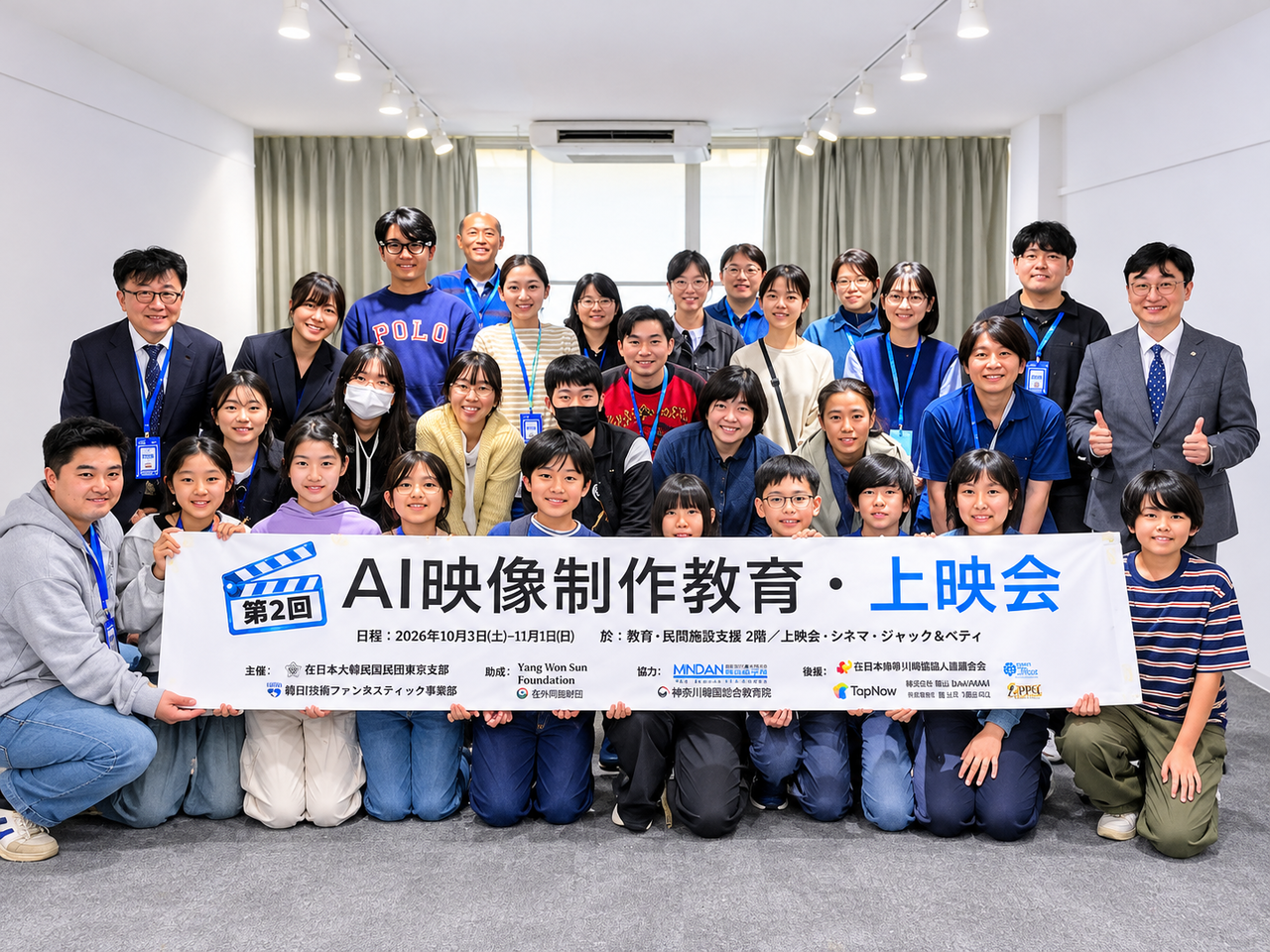
The program, held Saturday through Sunday, was organized by the Korean Residents Union in Japan's Kanagawa Prefecture Yokohama branch in partnership with the Bucheon International Fantastic Film Festival (BIFAN). Twenty-two participants ranging from young students to adults completed the course. They used AI tools to turn their own stories into short films, then screened the finished works together at a neighborhood movie theater near the venue.
Hands-on creation was at the heart of the event. The program went beyond explaining AI capabilities or demonstrating results. Participants chose a story they wanted to tell, planned the scenes they needed, and worked through the full process of assembling them into a short film.
For the children and teenagers, a one-minute film was a first step in translating imagination into a concrete finished work. Within that brief running time, they had to decide what story to tell, what to show first, and how to end it. Even with AI tools to assist, the participants themselves drove every creative decision.
On the first day, BIFAN Executive Director Shin Cheol delivered a lecture, followed by a hands-on AI filmmaking session led by director Bae Jun-won. Participants explored how AI has changed the filmmaking landscape and took part in practical exercises using production tools to bring their stories to the screen.
The possibilities introduced in the lecture fed directly into the production experience. As participants translated their ideas into footage, they learned how to use AI tools in practice — moving from instruction to creation and gradually completing their individual works.
On the second day, participants finished their films after a follow-up session and then screened them for an audience. The final goal of the program was not simply to complete the editing. It extended to sharing the finished films with others and watching them together.
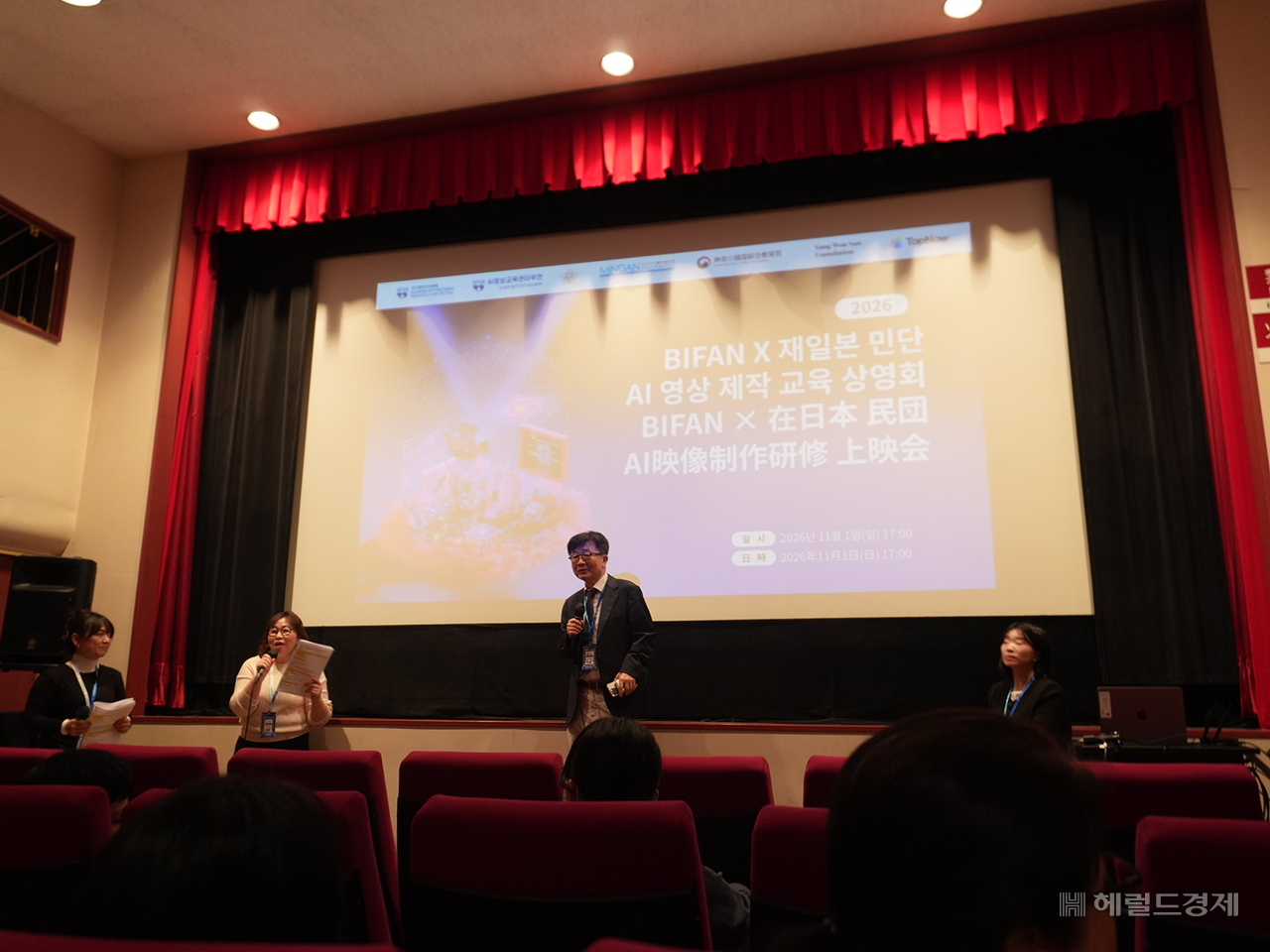
The 22 graduates' films screened at a neighborhood movie theater near the workshop venue. The short clips that had existed only on individual screens were now projected before an audience. Participants watched their own films from the seats, then stayed to see what their fellow graduates had made.
The screening and graduation ceremony were attended by No Jun-seo, deputy consul at the Consulate General of the Republic of Korea in Yokohama, Park Seon-yeong, director of the Kanagawa Korean General Education Center, Ju Myeong-hui, chair of the Kanagawa Korean Association, and officials and members of the Mindan Yokohama branch. In front of the local Korean community, participants presented works bearing their own names and brought the two-day program to a close.
The combination of production training and an actual theater screening drew a strong response from participants and the wider community. For the graduates, it was a chance to present their work to a real audience; for the Korean community, it was an occasion to witness and celebrate the creative output of local children, teenagers and other members.
For the younger participants in particular, the theater screening gave the production experience a broader meaning. They had not only seen their own stories through to completion — they had gone through the full process of sharing them with others. Two days of learning had become a finished film, and the community had gathered to watch it together.
Lead instructor Bae highlighted the mix of generations and backgrounds in the room as a defining feature of the workshop.
"It was meaningful that people from a wide range of occupations, environments and age groups — not just one particular field — came together to talk and create," Bae said. "It was a rare and valuable opportunity."
As Bae described, the program brought together not only professional creators but also students and adults, each translating their own story into film. The fact that people of different ages and life circumstances shared the same production process and exchanged their finished works added further significance to the event.
Bae, who has also run classes for elementary school students in South Korea, said the enthusiasm of the younger participants stood out. "Regardless of nationality, I felt that everyone had strong passion," Bae said.
Concerns about the language barrier proved smaller than expected once the workshop was underway. "There were things I worried about at the start, but ultimately the language of film and the language of creation are the same, even when spoken languages differ," Bae said. "The participants followed along remarkably well."
In a room where Korean and Japanese flowed back and forth, all participants shared the same goal: to shape their story into scenes, connect those scenes, and show the result to others. The final step of writing each film's title and director's name in both languages captured the spirit of the workshop.
The Mindan Yokohama branch was the driving force that connected the program to the local Korean community. It turned discussions about bringing BIFAN's accumulated education experience to Japan into an actual project, and worked to ensure local participants had access to the training.
The Yokohama branch sought support from the Mindan Kanagawa Prefectural Headquarters to secure funding for the program. Budget support channeled through the prefectural headquarters from the Overseas Koreans Agency, combined with contributions from Mindan members, underpinned the local workshop.
Yu Seon-yu, general affairs section chief of the Yokohama branch, helped identify the community's educational needs, coordinate support from the prefectural headquarters and members, and create opportunities for children and teenagers to take part. The result was a structure in which a local branch identified demand, connected it to a specialist organization, and had the Korean community back it up.
The workshop carried added significance as a model of cultural exchange: using cutting-edge AI technology as a bridge, participants from both Korea and Japan created films together across linguistic and national boundaries. The Mindan Yokohama branch said it believed the program had demonstrated "a new, forward-looking model of two-way cultural exchange through joint creative participation by Korean and Japanese participants," and pledged that the branch would continue to serve as "an open space that goes beyond being simply a Zainichi Korean organization — one that creates new arenas for cultural exchange together with local residents."
Jo Yang-il, BIFAN's AI specialist committee member, said the program had not started with funding in place. "It was a difficult beginning because the budget was not there from the outset," Jo said. "Building on last year's challenges, we prepared more and put in greater effort this year."
The expanded program hours provided a stronger foundation for hands-on production. Participants had more time to learn new tools and develop their stories into finished films — the result of refining the local curriculum based on the previous year's experience.
BIFAN's AI education team brought its accumulated experience in screen education to the Yokohama workshop. Drawing on its work with emerging visual technologies including virtual reality, the team has developed an AI curriculum that goes beyond teaching tool mechanics, placing emphasis on supporting creators in completing their own works.
Lead instructor Bae won an award in BIFAN's AI international competition section in 2024 and completed the AI+XR workshop at the AI Video Education Center Bucheon last year. This year, Bae joined the Yokohama program as the instructor guiding Zainichi Korean participants through the production of their own films.
When the two days ended, each of the 22 graduates was left with a one-minute film carrying their own name. It was the product of conceiving a story, building scenes and presenting the finished work to an audience — a process they had lived from start to finish. The neighborhood theater screening became both a way to share that learning with the community and a stage on which Zainichi Korean children discovered what they were capable of creating.
sjkim@heraldcorp.com