Free cash flow at major US technology companies has swung to a large deficit within a year, driven by a surge in AI capital spending, and analysts warn the shortfall could reach an all-time high next year. Securities industry analysts say the impact on South Korean chipmakers such as Samsung Electronics and SK hynix should remain limited, as AI infrastructure demand stays solid and Big Tech capital expenditure continues.
Earnings disclosures released Monday show that Amazon, Alphabet, Meta and Microsoft posted a combined free cash flow deficit of about $26 billion in the third quarter of this year — a swing of roughly $88 billion from a surplus of about $62 billion in the same period last year. Three of the four companies fell into negative free cash flow territory, with Microsoft the sole exception.
Free cash flow measures the cash a company generates from operations after subtracting capital expenditure and similar outlays. It is a key indicator of a company's ability to generate cash and fund future investment.
The primary driver of the deterioration is the rapid expansion of AI infrastructure spending. The four companies' combined operating cash flow rose 10.4 percent year-on-year in the third quarter, but capital expenditure jumped 107.8 percent over the same period. Investment is growing more than twice as fast as cash generation, sharply compressing free cash flow.
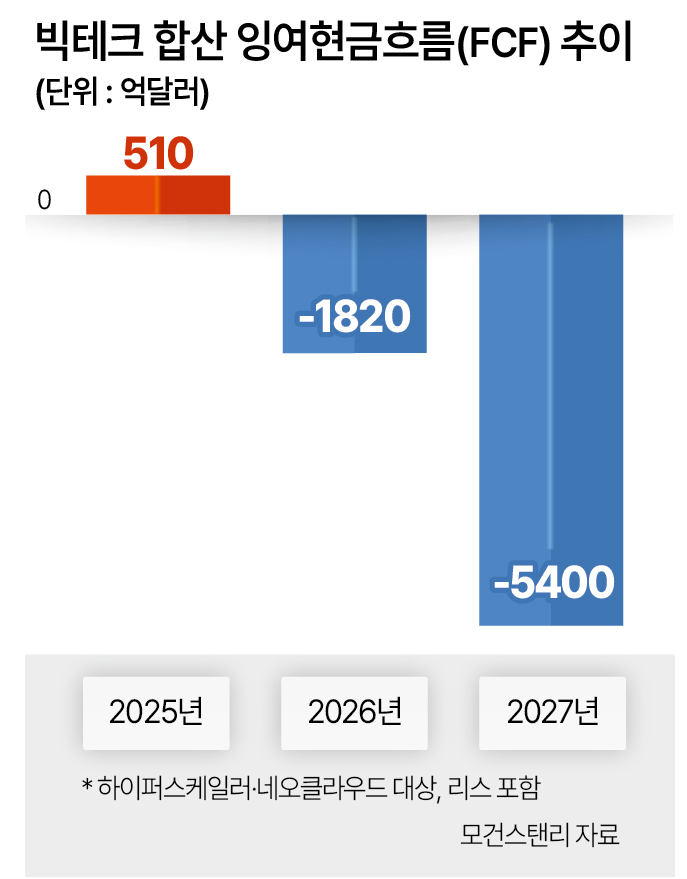
The outlook points to further deterioration. According to Morgan Stanley, the combined free cash flow of hyperscalers and neo-cloud companies is projected to reach a deficit of $540 billion next year, including lease costs. The bank estimated that free cash flow, which was in surplus last year, swung to a deficit of $182 billion this year and will hit a record shortfall next year.
"The cash flow burden from growing AI infrastructure demand and large-scale capital expenditure can appear simultaneously," said Kang Jae-gu, a researcher at Hana Securities. "Major cloud providers are sustaining massive capital spending, but it takes time before that investment translates into actual sales and profit."
Concern over the profitability of AI investment sent all three major New York stock indexes lower. On Friday (local time), the Dow Jones Industrial Average fell 1.09 percent and the S&P 500 dropped 1.82 percent. The tech-heavy Nasdaq Composite slid 2.86 percent.
Semiconductor stocks led the decline, with the Philadelphia Semiconductor Index tumbling 7.20 percent. Intel collapsed 28.58 percent after its fourth-quarter earnings outlook and cash flow burden fell short of market expectations. AMD (-10.88 percent), Micron (-5.30 percent) and Nvidia (-4.22 percent) also fell sharply.
"Following Alphabet's earnings miss and worsening free cash flow, Amazon's results and Intel's forward revenue guidance also fell short of expectations, raising concern over the sustainability of AI-related demand," said Yang Hyeon-gyeong, a researcher at iM Securities. "Concerns have grown that customers' investment burden could weigh on future orders and profit growth at domestic memory chip companies, as well as their shareholder return plans."
The deterioration in Big Tech cash flow poses a risk to South Korean chipmakers including Samsung Electronics and SK hynix. If financing pressure from expanded AI investment mounts, Big Tech could slow the pace of capital spending. Demand for HBM and server DRAM has jumped as global technology giants — the primary customers of both companies — have ramped up AI infrastructure investment.
Analysts at South Korean brokerages broadly agree that concerns about AI industry growth are overblown. Seo Sang-young, a managing director at Mirae Asset Securities, said the recent market pullback reflects "a reassessment of whether companies can absorb enormous investment costs and how quickly they can convert that spending into profit, rather than doubt about the industry's growth potential — given that underlying AI demand itself remains solid."
Ko Young-min, a researcher at Korea Investment Securities, said one common thread running through the earnings releases from Meta, Google, Microsoft and Amazon — with Microsoft as the exception — is that negative free cash flow has widened compared with before. "Even so, every single one of them is saying they will keep investing," Ko said.
Ko added that the results "once again showed that this is clearly not the moment to genuinely worry about their investment." Analysts broadly conclude that deteriorating Big Tech cash flow is unlikely to translate into an immediate pullback in capital spending, and that memory chip demand will hold up.
AI companies' cash generation capacity is expected to remain a key variable shaping share price performance going forward. "Differentiation will likely persist between companies with strong internal cash generation, those heavily reliant on borrowing, and semiconductor and network companies where actual demand is confirmed," Seo said. Seo added that "whether interest rates and AI-related credit spreads stabilize simultaneously will be an important benchmark for judging the sustainability of any rebound in technology stocks."

moon@heraldcorp.com