- Tomocube signs research application agreement with US university
- Alteogen and four other firms to seek overseas partnerships
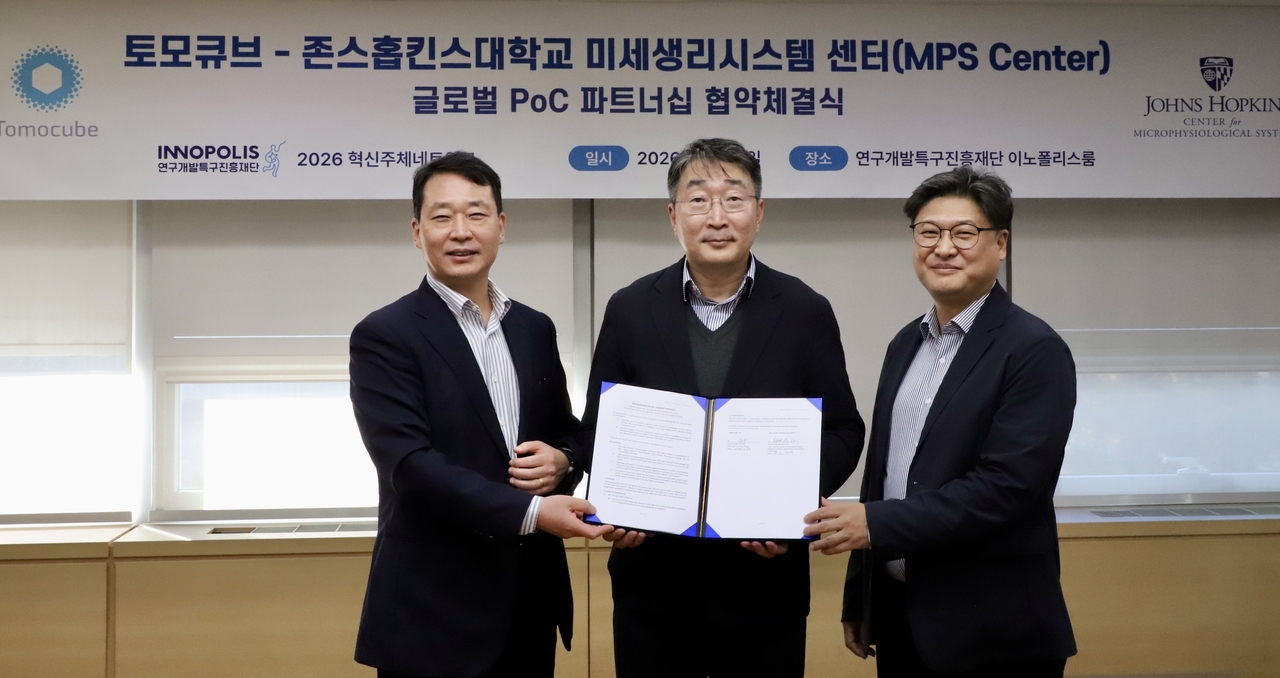
Advanced biotech technology developed in the Daedeok Research and Development Special Zone is set to be validated at Johns Hopkins University in the United States. Collaboration between domestic biotech firms and world-class research institutions is moving beyond simple technology exchange into on-site proof-of-concept testing, a shift expected to accelerate their entry into global markets.
The Daedeok R&D Special Zone office of the Korea Research Institute of Science and Technology Promotion announced Monday that Tomocube, a biotech company, and the Johns Hopkins Center for Microphysiological Systems had signed an MOU to conduct a global technology proof-of-concept.
The agreement is a result of the Daedeok Special Zone's "Innovation Network Project," a program that connects government-funded research institutes, universities and companies within the zone with overseas innovation institutions to support joint research and technology commercialization.
This year, the Daedeok Special Zone office partnered with the Johns Hopkins Global Biotechnology Innovation Center to run 16 online and in-person consultations. Through the process, 10 companies and four government-funded research institutes in the zone shared their technology and research needs with overseas researchers and explored possibilities for joint research.
The collaboration between Tomocube and the Johns Hopkins Center for Microphysiological Systems advanced to actual technology validation.
The two institutions plan to apply Tomocube's holotomography technology to research at the US site and jointly verify its potential applications.
Holotomography is an advanced imaging technology that enables three-dimensional observation and quantitative analysis of living cells and tissue without causing damage. It allows researchers to analyze minute internal structures and changes within cells in three dimensions, making it useful in biotech research.
The validation is significant in that it tests a domestic company's technology within the actual research environment of an overseas institution. It is expected to lay the groundwork for expanded joint research and overseas technology commercialization.
The Daedeok Special Zone office is also moving to broaden global biotech cooperation. It will host a "Global Biotech Partnership Showcase" at 2 p.m. on Nov. 16 at the Daejeon Science Complex.
The event will bring together five overseas experts, including researchers from Johns Hopkins, and five Daedeok Special Zone biotech companies — Alteogen, Thor Therapeutics, Medicos Biotech, Ingenium Therapeutics and Bio Orchestra.
Participating companies plan to present core technologies in biopharmaceuticals, therapeutics, biomaterials, cell-based technologies and RNA treatments, and explore possibilities for joint research and technology validation with overseas researchers.
"Global technology cooperation begins not with a simple meeting between institutions, but through a process of understanding each other's technologies and needs and identifying concrete areas for collaboration," said Im Moon-taek, head of the Daedeok Special Zone office. "We will continue to support cooperation among domestic and international innovation actors so that the Daedeok Special Zone can grow into a global open deep tech commercialization hub."
nbgkoo@heraldcorp.com