Full-time hiring goal only 67% met through September; experience-only internships up 5%
Fixed-term workers rise by 5,040 — more than double the gain in permanent headcount
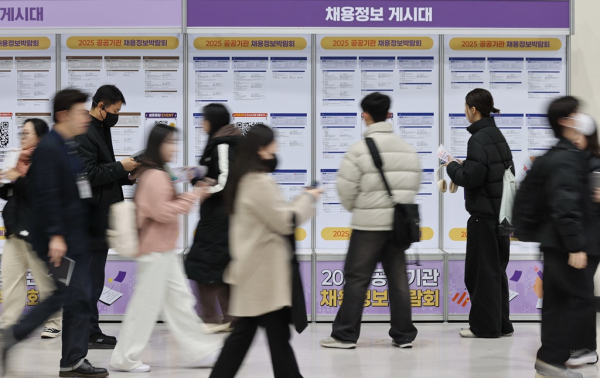
As youth unemployment drags on, hiring-track internships at public institutions — widely regarded as a pathway to permanent employment — fell more than 37% in a single year. Meanwhile, experience-only internships and fixed-term workers both increased, raising concerns that public institutions are shifting toward short-term work exposure rather than creating genuine routes to full-time jobs.
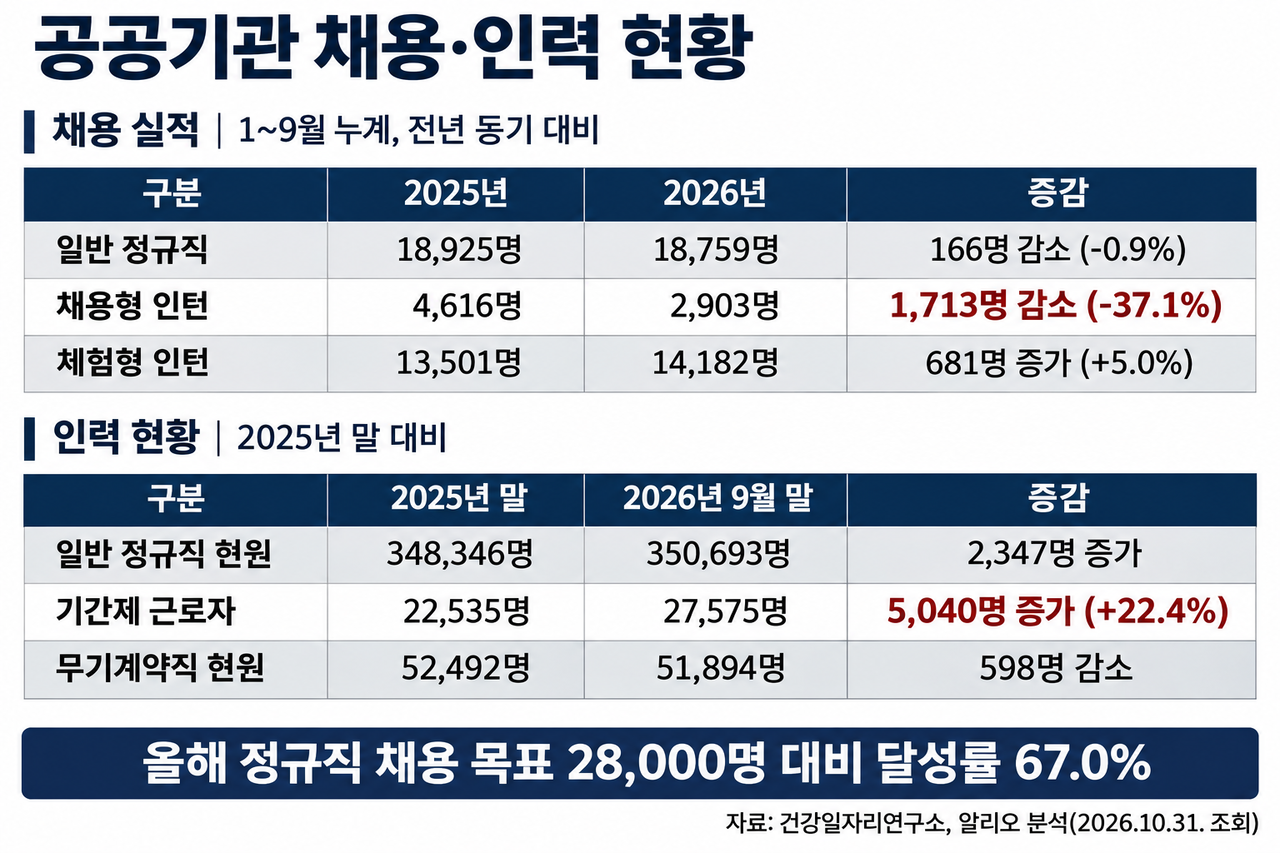
According to an analysis of public institution hiring data through the end of September 2026, obtained by The Herald Business, hiring-track interns at public institutions totaled 2,903 from January through September this year — down 1,713, or 37.1%, from 4,616 in the same period last year. The figures were compiled by Ha Tae-wook, head of the Health and Jobs Research Institute, using hiring and workforce data disclosed on Alio, the public institution management information system.
Hiring-track internships are positions in which participants work for a set period and, after evaluation, convert to permanent employment. The institute noted that because there is a time lag between an internship and the resulting permanent hire, the sharp drop in hiring-track interns could weigh on the scale of permanent recruitment going forward.
By contrast, experience-only internships — which carry no guarantee of conversion to permanent employment — rose by 681, or 5.0%, to 14,182 from 13,501 over the same period.
The shift comes as youth employment continues to deteriorate. According to the Ministry of Statistics, the number of employed people aged 15 to 29 fell by 147,000 in September compared with the same month a year earlier, marking 47 consecutive months of decline. The youth employment rate also fell 1.1 percentage points to 44.0%.
General permanent hiring at public institutions from January through September reached 18,759 — down 166, or 0.9%, from the same period last year. Youth hires among that group, however, edged up by 69 to 16,462, lifting the youth share of total permanent hiring from 86.6% to 87.8%. While permanent youth hiring posted a modest gain, hiring-track internships — which feed future permanent positions — fell sharply.
Meeting the government's annual permanent hiring target of 28,000 is also looking difficult. The achievement rate stood at 67.0% as of the end of September, meaning institutions would need to hire an additional 9,241 people in the fourth quarter. That is 977 more than the 8,264 fourth-quarter hires implied by last year's gap between the full-year and end-of-September figures. The institute said the annual target would likely be missed at the current pace.
Within the workforce, the growth in fixed-term workers stood out. Fixed-term employees reached 27,575 as of the end of September — up 5,040, or 22.4%, from the end of last year. That increase was more than double the 2,347 gain in permanent headcount over the same period. Workers classified outside the direct payroll — including dispatched, outsourced and in-house subcontracted staff — and subsidiary employees also rose by 937 and 672, respectively.
The data also revealed that expansions in permanent headcount ceilings have not translated into sufficient actual hiring. The authorized permanent headcount stood at 373,233 at the end of September, up 5,137 from the end of last year, but the actual headcount of 350,693 grew by less than half that amount. The gap between authorized and actual headcount was 22,540, putting the vacancy rate at 6.0%. The actual headcount of indefinite-contract workers fell by 598 from the end of last year to 51,894, with a vacancy rate of 11.3%.
The institute recommended expanding public social service staffing and improving the system for filling positions left vacant by parental and other leave. "Permanent replacement hiring should be allowed for employees on parental leave of less than three months and those on infertility treatment leave, and the gap between authorized and actual indefinite-contract headcount should be used to increase permanent positions," Ha said. "The hiring-track internship system needs to be overhauled, and the weight given to job creation in public institution management evaluations should be raised."
fact0514@heraldcorp.com