Analysis of 11 completed transfers from Aug.–Oct. finds 5 used seller financing; mortgage ceiling amounts range from 2 billion to 6 billion won
Young doctors and entertainers — high earners we call 'young rich' — often use seller financing to buy. Even when the loan runs into the billions of won, they have the income to cover the interest.
— Head of Real Estate Agency A in Apgujeong-dong, Gangnam-gu, Seoul
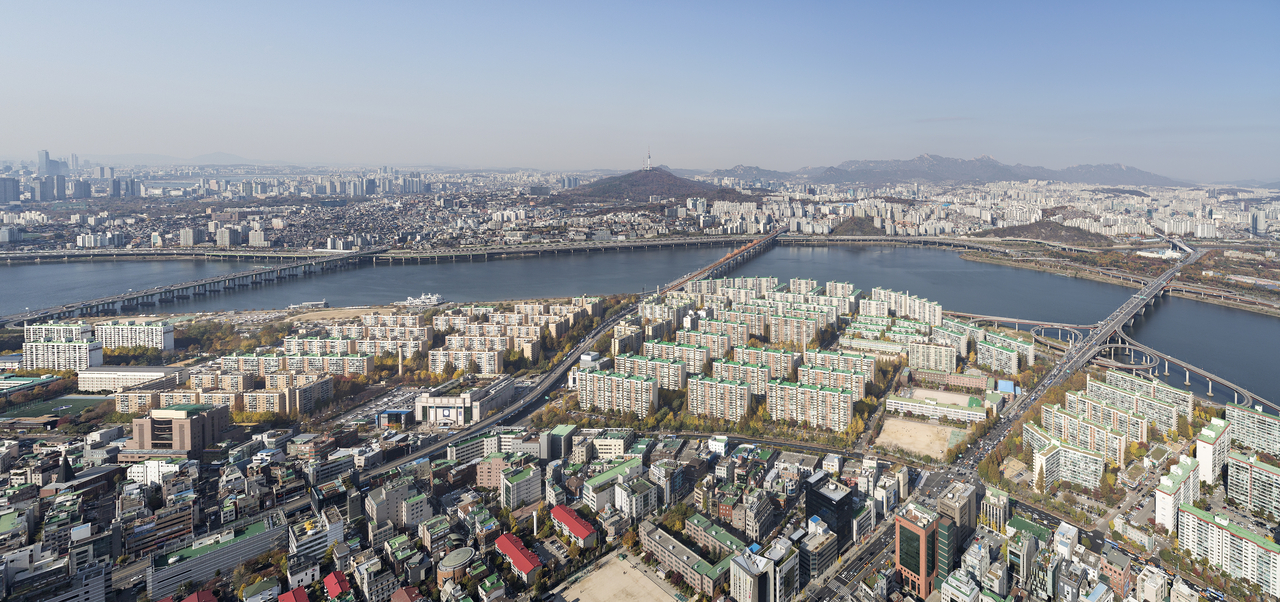
As the government tightens lending restrictions, seller financing — borrowing directly from the seller to fund a home purchase — is on the rise in the premium housing markets of Gangnam and Seocho. In the Apgujeong area, where transaction prices routinely reach 5 billion to 10 billion won, buyers have been observed financing more than half the purchase price this way. With mortgage limits on homes priced above 2.5 billion won capped at 200 million won, buyers looking to work around the restrictions and sellers eager to offload properties quickly ahead of heavier tax burdens appear to be finding common ground.
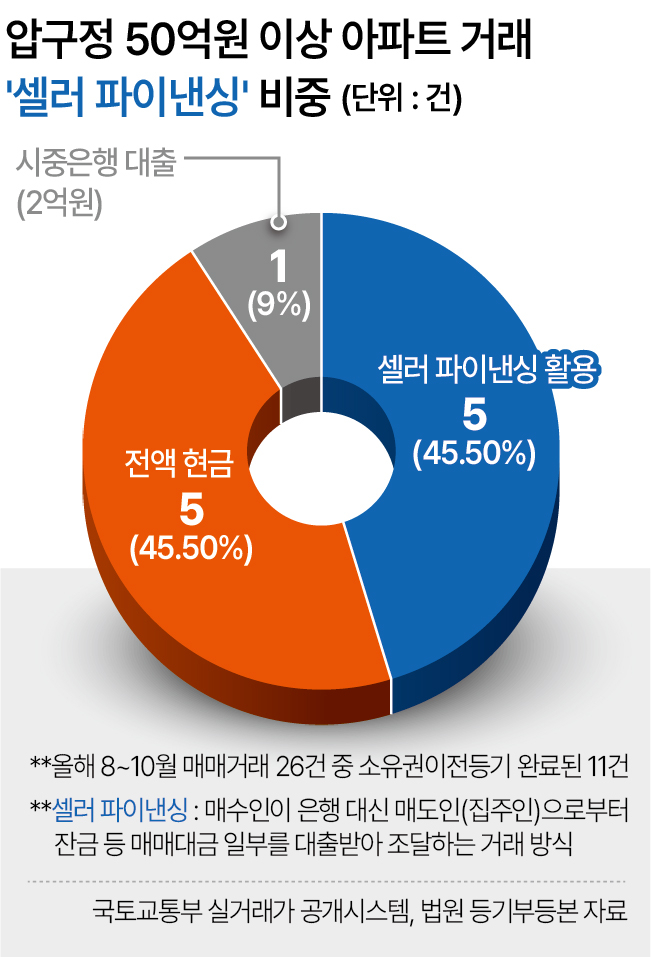
An analysis of registry documents for 11 completed ownership transfers — drawn from 26 Apgujeong apartment transactions above 5 billion won recorded between August and October — found that 5, or 45 percent, involved seller financing. Because the transaction amounts themselves are large, the maximum secured debt amounts registered against the properties also ran into the billions of won. Of the remaining six cases, five were all-cash purchases and one involved a 200 million won bank mortgage.
In one case, a couple identified as B completed the purchase of an Apgujeong apartment for 9.3 billion won in early October, settling the balance just 12 days after signing the contract. At the time of the ownership transfer, a seller-financing mortgage with a maximum secured debt of 5.16 billion won was registered on the property. Given that such ceilings are typically set at around 120 percent of the actual loan amount, the buyers are estimated to have put up roughly 5 billion won of their own funds and borrowed approximately 4.3 billion won from the seller.
Kim Dong-hyun, a broadcaster and former UFC fighter, signed a contract on Sept. 23 to purchase a 182-square-meter unit at Apgujeong Shinhyundai 12 for 10 billion won. Kim borrowed a portion of the purchase price from all four of the previous co-owners, with the combined maximum secured debt reaching 6 billion won.
A couple identified as C completed an ownership transfer just four days after signing a contract to buy another Apgujeong apartment for 6.9 billion won, also borrowing approximately 2 billion won from the seller. A buyer identified as D, who purchased an Apgujeong apartment for 5.59 billion won in late October, settled the balance in about a week; the registry shows a seller-financing mortgage with a maximum secured debt of 3.93 billion won.
The emergence of seller financing — colloquially known as "landlord loans" — as a primary funding method in the Apgujeong area reflects the combined effect of lending restrictions targeting high-value homes and proposed tax reforms. President Lee Jae Myung used a similar arrangement in July, when he sold his home in Bundang-gu, Seongnam, Gyeonggi Province for 2.9 billion won and registered a mortgage with a maximum secured debt of 1.77 billion won to accommodate the buyer's financing needs.
High-income buyers with the means to service large interest payments appear willing to pay above-market rates to sellers rather than be constrained by the 200 million won mortgage cap, using the arrangement to close the deal and buy time to arrange the remaining funds.
On the seller side, analysts say the push to dispose of properties before proposed tax reforms — which would gradually increase holding and capital gains taxes on high-value homes — take effect has been a key driver. Compounding this, some sellers face deadlines tied to reconstruction project timelines, specifically the window during which union membership can still be transferred to a new owner. Sellers with sufficient liquidity have increasingly embraced seller financing as a way to earn interest income while closing deals quickly, according to the analysis.
Lee Yun-seok, head of the Apgujeong Banpo real estate agency, said seller-financing arrangements in the Apgujeong area typically carry loan terms of six months to one year at an annual interest rate of around 5 percent. "In the case of the Shinhyundai complex, seller financing was widely used among those looking to sell quickly as Zone 2 of the Apgujeong reconstruction project nears its application for project implementation authorization," Lee said. "In other areas, sellers with ample liquidity occasionally register a mortgage for the buyer."
The government's position is that seller financing of this kind is difficult to classify as illegal or taxable. Im Gwang-hyeon, then commissioner of the National Tax Service, told the National Assembly's Finance and Economy Planning Committee during a national audit on Oct. 13 that the tax authority had reviewed the president's apartment transaction and concluded it was not subject to taxation. Im now serves as chief of staff to the president.
hwshin@heraldcorp.com