Policy forum on insurance sales order and consumer protection
Kim Dong-gyeom: mystery shopping, public disclosure of inspection results needed to embed new rules
Financial Supervisory Service calls for legal basis for GA internal controls
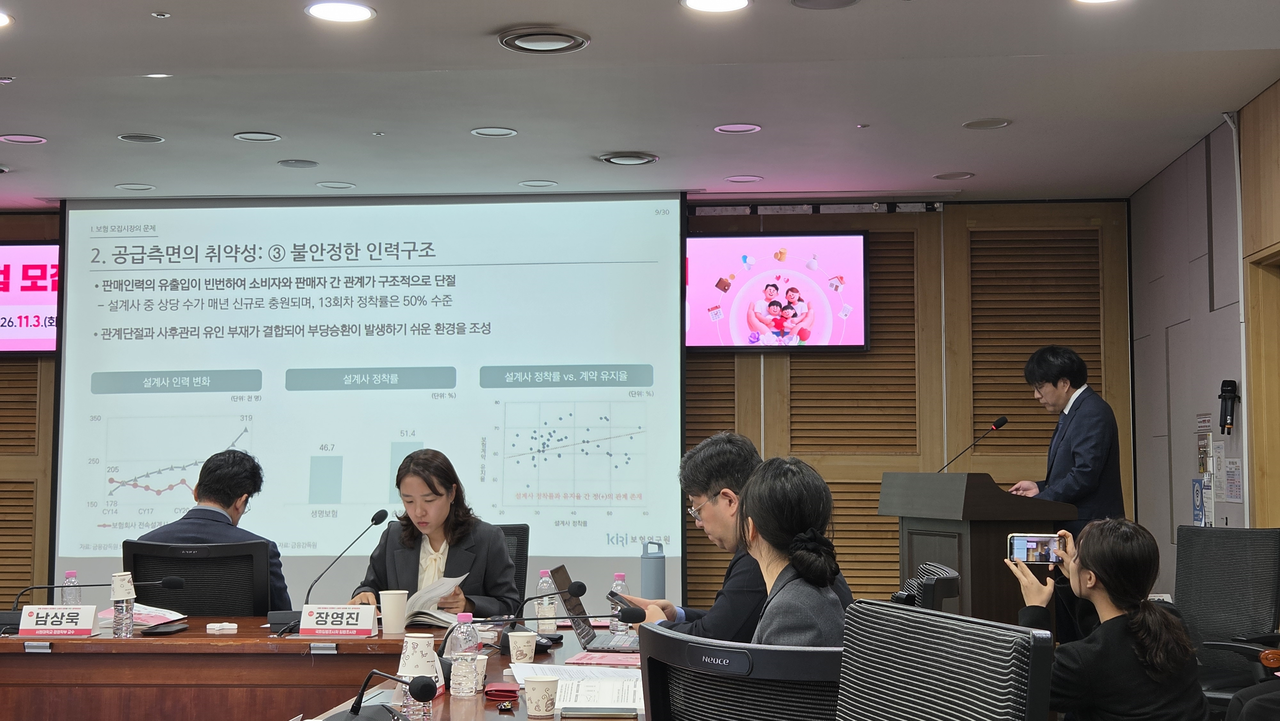
As insurance sales have shifted decisively toward general agencies, or GA, their accountability and internal controls must be strengthened to match, a researcher argued Tuesday. The immediate priority, the researcher said, is building a system to verify whether newly introduced rules — including commission disclosure requirements and mandatory product comparisons at large GA firms — are actually being followed in practice.
Kim Dong-gyeom, a research fellow at the Korea Insurance Research Institute, made the remarks while presenting on policy tasks for improving insurance sales order at a forum on "Improving Insurance Sales Order and Consumer Protection" held Tuesday at the National Assembly Members' Office Building.
Financial authorities introduced a commission comparison disclosure system in March and applied the "1,200 percent rule" to GA firms in July, while also requiring large GA firms to explain and compare products for customers. A deferred commission payment system — spreading sales commissions over four years — is set to take effect in January, with the deferral period extending to seven years in 2029. Kim urged that "mystery shopping and public disclosure of inspection results should be used to raise compliance incentives, and the criteria for sanctions against non-compliance and repeat violations must be made more specific."
Strengthening GA accountability was also identified as a core challenge. While sales authority has in effect shifted to GA firms and other distribution networks, the regulatory framework and obligations still assume the old model of exclusive insurer-affiliated agents. Misselling occurs at the sales stage, yet liability for compensation remains centered on insurance companies; large GA firms, despite exceeding insurers in scale, are subject only to a registration-based regime with inadequate soundness oversight. Critics also point out that while GA firms now handle the critical judgment of comparing and recommending products from multiple insurers, the qualification and training systems still reflect the era of exclusive sales agents.
A Financial Supervisory Service assessment of internal controls at 75 large GA firms found that 29.3 percent received a grade of 4 (vulnerable) or 5 (high-risk). A separate Korea Insurance Research Institute survey found that "accountability" was the value consumers most wanted when purchasing insurance, cited by 29.8 percent of respondents. Kim recommended that internal control obligations — including compliance and consumer protection frameworks — be scaled to company size, and that qualification, training and evaluation systems be upgraded to reflect each firm's actual role and authority.
Park Won-gyu, head of the insurance policy team at the Financial Supervisory Service, said at the forum that "while the supervisory authority is working on regulatory improvements, there are limits to how far those effects reach GA firms," adding that "structural factors such as sales commissions play a role, but the main cause has been the significant gap in accountability between insurance companies and GA firms." Park called for "the basic principles governing operating expenses and the legal basis for internal control mechanisms to be established in law, along with sanctions that can reinforce accountability."
The lawmaker who hosted the forum said insurance "serves as a private social safety net with public interest and social responsibility, yet the harm caused by overheated competition and unfair practices at the sales stage continues to be passed on to consumers," and called for "effective regulatory standards for sellers that reflect the changed business environment, and for transparency in sales order to be secured without delay."
won@heraldcorp.com