'About 30 trillion won of future response fund should go to local allocation tax'
'Public institution relocations should consider regional industry-academia-research links and local preference index'
'Political resolve needed from governors for administrative integration'
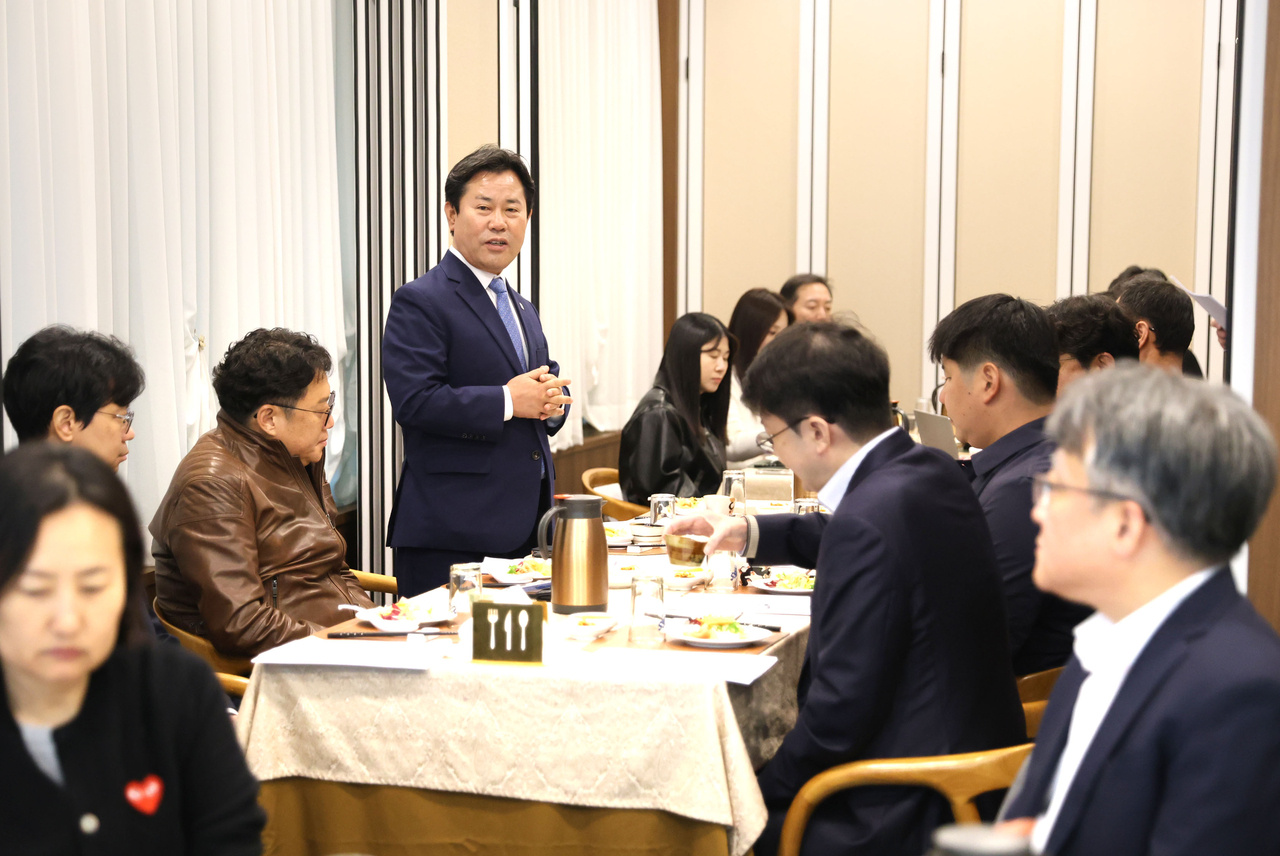
Park Jeong-hyeon, chair of the Presidential Committee on Balanced National Development, said Tuesday that grants cut over the past three years must be fully restored, and called for about 30 trillion won ($22.4 billion) from the future response fund to be redirected to the local allocation tax.
Park made the remarks at a luncheon meeting with reporters at a restaurant near Government Complex Sejong. "The decision will be made by the president and the Ministry of Planning and Budget, but I must convey the voices of the regions without filtering," Park said.
Park said local allocation tax and real estate grants were sharply reduced between 2023 and 2025 under the Yoon Suk Yeol administration, with the total shortfall amounting to about 15.5 trillion won. "The central government unilaterally withheld the grants on the grounds that tax revenues had fallen due to a sluggish economy," Park said.
Park added that if future response fund money were channeled to local governments, it would likely be used to advance campaign pledges made by local leaders. "There are many projects that need to be done so soon after the local elections, but local governments cannot carry them out alone — they have no choice but to pursue them as nationally co-funded projects," Park said.
On the relocation of central government agencies and public institutions to the regions, Park said grouping institutions with ties to local industry, academia and research before sending them together would maximize the effect. "They may prefer not to move too far, but national policy must be guided by principles and standards," Park said.
Park added that public institution relocations are also linked to the local preference index. "When sending public institutions to the regions, I think they will largely be grouped by function and directed to areas farther from Seoul among those with relevant ties — but we will have to wait and see," Park said.
Park also expressed hope that the administrative integration drives involving Daegu and North Gyeongsang Province, Daejeon and South Chungcheong Province, and Busan, Ulsan and South Gyeongsang Province — following the Gwangju-South Jeolla Province special integrated city initiative — would move forward swiftly through the political resolve of the respective governors.
"If integration is going to happen, it should happen quickly — that way the regions receive more support and waste less time," Park said, directing pointed remarks at the regional leaders involved. "Even if they won a hard-fought election, the regional government heads need to decide whether they will end their term in two years or serve the full four."
thlee@heraldcorp.com