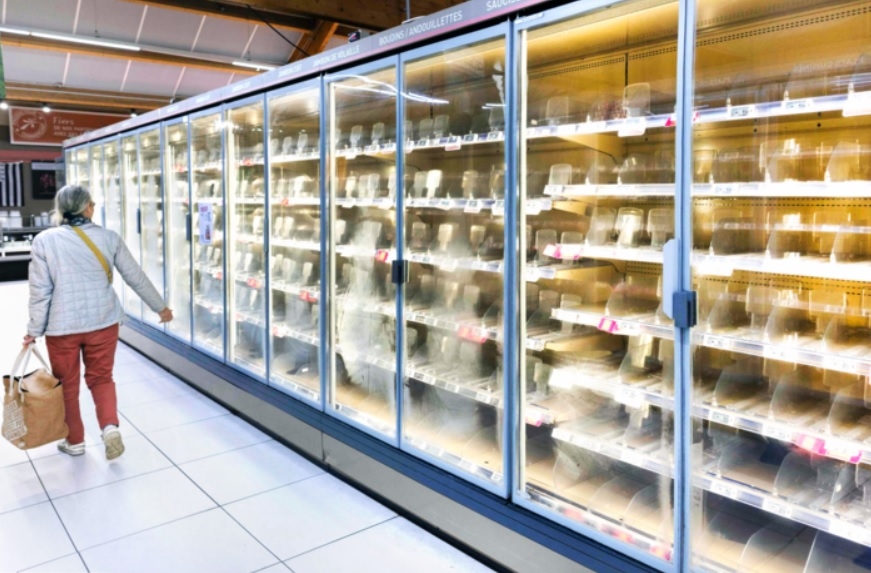
A wave of cyberattacks targeting supermarket refrigeration units has swept across Europe, beginning in France and spreading to countries throughout the continent. Hackers remotely manipulated the systems, pushing temperatures in freezers and refrigerators as high as 50 degrees Celsius and triggering the mass disposal of food on display at hundreds of stores simultaneously. Analysts say the attacks appear designed not to steal assets directly but to inflict psychological damage by showing the public that food safety cannot be guaranteed. Investigators have yet to significantly narrow the field of suspects, though hacking groups linked to Russia or China have been named as possibilities.
Following the Oct. 12 attack in France, hundreds of grocery stores in Belgium, Sweden, Finland and elsewhere across Europe were hit Monday (local time). According to multiple foreign media reports, affected retailers included Carrefour and IKEA in Belgium, Coop and ICA in Sweden, Delhaize in Luxembourg, Kesko in Finland, SuperValu in Ireland, and grocery chains in Estonia. Freezers that should have been kept below zero and refrigerators whose optimal temperature is around 2 degrees Celsius both climbed to 50 degrees.
Investigators have not yet reached a definitive conclusion, but speculation is growing that a similar refrigerator hacking incident may have occurred in the United States as early as last August. Unexplained malfunctions in refrigeration units were reported at commissaries on six US military bases at the time, and the US Department of Defense is investigating the matter.
The EU lashed out at the attacks, which effectively disabled hundreds of supermarkets, calling them "an attempt to disrupt our food supply chain and undermine consumer confidence in it." Authorities have yet to identify any suspects.
Leif Pilling, senior director of risk intelligence at cybersecurity firm Sophos, said the two most plausible scenarios are a state actor sending a signal and demonstrating its capabilities, or a lone hacker acting for personal reasons — and he leaned toward the state-linked possibility. Analysts say the logic is that targeting refrigerators rather than financial institutions is aimed at triggering the psychological shock the public experiences when food safety breaks down and large-scale food disposal follows.
The Guardian reported that hackers with ties to Russia and China could emerge as suspects. Russia in particular has been linked to various acts of sabotage across Europe — covert operations that outwardly resemble peacetime activity while causing damage to adversaries — a pattern analysts say raises the likelihood of Russian involvement in this case.
Commercial refrigerators are managed by software connected to the internet, making them vulnerable to exploitation by hackers. Unlike desktop computers or smartphones, home and commercial appliances are rarely updated, meaning security patches that address known vulnerabilities are often never installed. Experts warned that beyond commercial refrigerators, a growing number of household appliances — including washing machines and robot vacuum cleaners — are now internet-connected, leaving many devices exposed to similar attacks.
Experts urged operators to apply software update patches as a precaution. Nick Jackson, director of cyber operations at cybersecurity firm Bitdefender, said retailers have likely been slow to update their systems because installing patches on commercial refrigerators requires taking the machines offline. "The more serious cases are those where operators are not even aware that updates are needed, or simply do not treat them as a priority," he said.
kate01@heraldcorp.com