How to make sure your death benefit reaches the right person
If the beneficiary is 'legal heir,' a common-law spouse gets nothing
A former spouse can still collect if the beneficiary was never updated after divorce
Children named as policyholder and beneficiary owe zero inheritance tax on the payout
Renouncing an inheritance still leaves you on the hook for the deceased's unpaid taxes
Review your beneficiary designation whenever your family situation changes
South Koreans pay an average of 5.15 million won a year in insurance premiums, according to the Korea Insurance Development Institute's 2025 figures. Make every won count.

Park Gap-sang (pseudonym) ran a small business. About two decades ago, a divorce from his first wife also severed all contact with his only son. Park later met Kim Gil-yeo (pseudonym), and the two lived as a couple without registering their marriage. When Park suffered a stroke, Kim was the one who stayed by his side through seven years of illness.
Park held a 500 million won whole-life insurance policy. He had taken it out thinking, "If something happens to me, I should at least leave my wife something to live on in her old age." He told Kim more than once that the money was hers.
After Park died following his long illness, Kim went to the insurer to file a death benefit claim. The answer was not what Kim expected. "We are unable to pay the benefit to you. The payment will go to your husband's son." The beneficiary field on the policy read simply: "legal heir."
Few people scrutinize the beneficiary field when they take out a policy. Because collecting a payout feels like a distant prospect, most people make the easiest, most common choice: "legal heir" for the death benefit and "the insured" for illness or injury benefits. If you have no memory of designating a beneficiary when you signed up, there is a good chance your policy reads the same way.
For most people, that is a perfectly workable default. But when family circumstances are complicated — as they were for Park — the money can end up with the wrong person entirely. Depending on who is named as policyholder and beneficiary, inheritance tax liability can swing by hundreds of millions of won. Beneficiary designation sits at the intersection of civil law on inheritance rights, tax law on inheritance and gift taxes, and the potential for family disputes.
For insurance to do what it was meant to do — protect against future risk — deciding who gets the money matters just as much as buying the policy in the first place. Kim decided to consult a tax professional to find out what had gone wrong.
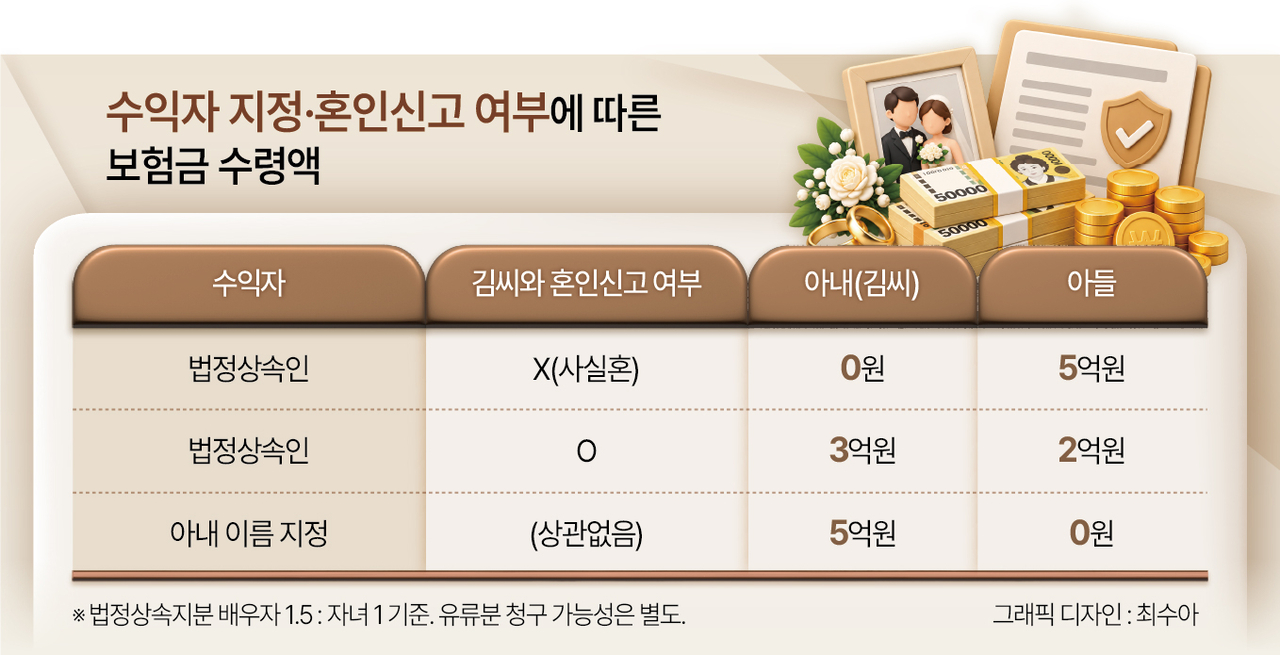
Q. Kim lived with Park as his wife for years. Why can't she receive a single won?
A. One of the most common questions in consultations is: "Surely a common-law spouse of many decades counts as an heir?" Under civil law, however, inheritance rights are recognized only for a legally registered spouse.
The beneficiary on Park's policy was listed as "legal heir." Kim, as a common-law spouse, is not a legal heir and therefore has no right to the payout. Because Park divorced his first wife, the only remaining legal heir is his son. By failing to name a specific beneficiary, Park inadvertently cut out the very person he intended to provide for.
Would Kim have received the full amount if the two had registered their marriage? Not necessarily — the words "legal heir" would still have created a problem. When the beneficiary is the legal heir, the payout is divided among heirs according to their statutory shares. A spouse's share is 1.5 times that of a child. On a 500 million won policy, Kim would receive 300 million won and the son from the first marriage would receive 200 million won.
To leave the full benefit to his wife, Park should have written Kim's name in the beneficiary field instead of "legal heir."
Q. Who exactly are the policyholder, the insured, and the beneficiary on an insurance contract?
A. Every insurance contract involves three parties. The policyholder is the person who enters into the contract and is obligated to pay the premiums. The insured is the person whose death, illness, or injury triggers a claim. The beneficiary is the person who receives the payout when a covered event occurs.
Of these, the beneficiary designation is where civil inheritance rights, inheritance and gift tax rules, and family disputes all converge. Policies typically set a "death beneficiary" and a "living beneficiary" — covering illness, injury, or pension payouts — separately, so both fields need to be checked.
Q. Do I really need to name a specific beneficiary?
A. Not necessarily. If no beneficiary is designated, the policy defaults to "legal heir" and the payout goes to whoever the civil code recognizes as an heir. For people with straightforward family situations, this rarely causes problems.
That said, it is worth naming a specific beneficiary if any of the following apply: there is a risk of conflict or disputes among family members after the inheritance; inheritance or gift tax is a concern; assets or debts are complicated; family circumstances are complex due to divorce or remarriage, or the policyholder is a single-person household; or there is a specific person the policyholder wants to make sure receives the money.
Q. What problems can arise from not designating a beneficiary properly?
A. There are two main categories. The first is family disputes over who receives the payout — disputes that can escalate into litigation. The second is taxes: inheritance and gift tax liability can vary significantly depending on who is named as beneficiary.
A Supreme Court case illustrates the stakes. A person died without updating the beneficiary after a divorce, and the entire death benefit went to the former spouse. The Supreme Court ruled that if a specific person — such as a spouse — was named as beneficiary at the time the contract was signed, that person remains the beneficiary even if the relationship has since ended. This is precisely why the beneficiary field should be the first thing to check whenever family circumstances change.
The outcome would have been different had the beneficiary been listed as "legal heir." A former spouse is not a legal heir and would have no claim. The payout would instead be divided among the deceased's current spouse and children — including children from both the previous and current marriage.
If there are no children, the picture changes again: the benefit would be split between the surviving spouse and the deceased's parents.
The right use for a death benefit varies from person to person — child support, medical bills for a sick family member, care costs for an aging parent, a spouse's retirement income. Decide first how you want the money used and for whom, then choose the beneficiary accordingly.
Q. Can't the heirs just agree among themselves on how to divide the death benefit, the way they would with other inherited assets?
A. That is possible when the beneficiary is listed as "legal heir." Inherited assets can be divided by agreement among the heirs. Under civil law, the statutory shares are 1.5 for a spouse and 1 for each child, but when heirs reach an initial division agreement, one heir receiving more than the statutory share is not treated as a gift between heirs. A death benefit payable to the legal heir can likewise be divided by agreement or according to statutory shares.
However, if the beneficiary is a specific named heir, the payout is not subject to division by agreement. Distributing such a benefit informally among heirs triggers gift tax. For example, if a mother receives a death benefit as the named beneficiary of a whole-life policy taken out by her late husband and then passes a portion to her son, the son owes gift tax on the amount received.
Even with a named beneficiary, the reserved portion — the legally guaranteed minimum inheritance share — remains an issue. Other heirs cannot demand that the named beneficiary split the payout equally, but they can file a reserved-portion claim arguing that their minimum share has been infringed.
Q. Should single-person households without a spouse also designate a beneficiary?
A. As single-person households become more common, beneficiary designation has grown more important. When an unmarried person with no children dies, parents become the primary heirs; if the parents are also deceased, siblings and other relatives inherit (Civil Act, Article 1000, Paragraph 1).
In practice, however, many single-person households have someone who is genuinely closest to them — a common-law partner, a long-term companion, or a friend with whom they have shared mutual care. These people are not legal heirs under civil law, which means that if the beneficiary field reads "heir" or "legal heir," they will receive nothing. Anyone who has a person in their life who provides or receives care should consider naming that person as beneficiary.
Q. If there are no legal heirs at all, what happens to the death benefit?
A. If someone shared a household with the deceased or provided nursing care — a person the law calls a "specially related person" — that individual may petition the family court for all or part of the estate (Civil Act, Article 1057-2). If no such petition is filed, the benefit reverts to the state.
In such cases, naming an organization as beneficiary is one option. A charity the policyholder regularly supported, or a cause they cared about, can be designated as beneficiary — a practice sometimes called "donation insurance."
To leave a death benefit to a friend, a common-law partner, or a nonprofit, the beneficiary must be identified precisely. For an individual, that means providing the full name, resident registration number, address, and contact information; for an organization, the name and corporate registration number. The designation must also be reported to the insurer — a beneficiary designation or change that has not been communicated to the insurer cannot be enforced against the insurer (Commercial Act, Article 734, Paragraph 1).
Q. My father died and I received the same 1 billion won death benefit as a friend did from their father's policy. My friend paid no tax; I paid half in inheritance tax. Why?
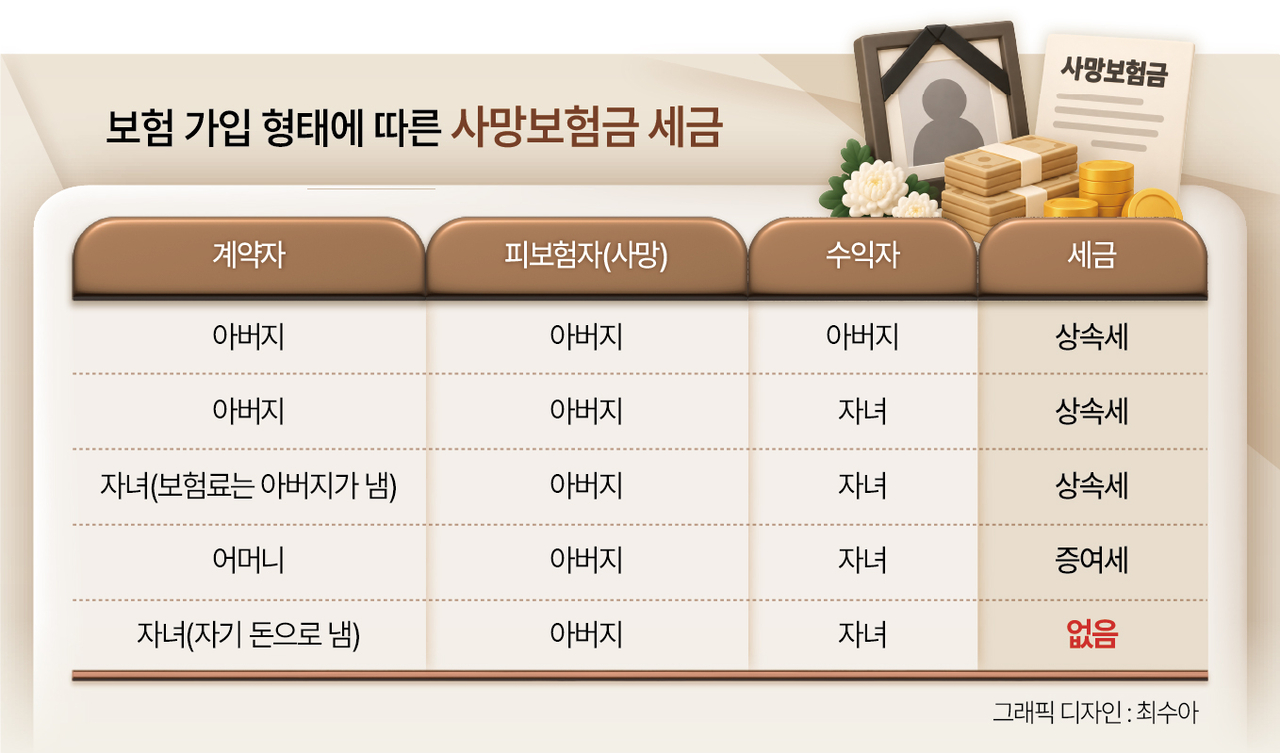
A. Whether you owe inheritance tax, gift tax, or no tax at all depends entirely on who is named as policyholder and who is named as beneficiary. Structuring these roles carefully can also be an effective way to prepare for a large inheritance tax bill.
Tax law treats two types of death benefits as part of the taxable estate. The first is a death benefit paid out on a policy where the deceased was the policyholder. The second is a death benefit on any policy where the deceased was, in practice, the one paying the premiums — regardless of whose name is on the contract. By contrast, if it can be demonstrated that the beneficiary paid the premiums from their own income and assets, the payout is not considered part of the estate.
Consider an example. If the policyholder and insured are the parents and the beneficiary is a child, the entire death benefit is subject to inheritance tax. On the other hand, if the child is both the policyholder and the beneficiary, the parent is the insured, and the child paid the premiums from their own money, the death benefit the child receives is subject to neither inheritance tax nor gift tax — because the child put in their own money and is the one collecting.
The difference becomes even starker for families already in the top inheritance tax bracket (50%) due to other assets. Under the first structure, a 1 billion won death benefit adds 500 million won in inheritance tax. Under the second, the tax is zero.
This approach is particularly useful when passing on assets that are hard to liquidate, such as shares in unlisted companies or real estate. The death benefit serves as a ready source of cash to pay the inheritance tax bill, preventing a distressed sale or payment in kind. If you have an older policy, it is worth reviewing the structure. If a child who was a minor when the policy was taken out has since grown up and started earning an income, switching the policyholder to the child now may be advantageous.
However, substance matters more than the name on the contract. If the child is listed as policyholder but the parents are actually paying the premiums, the tax authority will treat the premiums as having been paid by the parents and assess inheritance tax accordingly. Make sure the child's income and assets can be documented, and ensure the premiums are debited directly from the child's own bank account.
Q. I've heard that even if you renounce an inheritance because of a parent's debts, you can still collect the death benefit. Do I need to designate a specific beneficiary for that?
A. No. Whether a specific beneficiary is named or the policy defaults to "legal heir," renouncing an inheritance does not affect your right to collect a death benefit.
Courts have held that when a beneficiary is designated as an heir, the right to claim a death benefit is not part of the estate but rather the beneficiary's own personal property. Even if a child renounces the inheritance or accepts it only to the extent of the assets received because of a parent's debts, the death benefit can be collected in full. Creditors of the deceased cannot seize or enforce against that benefit.
Tax law, however, takes a different view. Even though the benefit is treated as personal property under civil law — meaning the debts are not inherited — if the deceased actually paid the premiums, tax law treats the payout as part of the estate and levies inheritance tax.
Unpaid taxes are also unavoidable. In the past, there was a loophole: a person could renounce the inheritance, collect the death benefit, and avoid inheriting the deceased's unpaid national taxes. That loophole has since been closed. Anyone who renounces an inheritance or accepts it with limited liability but still collects a death benefit must now pay the deceased's overdue taxes up to the amount of the benefit received.
To summarize: renouncing an inheritance because of debts does not prevent you from collecting a death benefit. However, inheritance tax and any unpaid taxes left by the deceased cannot be avoided.
Q. How do you change a beneficiary, and what should you watch out for?
A. Changing the beneficiary is the policyholder's right. The beneficiary does not have to be a blood relative, and organizations or corporations can be named just as individuals can. It is also possible to name multiple beneficiaries and specify the share each receives. Changes can be made through the insurer's customer service center, a branch office, a mobile app or website, or the assigned insurance agent. Check with the insurer in advance for the exact documents required.
There are three things to keep in mind.
First, if the policyholder and the insured are different people, the insured must consent to any change of beneficiary. If the policyholder is the wife and the insured is the husband, the husband must agree before the beneficiary can be changed. This requirement exists to protect the insured and prevent insurance fraud.
Second, the new beneficiary's full name, resident registration number, address, and contact information must be recorded accurately — or, for an organization, its name and business registration number.
Third, both the "death beneficiary" and the "living beneficiary" fields must be reviewed. If the policyholder or insured is seriously ill, designating a living beneficiary in advance can simplify matters considerably.
There is no single right answer for beneficiary designation that works for everyone — family relationships, trust, and financial circumstances all factor in. If you are concerned about family disputes or worried about inheritance and gift taxes, consult a professional before making a decision.
The beneficiary can also be changed as many times as the policyholder wishes, with no limit on the number of changes. The bigger risk is never reviewing the policy after it is taken out. Treat it like a regular health checkup. Whenever family circumstances change — marriage, divorce, remarriage, the birth of a child, the death of a child, or the start of a common-law relationship — and whenever the size of your estate shifts or someone in your life needs care or financial support, go back and check the beneficiary field on your policy.

won@heraldcorp.com