Attorney Kim Min-sik: 'Not expanding GA authority, but codifying accountability'
Life and non-life insurance associations: 'Need for new business category unproven'
GA industry: 'Legislation needed to protect consumers'
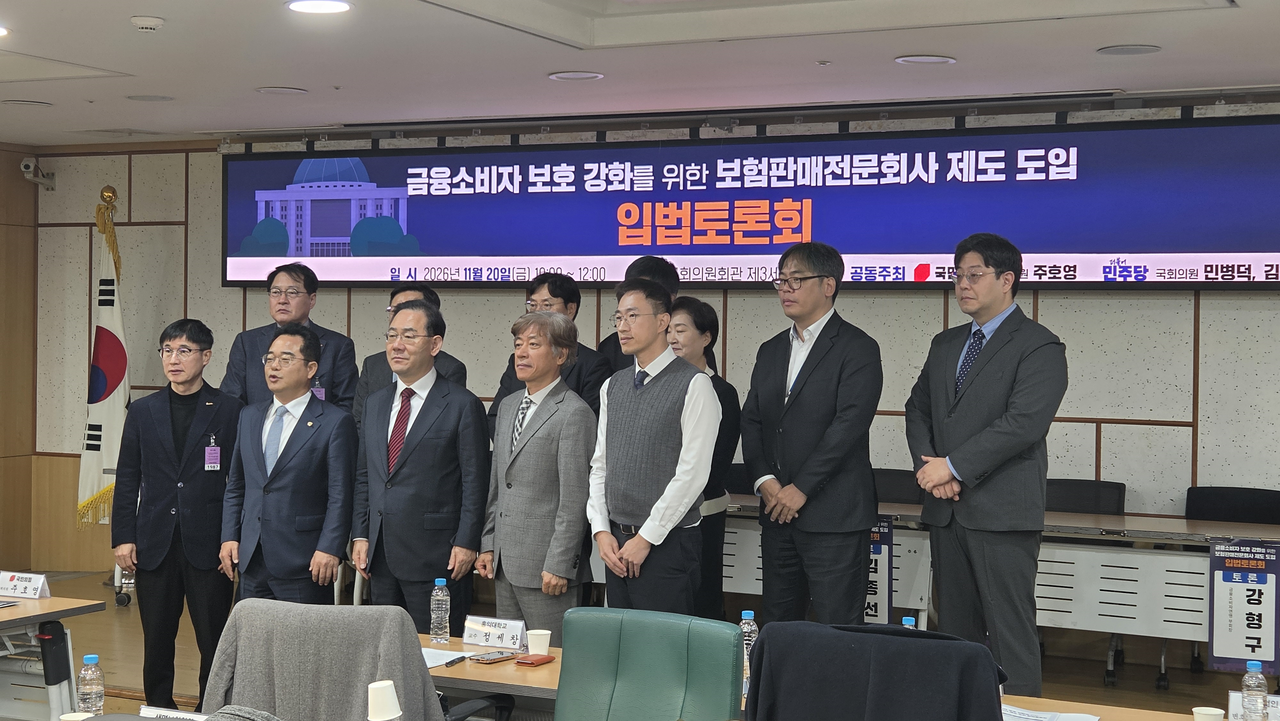
The insurance industry and the general agency sector clashed at the National Assembly on Friday over whether to introduce a specialized insurance sales company regime. The Korea Life Insurance Association and the General Insurance Association of Korea urged caution, saying the effects of ongoing reforms to the existing agency system should be assessed first, while the GA industry said legislation was urgently needed to clarify accountability among sales organizations and protect consumers.
At a legislative forum on introducing a specialized insurance sales company regime to strengthen financial consumer protection — co-hosted Friday at the National Assembly by Democratic Party of Korea lawmaker Min Byeong-deok and People Power Party lawmaker Joo Ho-young, among others — attorney Kim Min-sik of law firm Bae, Kim & Lee argued in favor of the regime. "It is not accurate to view the specialized insurance sales company regime simply as an expansion of GA authority," Kim said. The regime, he explained, should be understood as a measure to codify the legal accountability of organizations that already dominate insurance sales, commensurate with their market influence.
According to Kim, GA-affiliated insurance planners numbered approximately 319,000 as of 2025, accounting for 44.8 percent of all planners nationwide. Yet large GAs with tens of thousands of planners and single-person agencies still fall under the same legal category. He noted a contradiction: Article 45 of the Financial Consumer Protection Act places liability for damages arising from the sales process solely on insurers, allowing the organizations that actually conduct sales to sidestep responsibility.
Kim proposed that while preserving the agency structure, the law should explicitly designate specialized insurance sales companies as entities responsible for providing comprehensive contract management and services. He suggested raising the entry bar in line with the expanded scope of duties — setting a minimum capital requirement of 3 billion won ($2.25 million) by law, with the threshold rising incrementally based on the number of planners. He also said claims-filing assistance should be limited to factual acts such as document guidance and submission, with small-amount insurance payment processing excluded due to conflicts of interest. To prevent large GAs from avoiding the transition by remaining under the existing agency framework, he called for mandatory conversion above a certain size threshold.
Choi Mi-su, a professor at Seoul Digital University, said "the core issue is not elevating the status of sales organizations but raising the level of consumer protection," and presented six policy priorities including direct liability, securing compensation funds, and mandatory disclosure of incomplete-sales rates.
Insurers warn of codified expense-negotiation rights; GA industry insists on clear consumer-protection duties
The debate over introducing specialized insurance sales companies drew sharp disagreement between insurers and the GA industry. Park Soon-geun, a managing director at the Korea Life Insurance Association, said "strengthening seller accountability and creating an entirely new business category with statutory duties and authority are separate issues."
Park particularly warned that codifying expense-negotiation rights could entrench the dominant position of large GAs, potentially driving up commissions or skewing sales toward high-commission products. The association's position is that the effects of GA reforms already being pursued by financial regulators should be verified before any new framework is introduced, given the risk of increased costs for consumers.
Choi Jong-su, a managing director at the General Insurance Association of Korea, said the proposed legislation "focuses on expanding the scope of duties and authority of sales organizations." He raised concerns that overlapping maintenance responsibilities with insurers could blur accountability, and that consumers might be confused about who to hold responsible when small insurance claims arise. He also flagged the potential for unfair premium disparities across channels depending on expense-negotiation outcomes. "If this is a regime meant to protect consumers, strengthening accountability should come before expanding authority," Choi said.
Jang Nam-hun, a managing director at the Korea Insurance GA Association, rebuffed those arguments. "If the biggest objections to introducing the regime are GA credibility and consumer protection, those are precisely the reasons to legislate," he said. He stressed that limiting the scope of expense negotiations to maintenance costs rather than new-contract costs would leave total operating expenses and premiums unaffected. He also cited Japan's experience: after misconduct by large agencies, Japan did not abandon legislation but instead amended its Insurance Business Act in 2016 to impose insurer-level internal control and governance obligations on certain large agencies. Kim Jong-seon, chief executive of Global Financial Sales, said large firms already perform the maintenance and management work that insurers once handled and bear a substantial share of liability when incidents occur. "This simply formalizes what is already happening," Kim said.
Kim Won-gak, a professor in the law department at Dongguk University, agreed that large GAs should be given legal standing and accountability, but flagged several issues requiring further work: potential conflicts with loss-adjustment operations, an unclear definition of small insurance amounts, and insufficient compensation funds from a 3-billion-won capital requirement alone. Emphasizing the need to prioritize GA accountability in any legislation, he added, "We should remember that after Japan's 'Big Motor scandal,' the Financial Services Agency of Japan kept the name unchanged, refrained from significantly expanding authority, and instead imposed very heavy responsibilities."
won@heraldcorp.com