Recipient count doubles in 11 years, surpassing 8.06 million as of late July
Those receiving 200,000–400,000 won a month make up the largest group at 38%
Recipient count projected to exceed 10 million by 2030, yet retirement income gaps persist
The number of national pension recipients in South Korea has surpassed 8 million, marking a new milestone in the country's aging society. The figure has doubled in just 11 years since crossing the 4 million mark in 2015, driven by rapid demographic aging. The recipient count is projected to exceed 10 million by 2030. Yet nearly two in three recipients currently receive less than 600,000 won ($449) a month, fueling calls to strengthen the pension system's role in guaranteeing retirement income.
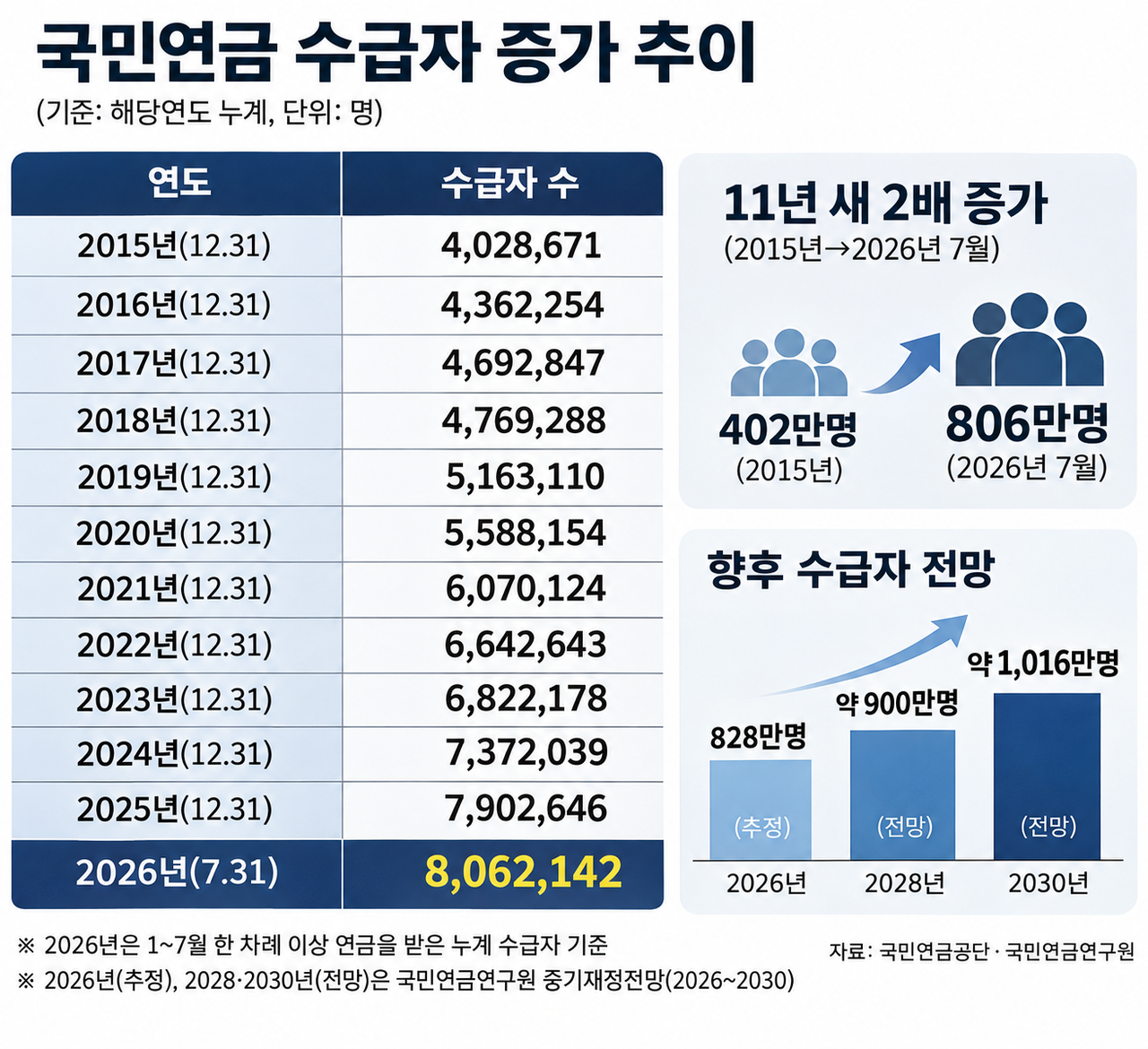
According to the National Pension Service's published statistics released Sunday, a total of about 8.06 million people received national pension payments at least once between January and July 31 of this year. The figure covers recipients of old-age, disability and survivor pensions, as well as lump-sum payments.
The recipient count stood at about 4.03 million at the end of 2015, rose to about 5.59 million in 2020 and reached about 6.64 million in 2022. It climbed further to about 7.37 million in 2024 and about 7.90 million in 2025 before crossing the 8 million threshold by the end of July this year.
The pace of growth is expected to accelerate. A medium-term fiscal outlook for 2026–2030 published by the National Pension Research Institute in August projected this year's total recipient count at about 8.28 million, with annual benefit payments reaching around 56 trillion won.
Growth is expected to slow temporarily in 2028, when the eligibility age for old-age pension benefits rises from 63 to 64, but the total recipient count is still projected to reach about 9 million by that year. By 2030, the figure is forecast to climb to about 10.16 million — roughly one in five South Koreans receiving national pension benefits.
The concern, however, is that despite the growing number of recipients, the pension amounts many receive fall short of what is needed to support a stable retirement.
A breakdown of monthly benefit amounts as of July this year shows that among the roughly 7.86 million recipients counted, those receiving between 200,000 won and 400,000 won made up the largest group — about 2.99 million people, or 38.0 percent of the total.
Those receiving between 400,000 won and 600,000 won numbered about 1.67 million, accounting for 21.2 percent. Another 535,279 recipients — 6.8 percent of the total — received less than 200,000 won a month.
Combined, recipients receiving less than 600,000 won a month totaled about 5.19 million, or 66.0 percent of all recipients — meaning nearly seven in 10 national pension recipients take home less than 600,000 won each month.
The figures suggest that even as the recipient base expands rapidly, the pension system still falls short of providing adequate retirement income for many. Recipients with shorter contribution periods or lower past earnings tend to receive comparatively smaller payments.
It should be noted, however, that the benefit statistics include not only old-age pensions but also disability and survivor pensions, so caution is warranted in treating the figures as representative of the average retirement income of old-age pension recipients alone.
As the baby boom generation continues to retire and the elderly population grows, the national pension's role is expected to become increasingly important. With the 10 million recipient milestone approaching, raising the actual level of retirement income security — beyond simply expanding the recipient base — is emerging as a key policy challenge.
For the national pension to serve as a stable income foundation for older Koreans, experts say efforts to extend contribution periods, close coverage gaps and introduce supplementary measures for low-benefit recipients must all be pursued together.
fact0514@heraldcorp.com