New crossing to open on Pedestrian Day, Nov. 11 — the 41-meter, 6-meter-wide crosswalk ends reliance on subway stairs; walking conditions near Junggok Station and Gwangyang Middle and High schools also set for improvement
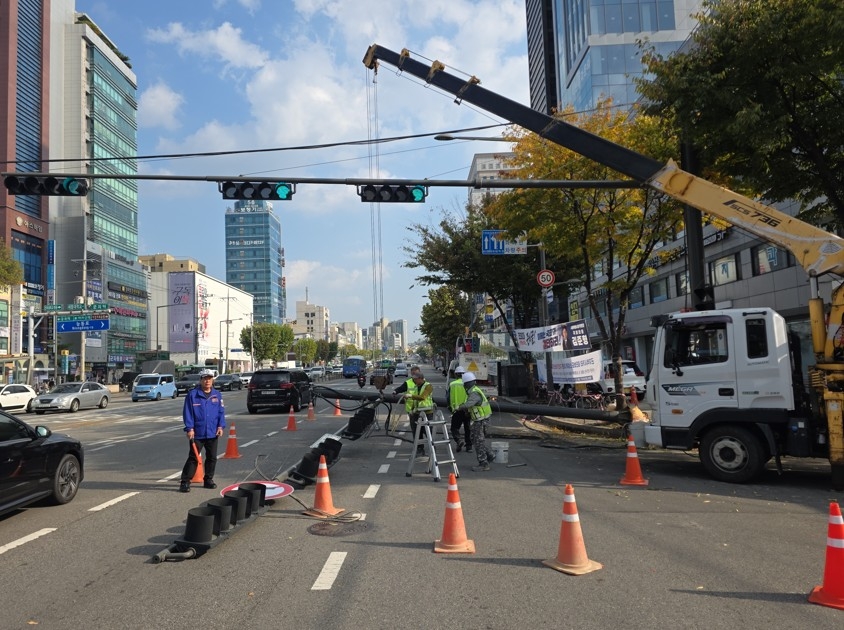
A new north-south crosswalk is set to open at the Gunja Station intersection in Seoul's Gwangjin-gu.
The installation resolves a residents' request that has been pending since 2009 — a 17-year wait.
Gwangjin-gu announced it will officially open the crosswalk on the eastern side of Cheonho-daero at the Gunja Station intersection on Nov. 11, Pedestrian Day.
The Gunja Station intersection serves heavy pedestrian traffic as the transfer point for subway lines 5 and 7 and a hub for nearby commercial areas. However, the eastern side of the intersection had no north-south crosswalk, forcing pedestrians to use subway station stairs to cross the road. The gap created significant inconvenience for elderly residents, people with disabilities, and stroller users, prompting residents to call for a crosswalk since 2009.
The district analyzed why earlier proposals had been rejected in traffic safety facility reviews and developed alternative plans. After conducting joint on-site inspections with relevant agencies and holding public briefings to gather residents' input, the district completed basic and supplementary design reviews with the relevant authorities and cleared a Seoul Metropolitan Police Agency traffic safety facility review last November.
The new crosswalk will be built between exits 3 and 5 of Gunja Station, measuring 41 meters long and 6 meters wide. Utility poles and other obstructions will be relocated and curb cuts installed to improve accessibility from approach to crossing.
Traffic signal operations at the Gunja Station intersection will also be partially adjusted when the crosswalk opens. The district urged drivers and pedestrians to check the updated signal system and exercise caution.
With the crosswalk in place, pedestrians will be able to cross Cheonho-daero without using subway station stairs. The district expects the change to shorten travel routes, improve accessibility for people with mobility challenges, and make it easier to move between neighborhoods on both sides of the road.
Gwangjin-gu is also accelerating pedestrian environment improvements across the district beyond the Gunja Station area.
In November, the district will secure a pedestrian path along an approximately 80-meter stretch of Neungdong-ro 53-gil near Junggok Station in Junggok 3-dong and upgrade traffic safety facilities including crosswalks and road markings.
A pedestrian improvement project is also underway along a 270-meter road section near Gwangyang Middle and High schools in Jayang 2-dong. Construction will begin after the College Scholastic Ability Test to avoid disrupting students and the academic schedule, with plans to complete the pedestrian path installation, road repairs, and traffic safety facility upgrades before year's end.
Gwangjin-gu District Mayor Kim Kyung-ho said the opening would ease the long-standing inconvenience residents have faced. "We will continue to pay close attention to everyday inconveniences and work to create a walking environment where everyone can get around safely and comfortably," Kim said.
seouldream01@heraldcorp.com