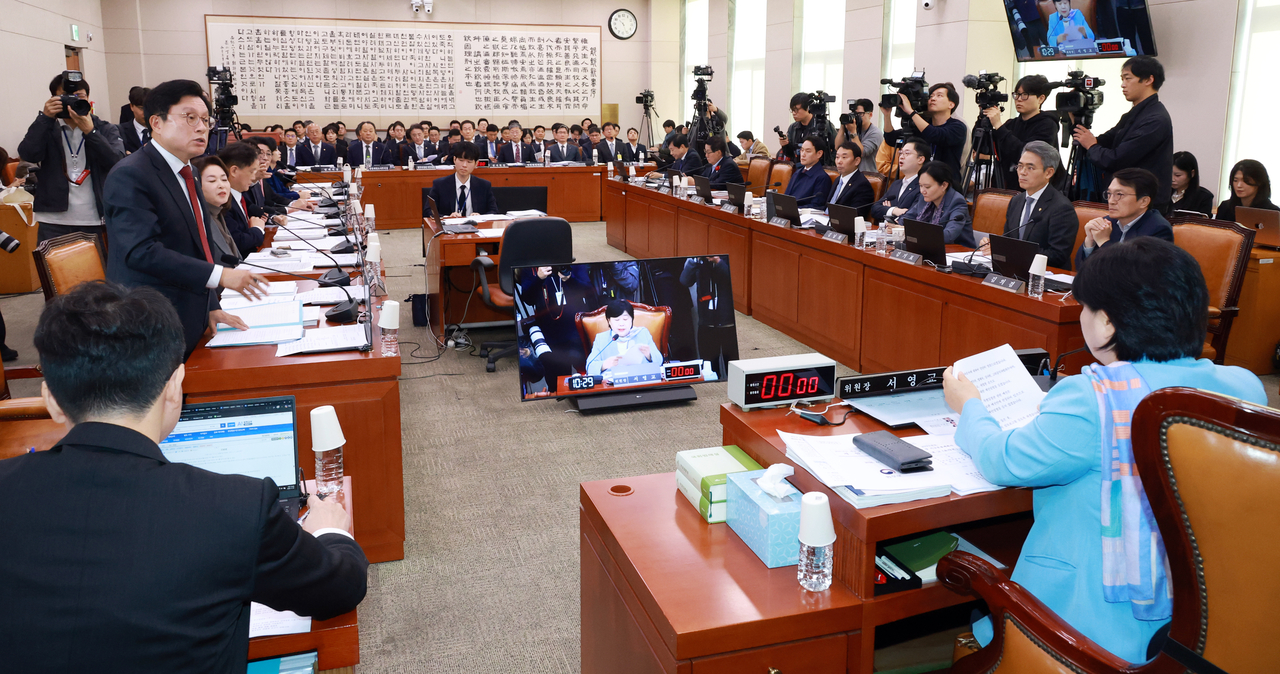
The key difference between the "fabricated prosecution" special prosecutor bill passed Wednesday by the National Assembly's Legislation and Judiciary Committee under Democratic Party leadership and the party's original bill is the removal of a provision allowing the special prosecutor to decide whether to maintain or withdraw charges — a clause that had drawn sharp criticism.
According to Yonhap, the bill the Democratic Party submitted in April — formally titled the act on appointing a special prosecutor to investigate allegations of fabricated investigations and indictments by the prosecution, the National Intelligence Service, the Board of Audit and Inspection and other agencies under the Yoon Suk Yeol administration — had defined the special prosecutor's duties as covering "investigation, indictment, maintenance of charges, and decisions on whether to do so." The revised bill narrows that to "investigation, indictment, and maintenance of charges."
The committee also revised a separate provision in the original bill that would have allowed the special prosecutor to demand the transfer of cases already under investigation, indictment or active prosecution.
Kim Eui-gyeom, who leads the Democratic Party's side on the committee, told reporters after the subcommittee session that the transfer-demand provision had been removed entirely because of objections that it could be used to bring in other cases and then drop charges. "Everything related to the withdrawal of charges has been cleanly deleted," Kim said.
The number of cases subject to special prosecutor investigation remains 12, the same as in the original bill.
However, the actual scope of allegations under investigation has expanded: cases involving former President Moon Jae-in were added, while cases involving President Lee Jae Myung were consolidated.
The committee added four new areas of investigation: the forced repatriation of North Korean defectors, bribery allegations related to the employment of former President Moon's son-in-law, the alleged leak of classified information on the Terminal High Altitude Area Defense system, and allegations of manipulated economic assessments of the Wolseong nuclear power plant Unit 1.
The forced repatriation case was bundled with the shooting death of a South Korean civil servant in the West Sea, which had already been listed as an investigation target in the original bill.
On top of those additions, the bill also covers prosecutorial investigations and indictments related to a range of existing allegations — embezzlement and bribery tied to development projects in Daejang-dong, Wirye new town and Baekhyeon-dong; violations of the Public Official Election Act in connection with the Daejang-dong and Baekhyeon-dong developments; bribery involving Seongnam FC sponsorships; alleged suborning of perjury by Kim Jin-seong; SBW's remittances to North Korea; allegations of improper use of a corporate credit card and embezzlement by Lee when he served as Gyeonggi Province governor; statistical manipulation under the Moon Jae-in administration; and fabricated reporting intended to defame former President Yoon Suk Yeol.
Among those, the Daejang-dong, Wirye new town and Baekhyeon-dong development projects and the bribery allegations against former Democratic Research Institute Vice Chairman Kim Yong — listed as separate investigation targets in the original bill — were consolidated into a single case in the revised version.
The special prosecutor team will consist of 309 people in total, including 20 seconded prosecutors, 70 special investigators and 210 seconded civil servants — a scale comparable to the insurrection special prosecutor team, which could deploy up to about 310 people.
Compared with the original bill, the number of seconded prosecutors was reduced from 30 to 20, and the cap on special investigators was cut from 150 to 70. The number of seconded civil servants, however, rose from 170 to 210.
The investigation period remains unchanged at a maximum of 200 days, comprising a 20-day preparation period and a 180-day investigation period.
The provision requiring the Democratic Party, the People Power Party and the Rebuilding Korea Party — the largest non-floor group by seats — to each nominate one special prosecutor candidate also remains the same, as does the rule that the president appoints the special prosecutor from among those nominees.
The Democratic Party plans to bring the bill to a plenary session vote Thursday, following Wednesday's committee approval.
Meanwhile, Deputy Justice Minister Lee Jin-su argued during the subcommittee deliberations that the number of prosecutors seconded to the special prosecutor team should be reduced below 20. The revised bill did not reflect that position.
It also emerged belatedly that a senior expert adviser to the committee had concluded that the special prosecutor could still withdraw charges even without an explicit provision authorizing it.
In a review report on the Democratic Party's April bill, committee expert adviser Choi Gi-do pointed to a clause requiring the special prosecutor act to apply, by analogy, the provisions of the Code of Criminal Procedure governing prosecutors' powers. Choi argued that "it can be interpreted that charges may be withdrawn on the basis of Article 255 of the Code of Criminal Procedure, which governs the withdrawal of charges."
Choi went on to say that "if it is determined that a special prosecutor appointed by the president holding the power to withdraw charges in a case where the president is the defendant does not accord with judicial fairness, there is a need to discuss explicitly excluding the prosecutor's power to withdraw charges."
The analogical-application clause that Choi flagged is retained in the revised bill that cleared the committee.
husn7@heraldcorp.com