'Golden time' becomes 'sallimdae,' 'showmanship' becomes 'kkipyeolchim'
Ulsan Office of Education holds 'Rewriting in Korean' contest
"Golden time" — the critical window for saving a cardiac arrest patient — is a phrase borrowed from English and written in hangul in everyday Korean. Students in Ulsan proposed native Korean alternatives including "sallim sigan," "sallimdae" and "gareumddae" for the term. The National Institute of Korean Language's own suggested replacement is "hwanggeun sigan" ("golden hour").
The Ulsan Metropolitan Office of Education ran the second-half edition of its "Rewriting in Korean" contest from Oct. 2 to Oct. 23, asking students across the region to suggest native Korean replacements for foreign words, loanwords, trendy slang, abbreviations and Japanese-influenced expressions used in daily life.
The office sent participating schools an online link containing the target words, and students entered their suggestions directly through the site. A total of 3,638 students took part — 668 elementary school students, 2,369 middle school students and 601 high school students — each proposing Korean alternatives for 10 designated words, including "golden time."
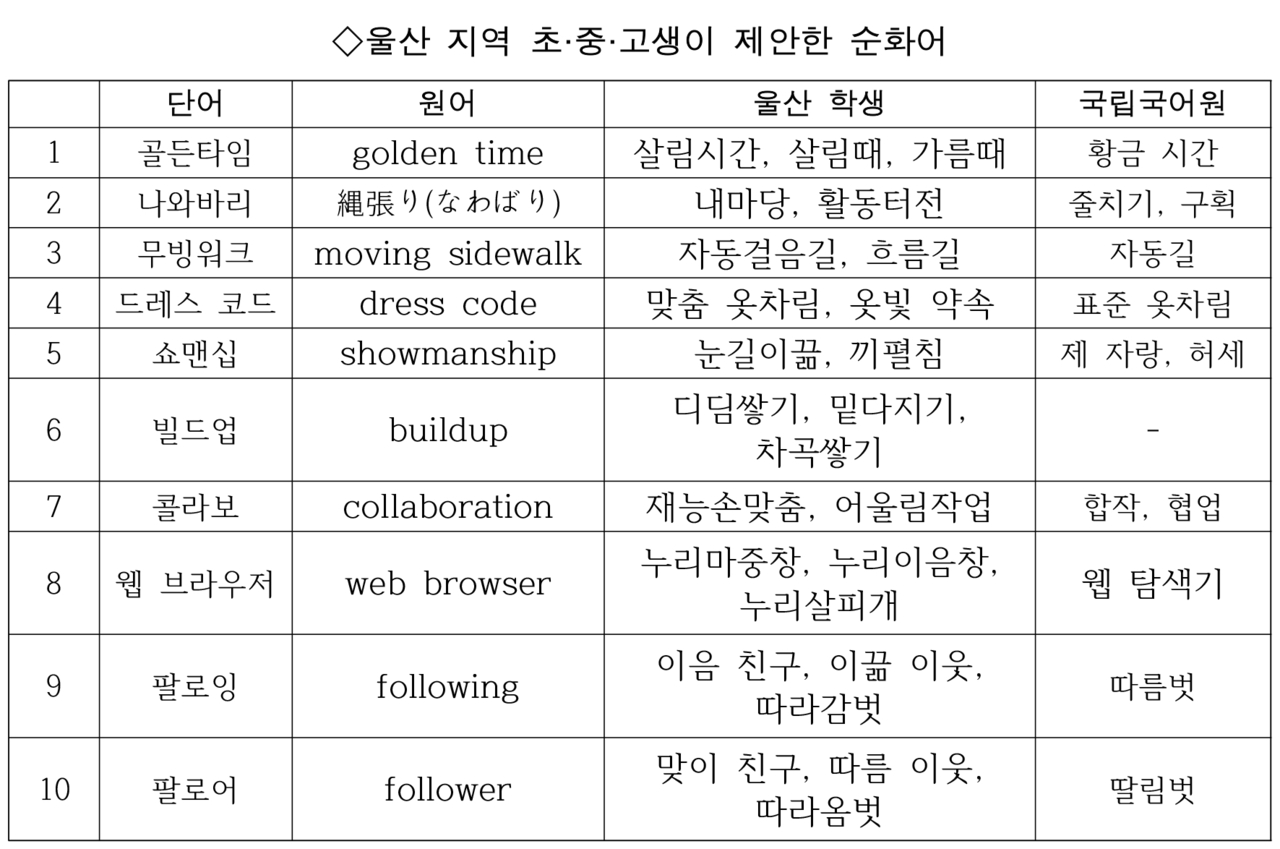
Among the proposed alternatives: "nawabari" (a Japanese-origin word for territory) drew suggestions of "naemadang" and "hwaldong teojeon"; "moving walk" prompted "jadong georeumgil" and "heureum gil"; "dress code" yielded "matchum otcharim" and "otbit yaksok"; "showmanship" inspired "nungil ikkeum" and "kkipyeolchim"; "build-up" produced "didim ssaki," "mitdajigi" and "chagok ssaki"; and "collaboration" brought "jaenung sonmatchum" and "eoulim jagop."
Students also tackled digital terminology. "Web browser" drew "nurimajungchang," "nurieuumchang" and "nurisalpigae"; "following" prompted "eueum chingu," "ikkeeum iut" and "ttaragambeos"; and "follower" yielded "majui chingu," "ttareum iut" and "ttaraombeos" (see table below).
The office evaluated entries on their ability to convey the original meaning, adherence to Korean grammar, conciseness and practical usability in daily life, selecting 85 winners in total — 17 first-place, 26 second-place and 42 third-place recipients. The winning alternatives will be posted on the office's social media channels to promote a culture of proper Korean language use.
Meanwhile, the first-half contest held in May drew proposals including "gilbeot swimteo" for "guest house," "sonmat gori" for "grip tok," "cheotseon madang" for "showcase," "eudum saenaegi" for "super rookie," "balgil jupgi" for "plogging," "somun jjokji" for "flyer," "kkori yeongsang" for "cookie video," "gareum munhang" for "killer question," "sijak bulsssi" for "trigger" and "onhim dollim" for "full operation."
cityblue@heraldcorp.com