City rejects president's linking of private redevelopment to corruption
Private sector accounts for 375,000 of planned units; city urges deregulation
The Seoul Metropolitan Government pushed back against the framing of private-sector redevelopment as a source of corruption, warning that such an approach would make it harder to expand housing supply, and urged the central government to ease regulations and improve project viability. With the private sector accounting for roughly 90 percent of Seoul's planned redevelopment units, the city said a binary public-versus-private approach was counterproductive.
"Treating private redevelopment as something sinful by drawing a sharp line between public and private does nothing to help expand housing supply," the city said Thursday in a reference document.
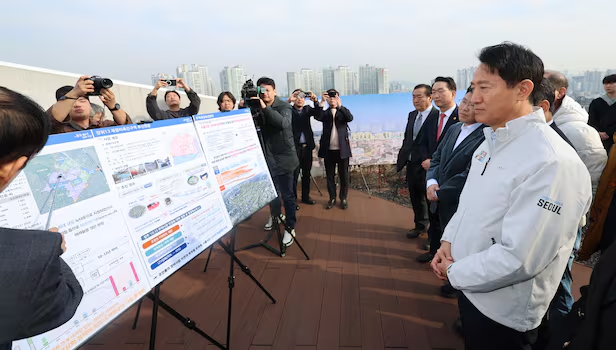
The remarks came in response to President Lee Jae-myung, who visited the Jangwi 9 public redevelopment site in Seongbuk-gu, Seoul, on Wednesday and said, "When the public sector takes charge, things move faster and the potential for corruption decreases." Lee added that "there are still many who want to proceed under private leadership," attributing that tendency to what he called corruption. He also directed officials to review ways to remove procedural penalties — such as delays — when residents wish to switch from private to public redevelopment.
According to the Seoul Metropolitan Government, the city's current redevelopment pipeline comprises 373 private-sector zones covering about 375,000 units and 32 public-sector zones covering about 42,000 units. The private sector accounts for roughly 90 percent of the total.
Seoul Mayor Oh Se-hoon also weighed in on Wednesday, writing on Facebook that "ignoring the role and importance of private development is no different from ignoring the very core of housing supply."
The city argued that transparency in redevelopment depends not on whether the implementing body is public or private, but on the standards, oversight and management applied. It said it has maintained operational guidelines covering association budgets, accounting, contracts and contractor selection through a public-support system for improvement projects since 2010, and has conducted on-site inspections of association operations since 2014.
The city also challenged the assumption that public redevelopment automatically guarantees faster timelines or better project viability. When the government introduced public redevelopment in 2020, it pledged to cut project timelines from more than 10 years to five — yet no public redevelopment groundbreaking has been recorded in Seoul to date, the city said.
Public redevelopment projects also carry a project management fee of about 3 percent of total project costs. On a project worth 500 billion won ($373 million), that fee alone could reach about 15 billion won. The city added that the advantage of being exempt from the price ceiling on new apartments has also narrowed considerably since 2023, when the zones subject to the ceiling were reduced to just the three Gangnam districts and Yongsan-gu, diminishing the benefit for most areas.
There are also cases of sites dropping out of the public redevelopment program. The Geumho 23 zone in Seongdong-gu was designated a candidate site in March 2021, but was removed from the program in January this year after 105 of 346 land and building owners — 30.3 percent — voted against it in a 2024 resident survey. The zone has since pivoted to the private fast-track integrated planning redevelopment scheme. A site in the Yeongeon-dong 305 area of Jongno-gu also had its candidate designation canceled in January this year due to resident opposition and other factors.
The city pointed to Jangwi New Town — the site President Lee visited — as an example of what happens when redevelopment stalls. Newly built apartment complexes developed through redevelopment now sit directly across the street from aging housing left behind after redevelopment zone designations were lifted, creating a stark gap in living conditions, the city said.
The city also cited the Changsin and Sungin neighborhoods. About 87 billion won was poured into urban regeneration across 14 zones in the Changsin-Sungin area after they were removed from the new-town program, but the improvements to residential conditions remained limited, the city said. Redevelopment is now being pursued again through the fast-track integrated planning scheme, though work in the Changsin 9 and 10 zones has been delayed over disputes involving the designation of project operators.
Mayor Oh called on President Lee to visit Changsin-dong. "You will be able to hear directly from residents why redevelopment and reconstruction are so desperately needed, and what is most urgently required right now," Oh said.
The Seoul Metropolitan Government is pushing to break ground on 310,000 units through improvement projects by 2031, using fast-track integrated planning, viability enhancements and permitting reforms. The city's position is that public involvement should be reserved for areas where viability is insufficient or private development is not feasible, while areas where private development can proceed should be supported through deregulation and project viability measures.
quq@heraldcorp.com