In the winter of 383 AD, the armies of Former Qin, led by Fu Jian, faced the Eastern Jin across the Fei River. Former Qin had mobilized a force said to number more than 800,000 men, against Eastern Jin's 80,000.
Flush from earlier victories, the Eastern Jin commanders sent word to their opponents: "Cross the river and face us head-on — but first pull your lines back so we have room to land." Fu Jian calculated that a frontal battle with his overwhelming numbers could only end in his favor. He planned to unleash his cavalry once the Jin forces were halfway across. He ordered his troops to fall back.
As the Qin army began to withdraw, Zhu Xu — a former Eastern Jin general captured by Former Qin — shouted from behind the lines: "Qin is defeated!" The troops, executing a deliberate tactical retreat, believed the cry and dissolved into panic.
Fear spreads fast. Large armies are hard to control. In ancient warfare, once a formation broke, no amount of manpower could hold it together. Former Qin suffered catastrophic losses. Internal rebellions followed the defeat, and Fu Jian was captured and killed in 385 by Yao Chang of Later Qin, a former subordinate. Former Qin itself fell in 394.
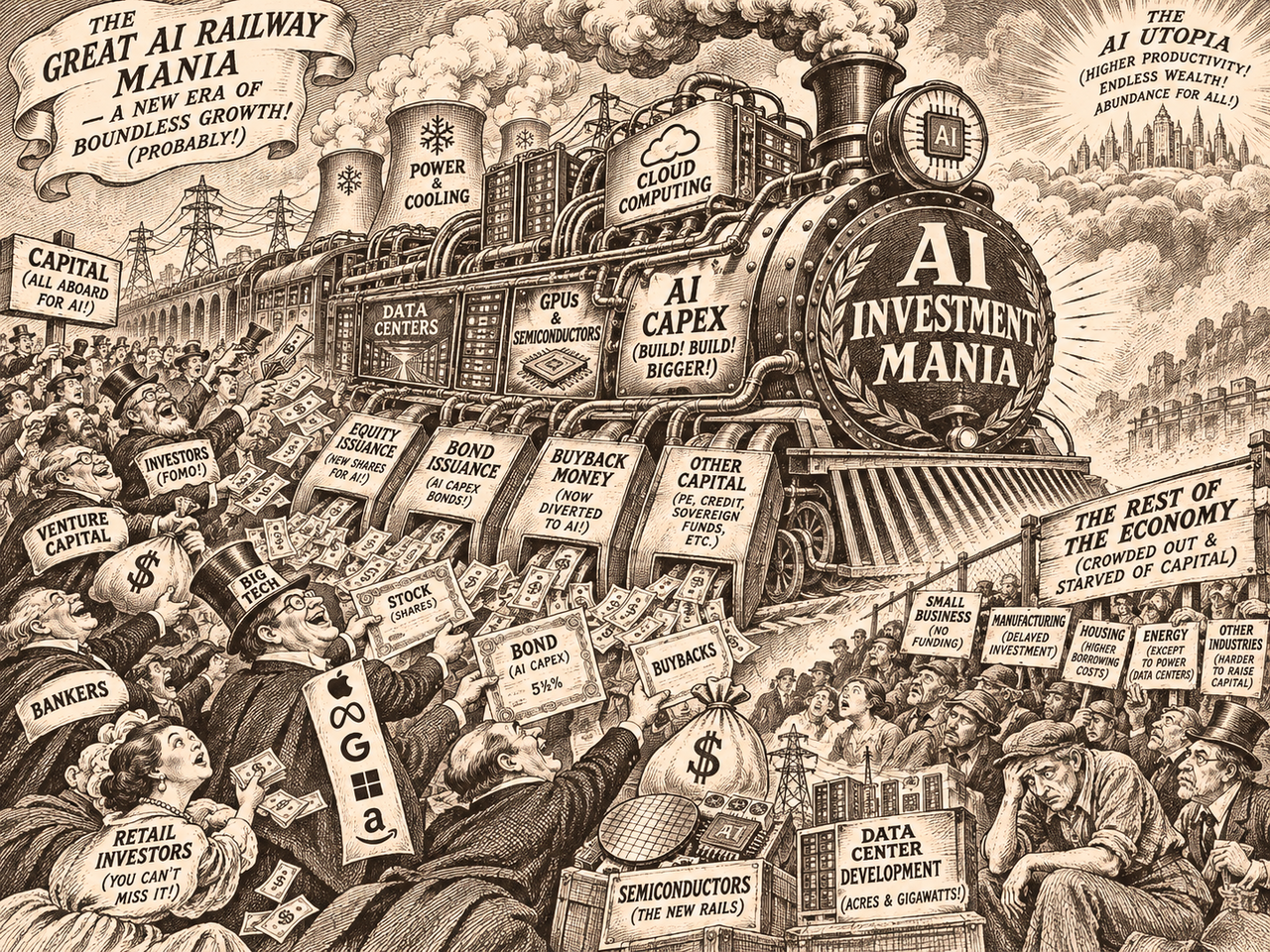
Many voters who resented Donald Trump likely cheered for the Democrats in the US midterm elections. Yet the outcome so many hoped for is now rattling financial markets. The culprit is the Democratic Party's AI regulation campaign pledge, shaped in response to public opinion. Markets have begun pricing in the fear that the AI ecosystem built up over recent years could be destabilized.
Has the situation really changed enough to bring down the AI industry? The fear that Democrats will regulate AI and block data center construction has taken on the character of a full-blown panic.
The most dangerous thing in investing is a hasty assumption. What is needed is a forecast grounded in an accurate reading of the situation, and what matters most is an appropriate response to new developments.
Below is a summary of what the midterm results mean, the AI regulation variable, supply-demand dynamics and investment strategy.
More than a Democratic landslide — a Trump collapse
To put it bluntly, the reason Trump won the presidential election two years ago was Democratic economic incompetence. This midterm is a Democratic landslide, but more precisely it is a Trump collapse. The Democrats did not do anything particularly well — the Republicans failed. Fiscal deficits were a problem even under Democratic rule, and it was the Joe Biden administration that missed the window on fighting inflation.
Populism has often proved a dangerous variable for economies. Britain voted to leave the EU. Germany abandoned nuclear power, grew dependent on Russian energy, failed to make the electric vehicle transition and is now grappling with inflation. Europe, having tightened regulations in pursuit of green goals and fairness, is falling behind the United States in technology and China in manufacturing competitiveness.
The US president wields considerable power. The veto can block legislation. No matter how thoroughly Democrats control both chambers of Congress, they cannot claim to be stronger than Trump, who holds executive authority — particularly on tariffs and diplomacy, including matters of war. The power of the purse is Congress's greatest lever, but reckless use of it that damages the economy could trigger a backlash at the presidential election two years from now.
Overregulating data centers could be a trap of their own making
Data centers are a core engine of US economic growth. The investment involved is among the largest in history, generating demand and employment across a wide range of industries — construction, power infrastructure and beyond. The Federal Reserve has been paying close attention to the productivity gains AI could bring to the broader economy. Would a Democratic-controlled Congress and state governments really win the next presidential election after hobbling the AI growth engine?
Most hyperscalers are Big Tech companies, which carry the largest share of the US stock market. Semiconductor firms and other companies that make up the AI ecosystem also account for a significant portion of market capitalization. American households hold large equity positions, and a drop in share prices would crimp consumption and deal a serious blow to the economy — a metric nearly as politically sensitive as inflation. Trump said Thursday, just after markets plunged, "401(k) retirement accounts have been wiped out. Blame the Democrats."
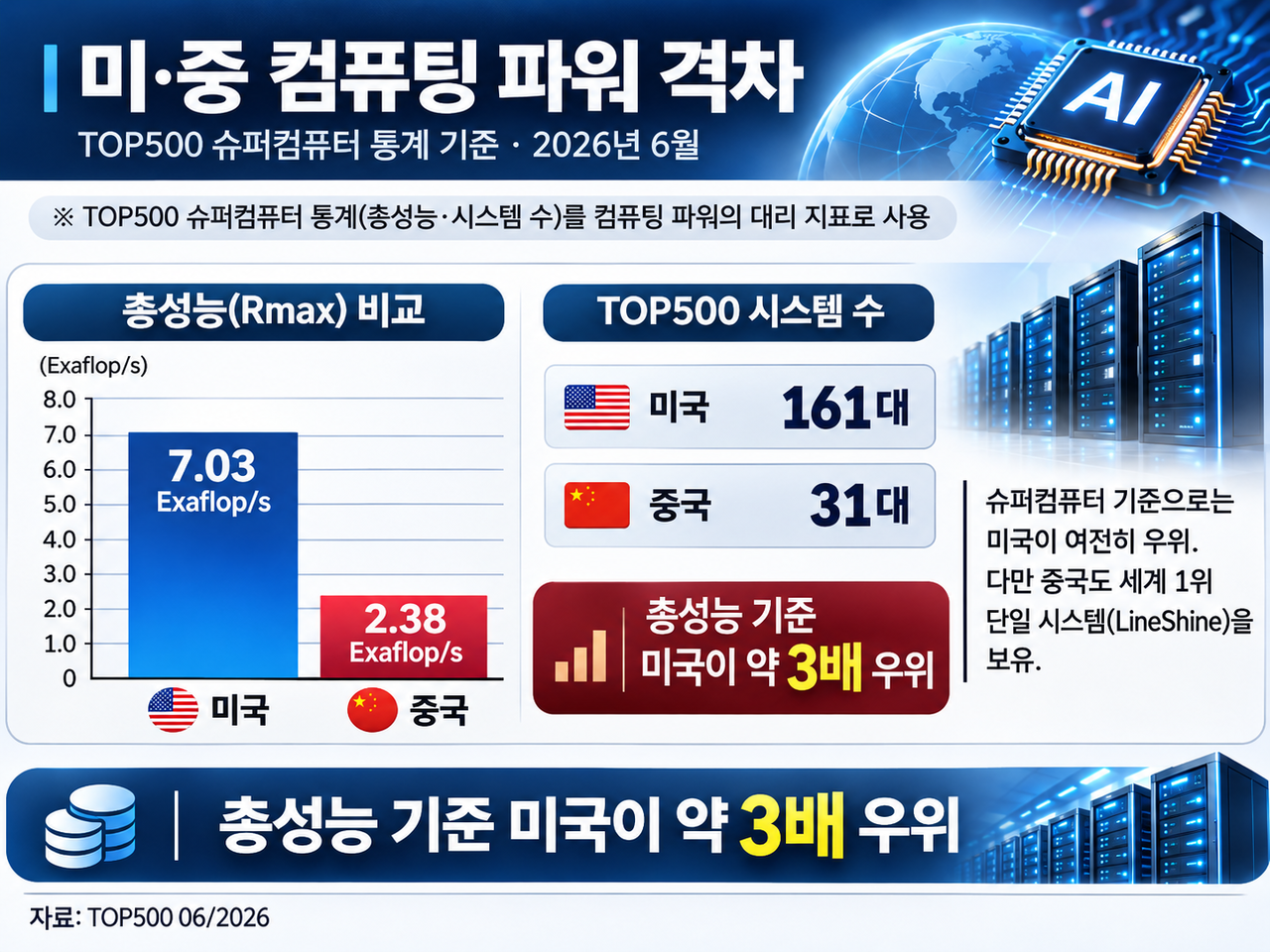
Both Democrats and Republicans agree that China must be kept in check. The area where China is most disadvantaged relative to the United States in AI is computing power. China is encouraging data center construction at the national level. Because it is not a democracy, it faces far less resistance from local communities or public opinion. Its power supply is considerably more ample than America's, and opposition to building transmission grids between regions is comparatively limited. If the United States slows data center construction and tightens AI regulation, China stands to gain the most.
It is important to understand what Americans actually think. Negative sentiment toward data centers likely reflects a demand for safeguards against side effects rather than outright opposition. Until now, the terms of data center contracts between the government and hyperscalers have been kept confidential. If those terms were disclosed transparently and communication with local communities expanded in the process, negative public opinion could soften.
A measured slowdown in AI investment could be a breakthrough for market supply and demand
Before the AI revolution, the US economy was driven by consumption rather than manufacturing, and investment was concentrated mainly in software. Money that companies earned flowed back through households into financial markets. Major US companies, unburdened by heavy fixed costs such as capital expenditure, channeled vast free cash flows into shareholder returns — which also flowed back through financial markets. In short, money circulated well within financial markets.
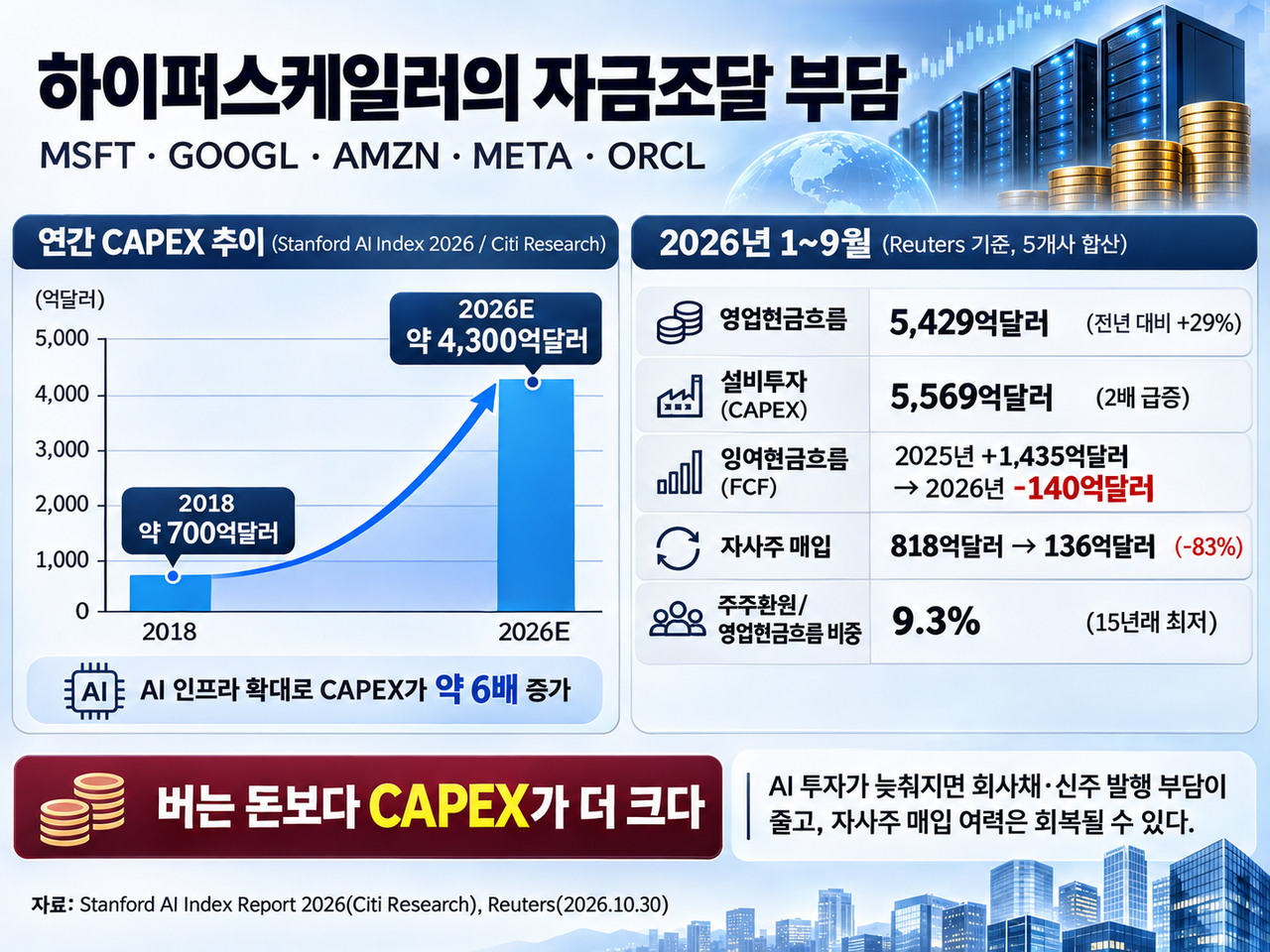
With the rise of AI, America's flagship companies began pouring money into large-scale tangible assets such as data centers. Semiconductors, power and water were all in short supply. Scarce resources command a premium. Big Tech firms that had been generating enormous profits began directing that money not back into financial markets but into the real economy — and overseas. Borrowing to invest was no longer enough; they have recently begun issuing new shares to raise fresh capital. Rather than buying back stock as they once did, they have flipped to issuing both equities and bonds to pull in funding.
If data center construction slows, the amount of capital that needs to be raised from financial markets will shrink, improving supply-demand conditions. Permitting delays and longer construction timelines that drive up costs will hit financially weaker neo-cloud operators first. Conversely, Big Tech firms that already own data centers will find themselves in an environment where supply constraints allow them to raise service prices. There is a real possibility of consolidation, with Big Tech acquiring neo-cloud assets — and if acquired cheaply, that would only deepen Big Tech's market dominance.
For now, US Treasuries; once the war ends, US equities
The midterms have thrown a long list of unresolved challenges into sharp relief — AI regulation, fiscal policy, war and more. The outcomes are hard to predict at this point. This is a situation defined more by uncertainty than by calculable risk. With uncertainty running high, safe assets look relatively more attractive than risk assets for now. The yield gap between equities and bonds is also narrow. The yield on 10-year US Treasuries, among the lowest-credit-risk assets available, stands at around 4.8 percent annually. Rates rising would mean capital losses, but a decline in rates would offer the prospect of price gains as well.
The recent surge in volatility in US equities — which had been holding up relatively well — owes more to tangled supply-demand dynamics than to any change in fundamentals, compounded by the unwinding of hedge fund and derivatives positions. If the pressure to invest in AI eases and investors rebalance their positions, volatility could subside.
The key variable is interest rates. A reduction in hyperscaler fundraising would create an incentive to push Treasury yields lower. With an eye on the presidential election two years away, both Democrats and Republicans will need to pursue policies that cool inflation. If that causes the Federal Reserve to pause or delay its rate-hiking cycle, it would be a tailwind for equity markets.
South Korea must see past the semiconductor illusion — for the domestic market, automobiles matter more
The record earnings posted by Samsung Electronics and SK hynix reflect higher prices, not higher volumes. According to the Bank of Korea, semiconductor export volumes rose 30.5 percent year-on-year in September, but export prices surged 182.1 percent. That is a structure where prices can fall just as quickly if demand weakens. Sustainable pricing power requires both volume and price to grow together. Right now, the industry is holding the blade, not the handle.
Samsung Electronics and SK hynix rank among the best in the semiconductor industry in terms of technology and production competitiveness — that deserves genuine recognition. Even so, their governance is opaque and shareholder returns are stingy. The labor relations model — where astronomical performance bonuses are paid out to employees at a fixed ratio of profits driven not by higher output but purely by higher prices — is unusual by global standards. Viewed with cold objectivity, there are plenty of reasons why the market assigns these companies valuations that seem almost absurdly low.
In truth, for South Korea's domestic stock market to rally sustainably, what needs to improve is not semiconductors but industries with stronger upstream and downstream linkage effects — automobiles being the prime example.
According to the Bank of Korea's 2023 input-output table, the influence coefficient — which measures how much an increase in demand for one industry stimulates production in others — stands at 1.335 for automobiles and 0.793 for semiconductors. The employment-inducing coefficient is also higher for autos: 1.0 job per 1 billion won ($745,000) of output, compared with 0.7 for semiconductors.
Yet the automotive sector is now hemmed in on all sides. Chinese rivals are squeezing electric vehicles, American companies are pulling ahead in self-driving cars, and Japan holds the edge in hybrids. A strong won, driven by the semiconductor trade surplus, adds another headwind.
Automakers played a significant role in the Kospi rally in the first half of this year. Hyundai Motor's share price rose 66.9 percent from the end of last year, while Kia gained 13.3 percent — driven less by core automotive performance than by excitement over Boston Dynamics' robot and physical AI business. For the domestic market to sustain its upward momentum, the "real" auto business needs to improve.
The budget for next year, drawn up aggressively on the assumption that the semiconductor boom will continue, is also a concern. The government has decided to set total expenditure for 2027 at 820.9 trillion won, an increase of 12.8 percent from this year. Tax revenue is projected at 584.4 trillion won, up 194.2 trillion won, reflecting higher corporate tax receipts from the semiconductor boom.
How deeply does the government actually understand the economic distortions created by the concentration of semiconductor-driven gains? Looking at the reality, politicians excel only at taking credit, while bureaucrats are practiced at telling them what they want to hear. If the semiconductor boom fades, tax revenue projections will be the first thing to unravel. Budgets, once expanded, are not easily cut. It is hard not to think of those who grew so excited about a rosy future unlocked by the semiconductor boom.
kyhong@heraldcorp.com