Gasoline at 1,855.4 won per liter, diesel at 1,842 won — weekly drop less than 1 won
Seoul posts highest gasoline price at 1,900.3 won; Daegu lowest at 1,826.8 won
Global crude falls sharply, but domestic pump prices barely move as government holds price cap
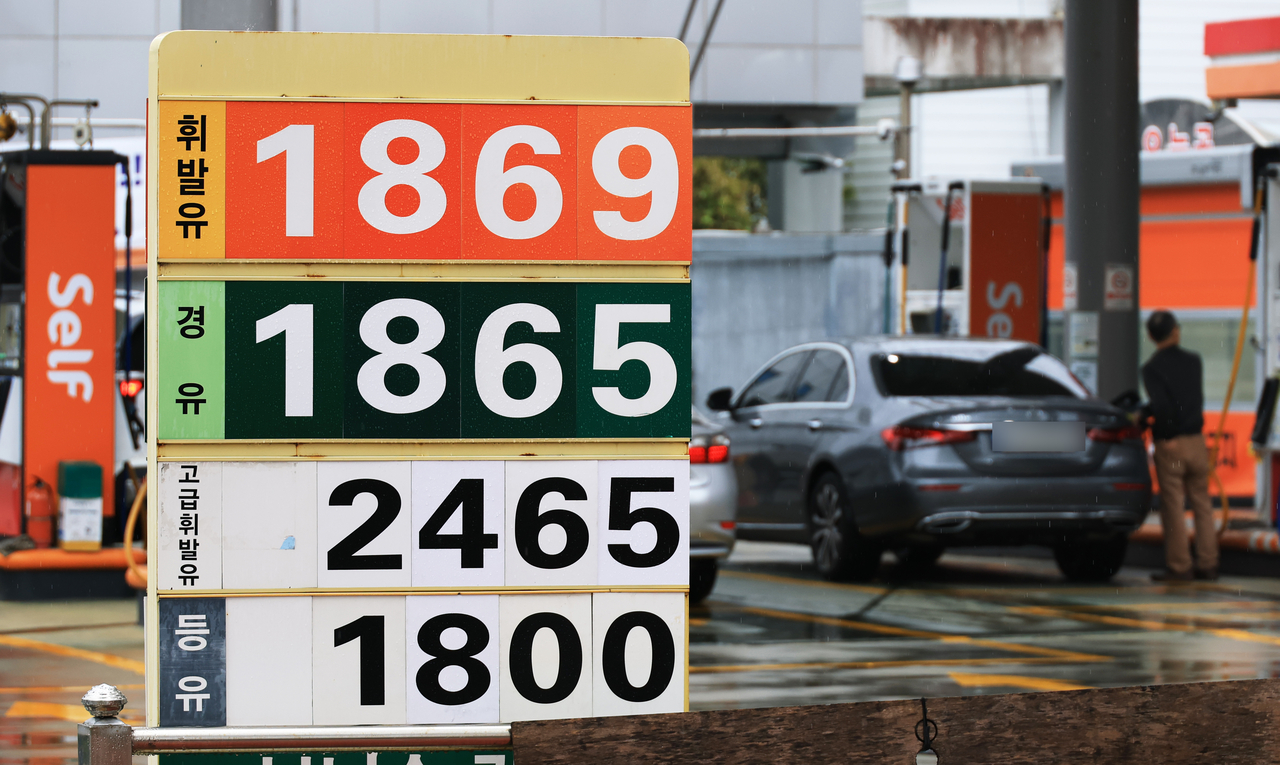
Gasoline and diesel prices at gas stations nationwide fell for the 25th consecutive week, but consumers are seeing little relief at the pump.
Of late, weekly price declines have shrunk to less than 1 won per liter, leaving both gasoline and diesel stuck in the 1,800-won range for the 18th straight week. Even as global crude prices trend lower, domestic pump prices have in effect stopped moving.
During the first week of November (Nov. 1–5), the national average retail price of gasoline fell 0.3 won per liter from the previous week to 1,855.4 won, according to Opinet, the price information system run by Korea National Oil Corp. The average diesel price slipped 0.1 won to 1,842.0 won per liter.
The 25-week decline is ongoing, but the pace of the drop is narrowing. Gasoline prices have fallen by less than 1 won per liter each week since the third week of September. Diesel has posted sub-1-won weekly declines every week since the fourth week of August.
As a result, both gasoline and diesel have remained in the 1,800-won range for 18 consecutive weeks since dropping into that band in the second week of July. Prices are technically still falling, but the cuts are too small for consumers to feel.
Regional price gaps persisted. Seoul, which had the highest gasoline prices in the country, averaged 1,900.3 won per liter — down 1.0 won from the previous week. Daegu, the cheapest market, came in at 1,826.8 won, down 0.5 won. The gap between the two cities reached 73.5 won per liter.
By brand, GS Caltex stations posted the highest average gasoline price at 1,858.3 won per liter, while budget discount stations — known as altteuljuyuso — were the cheapest at 1,845.8 won, a difference of 12.5 won.
Global crude prices fell sharply this week, driven by growing expectations of a diplomatic resolution between the United States and Iran and hopes that the resumption of trilateral peace negotiations among the US, Iran and Ukraine would ease geopolitical risks.
Dubai crude, the benchmark for South Korea's oil imports, dropped $15.3 per barrel from the previous week to $100.3. International gasoline prices fell $25.0 to $111.9 per barrel, while international automotive diesel prices declined $9.4 to $163.7 per barrel.
However, there is a lag before movements in global crude prices feed through to domestic pump prices — typically two to three weeks. If the recent decline in international oil prices continues, it could put additional downward pressure on domestic retail prices in the weeks ahead.
The government is maintaining a petroleum price cap to prevent sharp domestic fuel price increases driven by global crude swings. The 11th round of the cap was set at the same level as the 10th round, fixing maximum prices at 1,784 won per liter for gasoline, 1,773 won for diesel and 1,380 won for kerosene.
However, the government-set ceiling applies to supply prices charged by refiners and others in the supply chain, not to the final retail prices consumers pay at the pump.
Despite falling global crude prices and continued government price stabilization measures, pump prices remain elevated. How quickly the drop in international oil prices passes through to domestic retail prices will determine how much relief consumers ultimately see at the pump.
fact0514@heraldcorp.com