10 of 75 surveyed items cost more than nearby stores; lawmaker calls on public institution to do more to ease meal costs
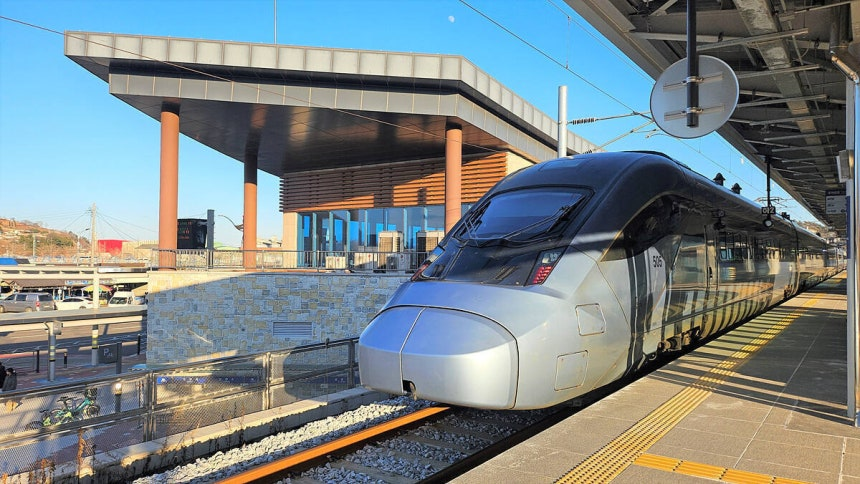
Restaurants operating inside railway stations raise their prices by an average of 12.5% each time they do so, a new analysis has found, with one in 10 hiking prices by more than 20%. Korail Distribution, the state-run subsidiary that approves such increases, has also been comparing station store prices against those at nearby department store restaurants — a practice that appears designed to make station food look cheaper by comparison.
The findings come from an analysis by People Power Party lawmaker Kim Mi-ae of the National Assembly's Land, Infrastructure and Transport Committee, who reviewed 125 price-increase approvals granted by Korail Distribution for specialty food outlets at railway stations from 2021 through this year. Of the 125 cases, 79 — or 63.2% — involved increases of 10% or more, and 15, or 12%, involved increases of 20% or more.
A snack restaurant at Pyeongtaek Station in Gyeonggi Province raised the prices of its udon and bibimbap three times each — in 2021, 2022 and 2024 — pushing both items from 4,500 won to 6,500 won, a 44.4% increase.
A bakery at Jeonju Station raised the price of its Americano twice in a single year, from 2,500 won to 3,000 won and then to 3,500 won in 2021. A Chinese restaurant at Dong-Daegu Station raised the price of its jjajangmyeon twice in 2022, from 5,500 won to 6,000 won and then to 6,500 won.
In eight of the 125 cases, the stated reason for the increase made no direct reference to rising raw material or labor costs.
Those eight cited reasons such as "sales growth" in two cases, "store profit improvement and cost burden relief" in three cases, and one case each for "sales price adjustment," "price change request," and "menu price increase and reorganization."
"Even in the remaining cases, most entries listed only brief reasons such as rising ingredient costs or higher labor expenses, with no indication of how the actual cost increase was assessed or how the appropriateness of the requested hike was reviewed," Kim said.
Between Sept. 7 and Sept. 11, Korail Distribution conducted a price survey comparing 75 products sold at station stores across seven stations — Seoul, Yongsan, Daejeon, Dong-Daegu, Busan, Iksan and Gwangju Songjeong — against prices at nearby stores. Station prices were lower in 51 cases, the same in 14 and higher in 10.
Notably, 22 of the 75 comparison cases — 29.3% — used stores inside department stores or large shopping malls as the benchmark, a choice that appears intended to make station food prices look more affordable by contrast.
At Dong-Daegu Station, for instance, 19 of 23 food and beverage items were compared against products sold at restaurants inside Dong-Daegu Shinsegae department store. Four varieties of kimbap sold at the station for 5,000 won were benchmarked against kimbap priced at 8,800 won at the department store.
Some comparisons also raised questions about whether the product composition and unit sizes were equivalent.
At Gwangju Songjeong Station, a single piece of mini kimbap priced at 1,600 won was compared against kimbap sold at a nearby store for 3,000 won. Kim's office said the submission form did not specify the unit size of the nearby store's kimbap.
Among the 10 cases where station prices were higher, a bowl of ramyun at a snack restaurant at Busan Station cost 5,500 won — 1,500 won, or 37.5%, more than the 4,000 won charged at nearby stores.
Udon at a snack restaurant at Iksan Station was priced at 7,500 won, 1,500 won — or 25% — more than the 6,000 won at nearby stores.
"Food prices at railway stations are directly tied to the living costs of passengers," Kim said. "Korail Distribution should not simply rubber-stamp price increases — it must fulfill its responsibilities as a public institution to ensure people can afford a meal without financial strain."
"The Ministry of Land, Infrastructure and Transport and Korail Distribution need to conduct a comprehensive review covering everything from the price-increase approval process to the commission burden on tenants, and come up with measures that passengers can actually feel are reducing their food costs," Kim added.
Separately, data submitted to Kim's office by Korea Railroad Corporation (Korail) on rental fees and sales commissions at food and beverage outlets at railway stations nationwide showed that total annual rent collected from major food and beverage stores surged 166.3% — from 6.3 billion won ($4.69 million) in 2021 to 16.7 billion won in 2025. The number of stores paying annual rent of 100 million won or more more than tripled, from 15 in 2021 to 56 in 2025, while those paying 200 million won or more jumped from one to 19.
As of 2025, bibimbap restaurants — with 10 locations — recorded the highest average rent per store at 127.72 million won. Pork cutlet restaurants, with 17 locations, came second at an average of 110.48 million won. Coffee shops averaged 94.08 million won and kimbap stores 83.77 million won.
cook@heraldcorp.com