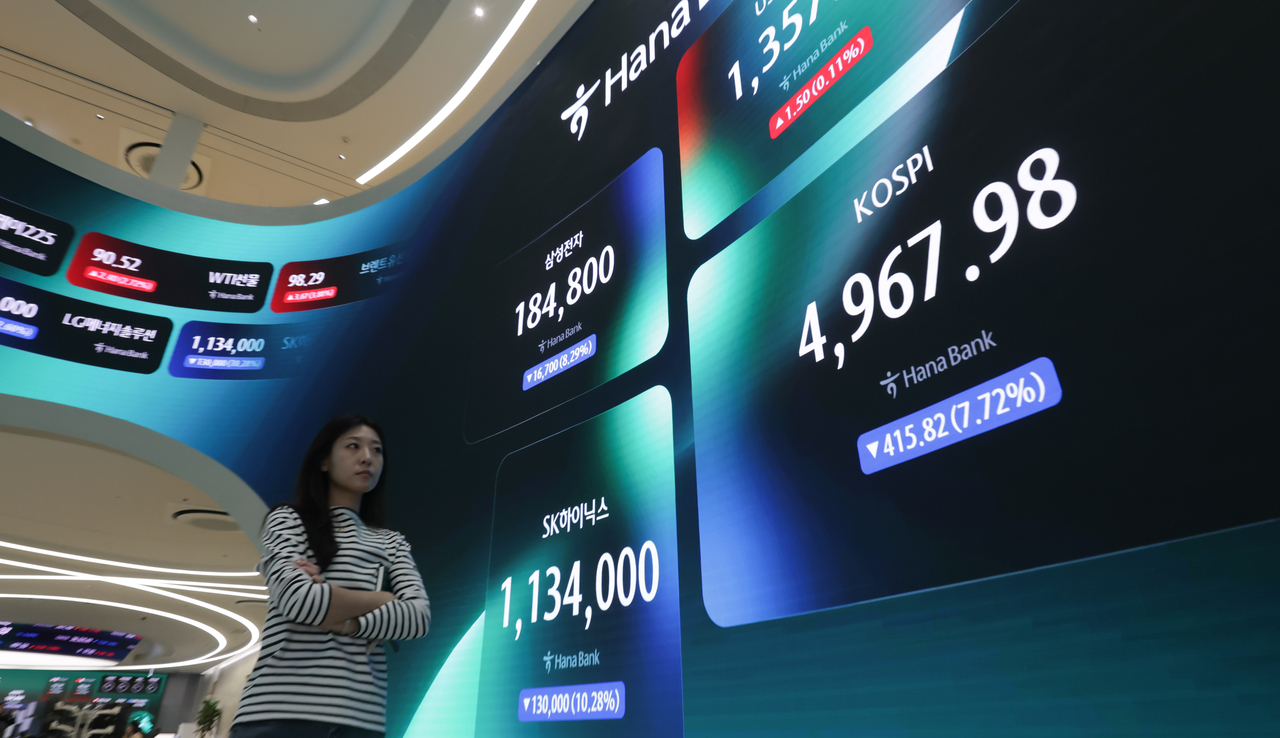
Fear of a slowdown in the AI ecosystem swept global markets Friday, sending the Philadelphia Semiconductor Index to its steepest single-day loss in six years and eight months. The Kospi, heavily weighted toward chipmakers, broke below the 5,000-point mark during trading, with Samsung Electronics and SK hynix both tumbling sharply. Analysts broadly agreed that investors should resist panic selling, arguing that historical precedent and current valuations suggest the index is not far from a floor.
According to the financial investment industry, the Philadelphia Semiconductor Index plunged 12.2 percent on Thursday (local time) on the New York Stock Exchange — its largest single-day drop since March 16, 2020, when it fell 15.9 percent at the height of COVID-19 pandemic fears.
The sell-off was driven by a combination of regulatory pressure on data centers and concerns about cuts to AI capital expenditure that emerged after the US midterm elections. Five states — including Texas, Georgia and Ohio — where the Democratic Party recaptured governorships account for 41.2 percent (142.5 gigawatts) of the total power capacity of data centers under construction or in planning across the United States (345.9 gigawatts). Fears of construction delays spread particularly after the incoming governor of Texas, which alone accounts for 26.9 percent of that capacity, called for a halt to new data center development.
News that Microsoft was reviewing its NeoCloud contracts added to the anxiety, spreading "end of the AI season" fears from NeoCloud providers to big tech broadly and triggering a wave of selling.
Single-day drops of around 10 percent in the Philadelphia Semiconductor Index have historically coincided with major shocks: the 1997 Asian financial crisis, the 2000 dot-com bubble collapse, the 2020 COVID-19 pandemic and the announcement of US reciprocal tariffs in 2025.
The Kospi took an immediate hit, given that Samsung Electronics and SK hynix together account for roughly 50 percent of its market capitalization. After falling 5.28 percent on Thursday, the index plunged more than 8 percent at Friday's open, triggering a circuit breaker.
Samsung Electronics, the index's bellwether, fell more than 6 percent on Thursday, with its share price breaking below 200,000 won during trading before slipping further to lose the 190,000-won level as well. SK hynix slid to an intraday low of 1.07 million won ($797), putting the 1 million won threshold under threat.
Analysts are increasingly calling the panic selling overdone. Kang Hye-seong, a researcher at Sangsangin Investment & Securities, said the Philadelphia Semiconductor Index has historically rebounded sharply after steep drops. "The Kospi also tends to underperform for up to five trading days after such events, but in many past cases it recovered over the following 15 trading days," Kang said.
When the Philadelphia Semiconductor Index plunged 15.9 percent on March 16, 2020, it rebounded 9.8 percent the very next day. The Kospi fell 2.5 percent on a closing basis that same day but was up 6.5 percent 20 trading days later. "Sentiment may remain fragile through next week, but investors should keep in mind that ultimately, opportunities tend to emerge in the midst of fear," Kang said.
Some analysts also argue that the Kospi's additional downside is limited when measured against past boom-bust cycles. Heo Jae-hwan, a researcher at Yuanta Securities Korea, noted that outside the Asian financial crisis — when the index fell 60 to 70 percent — the Kospi has typically dropped about 50 percent from its peak when major booms end, as in the 2000 dot-com bust and the 2008 China boom. "Based on that, the index floor works out to around 4,500 to 4,600 points, implying a maximum further decline of roughly 10 to 15 percent from current levels," Heo said.
Heo added that while the semiconductor sector's outsized 50 percent weighting in the domestic market warrants some reduction in exposure, joining the panic selling after the index has already fallen sharply is something investors should avoid.
Both inside and outside the market, voices are growing louder that the Democratic Party's AI regulation risk was underestimated — and that investors now need to assess whether underlying fundamentals have actually been damaged.
Lee Jae-won, a researcher at Yuanta Securities Korea, said the market must acknowledge that regulatory risk has grown beyond what was expected, but stressed the need to assess how much of the fear priced into current share prices exceeds actual damage to corporate earnings. "Even if the Democratic Party takes control of the federal legislature, halting AI investment altogether is structurally impossible, given the president's veto power and the strategic importance of the US-China AI rivalry," Lee said.
Lee added that a distinction must be drawn between delays in data center construction due to tighter regulation and actual cancellations of server and memory chip orders, arguing that markets are currently pricing in extreme scenarios. "Given that shareholder return policies are continuing at current valuation levels, investors should maintain their positions in core holdings — but decisions on adding new exposure should wait until there is confirmation of whether 2028 earnings-per-share estimates are revised down and whether credit risks at individual AI companies have stabilized," Lee said.
jiyun@heraldcorp.com