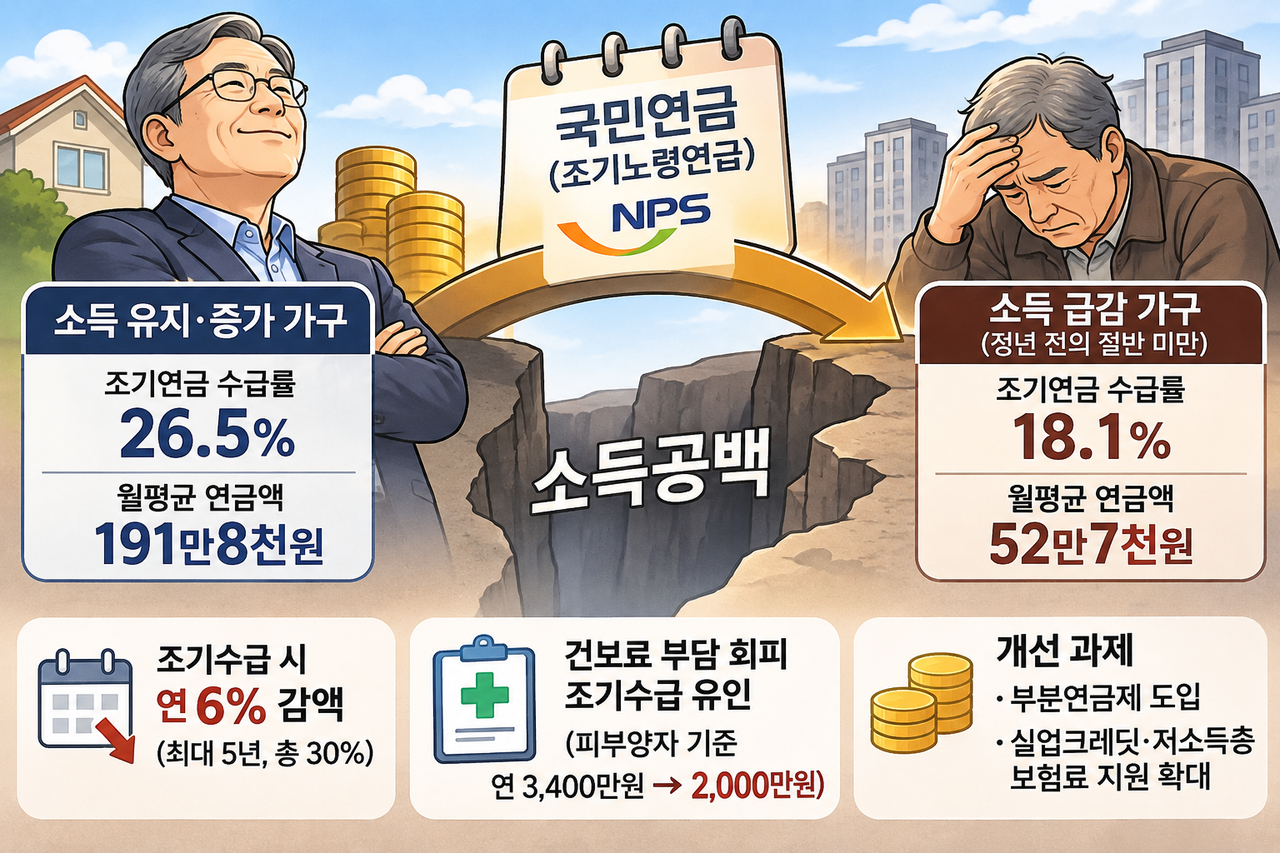
Households maintaining income claim early pension at 26.5% rate vs. 18.1% for those with sharp income drops
Monthly pension gap reaches 3.6 times between the two groups — 1.92 million won vs. 530,000 won
Health insurance cost avoidance cited as added incentive; report calls for partial pension system and expanded low-income support
South Korea's early old-age pension — designed to bridge the income gap between mandatory retirement and the start of national pension payments — is being used more by financially comfortable households than by those who have suffered sharp income drops, a new report has found.
Households that maintained or even increased their pre-retirement income were more likely to claim the early pension than those struggling to make ends meet after a severe income decline. The findings suggest that the national pension system, meant to serve as a retirement safety net, shows significant disparities in both uptake and benefit amounts depending on a household's economic standing.
According to a report released Monday by the Korea Institute for Health and Social Affairs, titled "Income Crevasse Among Middle-Aged and Older Adults: Current Status and Policy Responses," households facing an income gap between retirement and the start of public pension payments show markedly different early pension uptake rates depending on their financial circumstances.
Researchers analyzed households passing through the institutional income gap period using Statistics Korea's Household Income and Expenditure Survey data from 2019 to 2025. Among households that maintained at least 100 percent of their pre-retirement median income or saw their income increase, the early public pension uptake rate stood at 26.5 percent. By contrast, the rate was limited to 18.1 percent among vulnerable households whose income had fallen to less than half of their pre-retirement level — a gap of 8.4 percentage points.
The disparity in actual pension income was even wider. Households that maintained or grew their income received an average of 1.92 million won ($1,430) per month in public pension benefits, while those whose income had dropped to less than half received just 527,000 won. Financially stable households were collecting 3.6 times more in pension payments than their vulnerable counterparts.
The figures do not compare individual early old-age pension amounts alone. The totals reflect combined public pension receipts for all household members, including spouses, and cover not only the national pension but also occupational pension schemes for civil servants, private school employees and military personnel. The higher figures among better-off households partly reflect the presence of recipients of large occupational pensions, which tend to be concentrated in higher-income groups.
A key structural issue is the penalty built into early pension claims. Under the national pension system, subscribers can begin receiving benefits up to five years before the standard eligibility age, but the monthly amount is reduced by 6 percent for each year claimed early. Claiming five years early results in a permanent 30 percent reduction in lifetime benefits.
For example, a subscriber entitled to 1 million won per month at the standard age would receive only 700,000 won if claiming five years early. While the early option provides immediate living expenses during the income gap period, the permanently reduced amount means a long-term decline in retirement income is unavoidable.
Accessing early pension benefits at a meaningful level therefore requires having accumulated sufficient pension entitlements in the first place. Subscribers who held stable jobs over a long period and paid premiums consistently are better positioned to cover living costs even after accepting the early-claim reduction.
Data bear this out. Among new early pension recipients, the share of long-term subscribers with 20 or more years of national pension contributions rose sharply — from 47.4 percent in 2014 to 77.2 percent in 2024 among men, and from 16.2 percent to 34.7 percent among women over the same period, more than doubling for women.
Lower-income individuals who lose jobs or see their earnings fall after retirement, by contrast, often find that even an early pension claim does not provide enough to live on. The national pension's structure ties benefit amounts directly to contribution history, meaning shorter or more irregular contribution records translate into smaller payments.
Strategic use of early pension claims to reduce national health insurance costs has also been identified as a factor driving uptake. After the income threshold for dependent coverage under the national health insurance system was lowered from 34 million won to 20 million won per year, some retirees with higher public pension entitlements gained an incentive to claim early in order to keep their monthly pension income below the threshold and retain dependent status.
By claiming early and accepting a reduced monthly amount, such subscribers may be able to avoid paying health insurance premiums altogether. Even though the immediate pension payment is smaller, the calculation can favor early claiming once the cost of health insurance premiums is factored in.
For lower-income groups, a different structural problem discourages pension participation and uptake. Receiving national pension income can reduce basic pension payments or cut into livelihood benefits under the basic living security system, creating a disincentive to enroll or claim. Public pensions may therefore fail to serve as an adequate safety net during the income gap period, and interactions with other welfare programs can leave vulnerable households worse off.
To address these issues, the report proposed introducing a partial pension system as an alternative to the current all-or-nothing early claim structure. Rather than drawing the full pension early at a permanently reduced rate, subscribers would be able to draw only the portion they need during the income gap period, with the remainder paid at the standard rate from the normal eligibility age — minimizing the lifetime reduction in benefits.
The report also called for restructuring the links between the national pension and other social security programs, including national health insurance and the basic pension, and for expanding unemployment credits and premium support for low-income subscribers to strengthen their contribution records.
As debate over extending the mandatory retirement age intensifies, closing the income gap between the legal retirement age and the start of national pension eligibility is emerging as a pressing policy challenge. The solution must go beyond simply allowing earlier pension access, experts said, and employment, pension and welfare policies need to be designed together to help vulnerable households survive the gap period.
fact0514@heraldcorp.com