Co-hosted CEO seminar with Eurasia Group
Changes in global geopolitical risks after US midterm elections
As the US-led global order weakens and no rival power emerges to replace it, companies that can quickly identify the risks of the so-called "G-Zero" era will be best positioned to seize new opportunities, experts said.
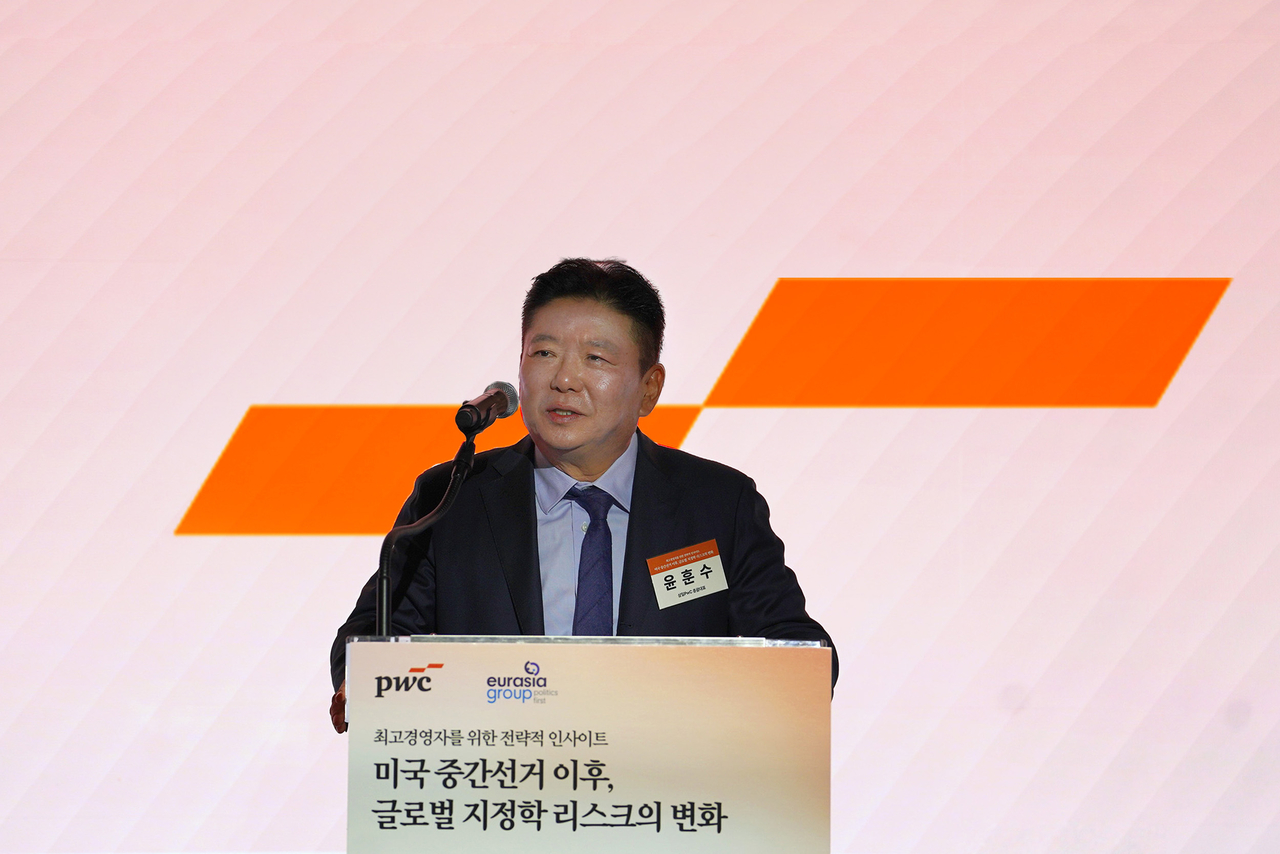
Samil PwC announced Monday that it co-hosted a CEO seminar with global geopolitical risk advisory firm Eurasia Group on Friday at the Four Seasons Hotel in Jongno-gu, Seoul. The event focused on changes in global geopolitical risks following the US midterm elections.
Eurasia Group is a geopolitical risk advisory firm founded by political scientist Ian Bremmer. The seminar drew more than 200 participants, including company owners and CEOs from major industries such as semiconductors, automobiles, shipbuilding, defense, energy and finance, as well as experts from policy, industry and academia.
In his opening remarks, Managing Partner Yoon Hoon-soo said "reliable, high-quality intelligence is essential for companies and institutions to respond proactively and make sound decisions amid growing geopolitical uncertainty." He added that he hoped the seminar would offer practical help to Korean companies and institutions in accurately assessing the global landscape and making better decisions.
Bremmer said in his congratulatory address that "the geopolitical recession of the G-Zero era is amplifying risk and uncertainty worldwide," adding that "those who can identify risks clearly and quickly will be the ones to seize new opportunities, since disruption brings both danger and opportunity."
International speakers included Gerard DiPippo, chief economist for global macroeconomics and a former analyst at the CIA and the National Intelligence Council; Heather West, head of geotechnology, who previously handled technology policy at Google and Meta; and Herbert Crowther, an energy and resources expert who formerly served at the US Department of State's Bureau of Energy Resources. Korean participants serving as moderators and panelists included former ministers and vice ministers in diplomacy, trade, industry and science and technology, senior executives from major companies, and heads of public and private research institutions in macroeconomics and AI, as well as academic experts.
The seminar covered three sessions: the reshaping of the global order following the US midterm elections and strategic responses for Korean companies; shifts in the global AI competitive landscape and corporate investment and growth strategies; and the impact on businesses of energy security, supply chain restructuring and power demand in the AI era.
In the first session, DiPippo presented on the reshaping of the global order after the US midterm elections and strategic responses for Korean companies. He noted that while the Democratic Party had secured majorities in both chambers of Congress, it had not won enough seats to override presidential vetoes. He projected that the Democratic Party would focus on investigating and overseeing the Donald Trump administration rather than pursuing legislation.
DiPippo expected South Korea's overall tariff levels to remain largely unchanged, but said pressure would continue over investment commitments to the United States and expanded shipbuilding cooperation. "US-China relations are likely to evolve into a pattern of managed decoupling," he said. "Korean companies need to build frameworks to navigate rules of origin and export controls from both countries, and refine their investment and supply chain strategies."
In the second session, West presented on shifts in the global AI competitive landscape and corporate investment and growth strategies. She projected that over the next two years, a "hybrid regime" is likely to take shape in which Chinese open-source AI models spread on the back of US-made semiconductors and cloud infrastructure.
West said South Korea, which is heavily dependent on AI hardware exports, must closely examine how the pace of capital expenditure and data center construction by US big tech companies will affect exports of memory chips and HBM and the country's trade balance. She advised Korean companies to use their investments in the United States as strategic leverage to ease the burden of semiconductor tariffs, and to differentiate their power and grid equipment as a reliable, non-Chinese supply chain alternative.
In the final session, Crowther presented on energy security, supply chain restructuring and the impact of AI-era power demand on businesses. He projected that tensions between the United States and Iran, combined with instability along key maritime routes including the Red Sea, the Panama Canal and the Strait of Malacca, would keep energy procurement costs — including not just oil prices but also shipping and insurance costs — elevated through 2027.
Crowther said that as South Korea, the EU, China, India and other major energy-importing nations electrify their economies, Korean companies can secure opportunities as trusted non-Chinese suppliers in the market for grid equipment such as inverters, transformers and switchgear. "Domestic and geopolitical constraints facing traditional nuclear power leaders could expand opportunities for Korean companies to win contracts for large nuclear power plants and small modular reactors in Southeast Asia," he said.
In the expert panel discussion, participants said generation capacity and transmission networks must be expanded in a timely manner to meet rising power demand, and that medium- to long-term strategies accounting for supply timing and costs need to be developed. They also said it is necessary to consider a range of options alongside the expansion of renewable energy, including new nuclear power plants, improvements to the continued-operation regime and distributed power sources.
Meanwhile, Samil PwC posted sales of 1.63 trillion won ($1.21 billion) for fiscal year 2026 (July 2025–June 2026), up 4.6 percent from the previous year. Samil PwC's audit arm and PwC Consulting drove the growth, recording sales of 1.16 trillion won and 463.7 billion won, respectively.
park.jiyeong@heraldcorp.com