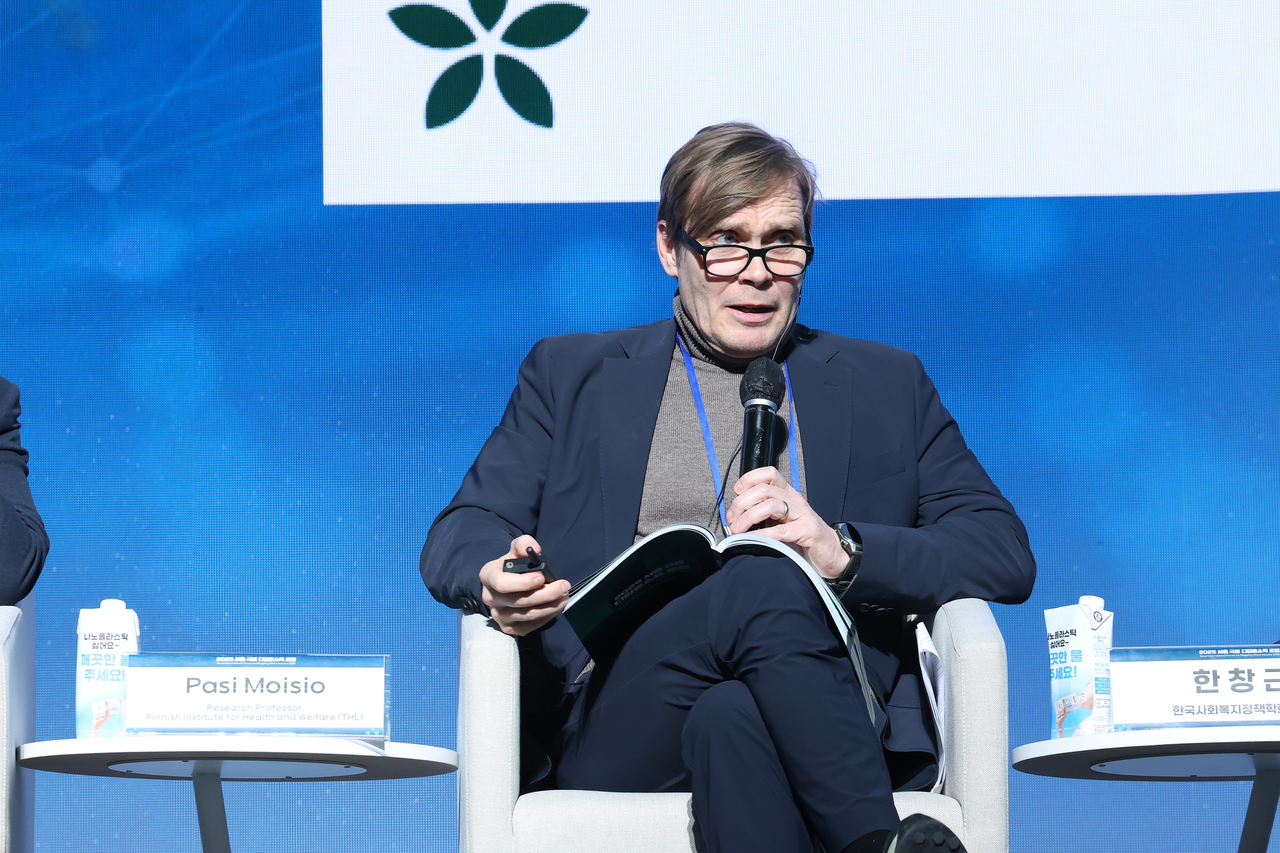
Interview with Pasi Moisio, research professor at Finland's National Institute for Health and Welfare
'Additional work leading to greater economic reward is also an innovation'
Seoul Metropolitan Government has run Didimdol Income pilot since 2022, with rising share of participants leaving the welfare rolls

"The innovation of Didimdol Income lies in ensuring that additional work leads to greater economic reward, and in reducing the risks that can arise between receiving benefits and finding employment."
Pasi Moisio, head of the welfare system research department and research professor at Finland's National Institute for Health and Welfare, offered that assessment of the Didimdol Income program currently under way in Seoul. Moisio said the experiment "provides answers to questions such as how to balance income security with work incentives, and how to more effectively identify people in vulnerable situations." Didimdol Income supplements the household income of families earning below 85 percent of the median income standard, covering a portion of the gap between their actual income and the benchmark. Unlike the basic livelihood security system, under which recipients lose eligibility once their income exceeds a set threshold, Didimdol Income reduces benefit payments gradually as income rises.
The three-year pilot program, which Seoul launched in July 2022, is showing results. As of the end of last year, 148 of the 1,527 households participating in Didimdol Income — 9.7 percent — had seen their income surpass the benchmark and exit the program. That so-called "welfare exit rate" rose from 8.6 percent the previous year.
Moisio also chairs the Parliamentary Social Security Committee under Finland's Ministry of Social Affairs and Health and is a specialist in income security systems. He has participated in numerous major social security reforms in Finland, including serving on a working group for family benefit reform. He also joined a panel at the 2025 Seoul International Didimdol Income Forum held in December last year. The Herald Business recently conducted a written interview with Moisio to ask for his assessment of the program. The following is a question-and-answer interview.
— Seoul has tracked how the lives of program participants have changed over the past four years through Didimdol Income. What are the implications?
▶ Seoul's experiment has shown that it is possible to pilot a modern minimum income guarantee system, evaluate its effects over several years, and adjust the program based on evidence. This is not to say other countries should simply copy Seoul's model — welfare systems vary too widely from country to country. The significance of the Didimdol Income experiment lies in providing an evidence-based case study that addresses challenges common to many nations: how to balance adequate income security with work incentives, and how to effectively identify people in vulnerable situations.
— Unlike the government's basic livelihood security system, Didimdol Income allows recipients to retain their eligibility even after their income exceeds the threshold. How does that affect motivation?
▶ I see two work incentives built into Didimdol Income. The first is economic. Under the existing basic livelihood security system, benefits can be cut off once income reaches a certain level, which can weaken the motivation to earn more through work. Didimdol Income, by contrast, is structured so that support does not stop abruptly as household income rises — it tapers off gradually. The more a person works and earns, the better off they become financially, which provides a genuine incentive to increase income through employment. The second incentive concerns risk. In reality, people do not face a simple choice between staying unemployed and landing a full-time permanent job. Short-term contracts, irregular hours, positions that may disappear in a few months — these are often the real options. If taking such a job means losing the safety net and then having to go through a complex eligibility review process from the outset to receive support again, the choice becomes very difficult. Allowing people to retain eligibility even when their income temporarily rises reduces that risk.
— Finland conducted a basic income experiment from January 2017 to December 2018, selecting 2,000 benefit recipients and paying each a fixed monthly amount of 560 euros ($624), equivalent to about 770,000 won. What does that experiment suggest?
▶ One of the key lessons from Finland's basic income experiment is that unconditional cash payments do not necessarily produce dramatic change. Basic income freed recipients from the job-search requirements and mandatory participation in labor market services attached to existing unemployment benefits, but the effect on employment was modest. There had been an expectation that basic income would boost employment and thereby offset some of its costs — the results overturned that expectation in an important way. This also suggests that the main barriers to employment are not simply the rules governing welfare payments or economic incentives. Health problems, lack of skills, caregiving responsibilities, and the need for personalized employment and social services all play significant roles.
— How does that compare with Seoul's Didimdol Income?
▶ Basic income is a cash benefit paid to individuals without means-testing — there is no need to prove employment status or exposure to a specific social risk, and the benefit does not disappear as income rises. Didimdol Income is different. Eligibility is determined by household income and assets, and the benefit amount is directly tied to household income — specifically, 50 percent of the gap between 85 percent of the median income standard and the household's actual income. As income rises, the benefit tapers off gradually. Didimdol Income falls within the broader category of asset- and income-based minimum income guarantee systems, but it has innovative features in its design — and that is precisely why I find it worth paying attention to. Its innovation lies in redesigning the existing welfare system to expand the income range eligible for support, ensuring that additional work translates into greater economic reward, and reducing the risks that can arise in the transition between receiving benefits and entering employment.
cook@heraldcorp.com